


Your teenager's home experiments are building real skills—but stem challenges for high school students translate those capabilities into measurable achievements that colleges and employers recognize. These structured competitions aren't just résumé padding. They're opportunities to test problem-solving under constraints, collaborate across skill sets, and present technical work to expert judges. For families investing in home STEM labs, competitions provide clear milestones that validate your child's progress and reveal gaps in their learning path.
What Are STEM Challenges for High School Students?
STEM challenges for high school students are structured competitions where teens apply science, technology, engineering, and mathematics skills to solve defined problems within specific constraints. Unlike open-ended science fair projects, these challenges typically include strict timelines, material limitations, and objective judging criteria. Teams or individuals design solutions to real-world problems—from building autonomous robots to analyzing environmental data to pitching sustainable business models.

These competitions range from local school-level events to international showcases like the FIRST Robotics Competition and the International Science and Engineering Fair. Some focus on a single discipline (coding marathons, mathematics olympiads), while others demand interdisciplinary thinking (combining engineering design with environmental science and data analysis).
What makes these different from traditional science fairs? Stem challenges for high school students emphasize iterative problem-solving rather than hypothesis testing. Your child isn't just demonstrating what they know—they're applying skills to constraints they've never encountered, often with teammates who bring different technical backgrounds. This mirrors actual industry workflows far more closely than isolated classroom assignments.
The technical requirements vary dramatically. Some robotics competitions mandate specific platforms (VEX Robotics kits use proprietary VEXcode or C++ programming; FIRST Tech Challenge allows both Blocks-based and Java coding). Others permit any tools within safety parameters. Understanding these specifications before committing helps you assess whether your existing home STEM lab equipment aligns with competition standards or requires new investments.
How STEM Challenges Work: Structure and Requirements
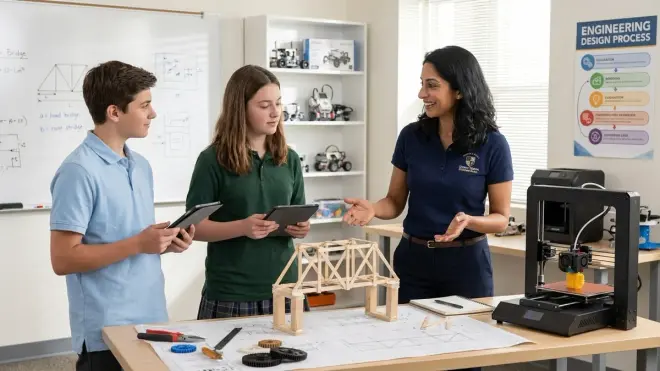
Most high school STEM competitions follow a seasonal cycle with distinct phases: registration, design period, regional qualifiers, and championship rounds. Let's walk through what your teenager actually experiences.
The challenge announcement typically arrives 2-6 months before competition day. Organizers release a problem statement—"design a device that removes microplastics from water samples using only materials under $50" or "program a robot to navigate an obstacle course while sorting recycling by material type." The specificity varies, but constraints are always present: budget caps, size limits, programming language restrictions, or required sustainability elements.
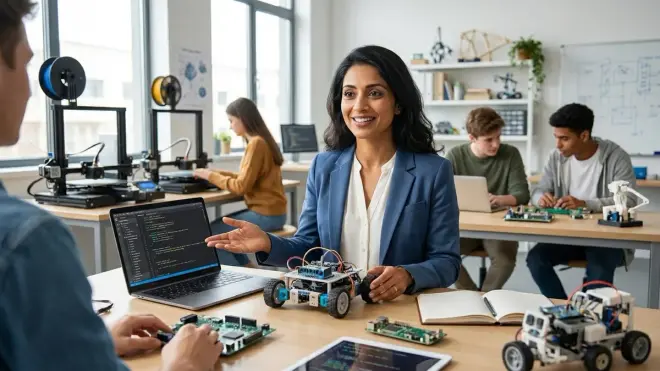
Your child then enters the design and prototyping phase. For robotics competitions, this means assembling hardware (often using platforms like Arduino or LEGO SPIKE Prime), writing control code, and testing iteratively. Engineering challenges might involve 3D-printing custom components, calibrating sensors, or designing structural elements that meet load specifications. Research-based competitions require data collection with tools like environmental monitoring kits and statistical analysis that demonstrates methodology rigor.
Teams maintain engineering notebooks documenting every design decision, failed attempt, and problem-solving pivot. Judges scrutinize these records during evaluation—they want to see evidence of systematic thinking, not lucky guesses. This documentation skill directly prepares students for industry practices like version control in software development or lab notebooks in pharmaceutical research.
Competition day varies by format. Robotics events typically involve multiple timed match rounds where your child's creation performs autonomously or via driver control, accumulating points based on tasks completed. Science research competitions include poster presentations where students explain methodology and defend conclusions to rotating panels of professional scientists. Engineering design challenges often combine physical prototypes with formal pitch presentations—your teenager explains their solution's technical merits, cost-benefit analysis, and scalability to judges who ask probing questions.
Judging criteria break into categories: technical execution (does it work reliably?), innovation (does it solve the problem in a novel way?), documentation (is the design process clear and replicable?), and often teamwork or professional presentation quality. Top-tier competitions add complexity—FIRST Robotics includes community outreach requirements; Intel ISEF demands ethical review board approval for certain research types.
The technical setup matters for preparation. Does your child need Windows/Mac/Linux compatibility for required software? Will they program in Scratch, Python, or C++? Can they test at home or do they need access to specialized facilities? Some competitions permit cloud-based simulation environments; others require physical builds. Understanding these requirements early determines whether your home STEM lab setup suffices or needs expansion.
Why STEM Challenges Matter Beyond Trophy Cases
You're watching your teenager spend hours troubleshooting sensor calibration or debugging motion planning algorithms. Why does this matter more than standard coursework?
STEM challenges build constraint-based problem-solving skills that classroom projects rarely demand. When your child has unlimited time and open-ended requirements, they can follow tutorials or copy proven designs. Competitions impose artificial scarcity—limited materials, tight deadlines, unexpected rule changes—that force genuine innovation. This pressure reveals whether they've internalized concepts or just memorized procedures. I've watched teens who breezed through physics homework completely stall when their robot needed to account for battery voltage drop over a three-minute match. That gap between theoretical knowledge and applied competency? Competitions expose it ruthlessly.
These events provide measurable skill validation that college admissions and scholarship committees recognize. Your teenager can list "proficient in Python" on applications, but placing in USACO (USA Computing Olympiad) or advancing to ISEF semifinals demonstrates verifiable capability. Selective universities increasingly look for students who've stress-tested their abilities in competitive environments, not just maintained high GPAs in controlled settings.
The teamwork dimension matters professionally. Most high school competitions require collaboration across different skill domains—your child might excel at mechanical design but need teammates who understand control systems and strategy optimization. They'll experience the friction of conflicting ideas, the necessity of documentation for knowledge transfer, and the complexity of task dependencies. These social-technical dynamics mirror every engineering workplace they'll encounter later. Learning to navigate them at sixteen, when stakes are lower, builds resilience for industry environments where miscommunication costs months of project time.
Competitions also clarify career direction faster than abstract exploration. Your teenager might think they love robotics until they spend three months hand-tuning PID controllers and realize they'd rather design algorithms than wrestle with physical hardware variability. Or the opposite—they discover that the satisfaction of building something tangible outweighs their interest in pure software development. This self-knowledge, gained through intensive project experience, helps them make informed decisions about STEM career pathways and college majors before committing to expensive degree programs.
Finally, many competitions connect students directly with industry mentors and recruiters. FIRST Robotics teams often partner with engineering firms who provide workspace, technical guidance, and career mentorship. Intel ISEF brings student researchers face-to-face with practicing scientists. These relationships open opportunities—internships, recommendation letters, early insight into what specific technical careers actually entail day-to-day—that typical high school experiences simply don't provide.
Types of STEM Challenges for High School Students
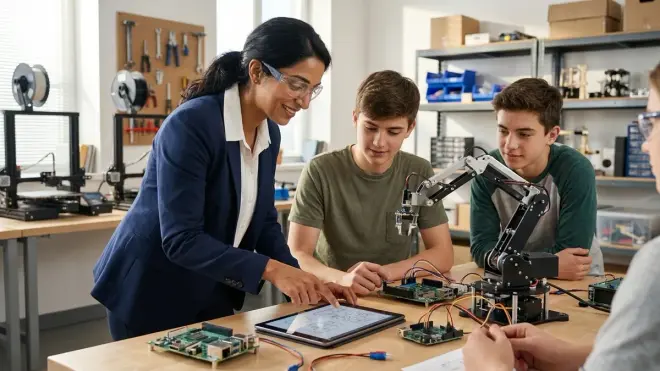
Robotics competitions dominate the high school STEM challenge landscape. FIRST Robotics Competition (FRC) involves building 120-pound robots that compete in alliance-based matches—complex enough that teams function as miniature engineering firms with specialized subteams for mechanical design, programming, and strategy. FIRST Tech Challenge (FTC) uses smaller-scale robots with more accessible kit components but still demands sophisticated autonomous programming. VEX Robotics focuses on iterative game challenges with standardized parts, making it easier to start but still competitive at championship levels. These competitions require progressive learning paths from building basic mechanisms to implementing computer vision and machine learning for object recognition.
Coding and computer science competitions test algorithmic thinking and programming fluency. USACO presents increasingly difficult problem sets requiring efficient data structure implementation—success here genuinely prepares students for technical interviews at software companies. Hackathons like HackMIT or localized 24-hour coding marathons emphasize rapid prototyping, often incorporating AI and machine learning components. Cybersecurity competitions like CyberPatriot challenge teams to identify and patch system vulnerabilities. These events require minimal physical equipment but demand strong foundational skills in Python or Java and comfort with industry-standard development environments.
Science research competitions reward original investigation and rigorous methodology. Intel ISEF (International Science and Engineering Fair) and Regeneron Science Talent Search showcase student-designed research projects across all scientific disciplines. These aren't build-and-test challenges—they're genuine contributions to knowledge that require hypothesis formation, experimental design, data collection, statistical analysis, and peer-reviewed presentation standards. Students often spend 6-12 months on single projects using specialized equipment. For families with citizen science interests, these competitions validate the long-term environmental monitoring or data collection work your teenager might pursue independently.
Engineering design challenges blend creativity with technical constraints. eCYBERMISSION focuses on STEM solutions to real community problems, judged on feasibility and impact. Future City Competition has middle and early high school divisions where students design sustainable cities using SimCity software, build tabletop models, and present to engineer panels. The Department of Energy's National Science Bowl tests rapid-recall knowledge across science disciplines in tournament format. Some engineering challenges incorporate renewable energy requirements or sustainability criteria, preparing students for the design thinking and systems analysis common in modern engineering careers.
Mathematics competitions range from individual olympiads to team problem-solving events. The American Mathematics Competitions (AMC) series progresses from school-level tests to the USA Mathematical Olympiad, identifying top mathematical talent nationwide. MATHCOUNTS emphasizes rapid problem-solving in team and individual formats. These competitions develop the quantitative reasoning foundation that underlies all STEM disciplines and directly prepares students for advanced coursework in fields like physics, computer science, and quantitative finance.
Lab Specs: What Your Teen Needs to Compete Successfully
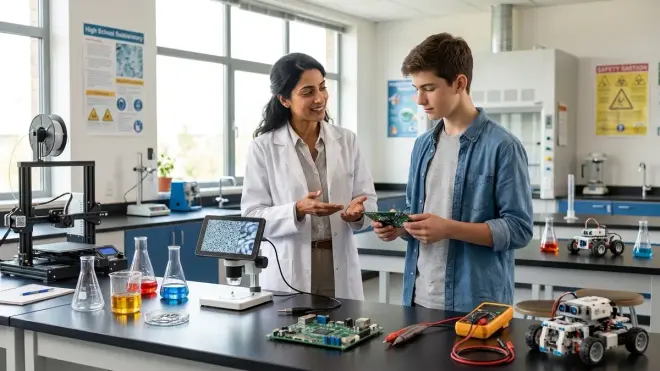
Power and connectivity infrastructure varies dramatically by competition type. Robotics teams need dedicated build space with multiple 120V outlets—battery charging stations alone draw significant current when you're cycling 4-6 lithium batteries daily. Reliable Wi-Fi matters for cloud-dependent programming environments and research teams managing large datasets. If your teenager's competing in computer science challenges, ensure your home network can handle simultaneous video conferencing (for virtual competitions) and large code repository uploads without bandwidth throttling.
Essential tools and equipment scale with competition category. For robotics, budget at minimum for:
- Competition-specific kit components ($500-$3,000 depending on platform—FRC starter kits run significantly higher than VEX V5)
- Hand tools: hex key sets, precision screwdrivers, wire strippers, diagonal cutters
- Power tools if permitted: cordless drill/driver, Dremel rotary tool
- Prototyping supplies: bulk fasteners, structural materials, spare electronics
- Testing arena space: minimum 10'×10' floor area for driver practice
Science research competitors need field-specific equipment. Environmental science projects require calibrated sensors, waterproof data loggers, and sometimes water quality testing kits. Biology research demands sterile technique supplies and potentially refrigerated storage. Physics investigations might need precision measurement instruments, high-speed cameras, or specialized lighting.
Engineering design challenges increasingly incorporate digital fabrication. A capable 3D printer for teen projects expands prototyping options significantly—look for platforms supporting multiple filament types (PLA for rapid iteration, PETG for functional parts requiring durability). CAD software becomes essential: Tinkercad for beginners transitioning to Fusion 360 for parametric design mirrors industry workflows.
Software compatibility deserves careful attention. FTC supports Android Studio for Java programming or Blocks-based coding through proprietary apps—both require specific SDK versions. VEX Robotics uses VEXcode IQ/V5 (available for Windows, Mac, and Chromebook) or Robot Mesh Studio. FIRST Robotics teams typically program in Java, C++, or LabVIEW, requiring development environments with 4GB+ RAM and modern processors. Offline capability matters—if competition rules prohibit internet access during match periods, cloud-dependent tools become liabilities.
Expandability planning prevents expensive restarts. Choose platforms with robust third-party ecosystems. Arduino-compatible microcontrollers offer enormous sensor and actuator options beyond starter kit components. LEGO robotics platforms integrate smoothly but lock you into proprietary connectors—fine if you're committed to that ecosystem, limiting if your teenager wants to transition to more open hardware later. Consider how components transfer between competition seasons. Can this year's drivetrain be repurposed next year, or does rule redesign force complete rebuilds?
Durability under iteration separates competition-grade equipment from hobbyist tools. Your teenager will assemble, test, disassemble, and reassemble mechanisms dozens of times. Structural components that develop stress fractures after five cycles won't survive to competition day. Metal components typically outlast plastic but add weight and fabrication complexity. Battery longevity matters—cheap power cells lose capacity quickly, and competition rules often mandate specific battery types. Budget for consumables: replacement motors, worn drive belts, damaged sensors, filament for failed 3D prints.
Frequently Asked Questions
What STEM challenges are best for high school students with no prior competition experience?
Start with single-day or weekend events requiring minimal specialized equipment. Regional science fairs let students design independent projects without mandating specific platforms or kits, making them accessible entry points. Hour of Code competitions and introductory hackathons provide structured support for beginners with basic programming knowledge. For hands-on builders, VEX IQ (despite being marketed younger) offers a gentler learning curve than VEX V5 or FIRST competitions—teams can be competitive within one season while learning core robotics concepts. Many communities host eCYBERMISSION teams through schools or libraries, providing mentorship and defined problem scopes that prevent overwhelming open-ended confusion.
Do STEM competitions require expensive kits or can students use what they already have?
Requirements range from zero-cost to several thousand dollars depending on competition structure. Mathematics olympiads and many computer science challenges (USACO, Codeforces) require nothing beyond a computer and internet access. Science fairs permit projects using improvised materials and borrowed equipment—renewable energy experiments can be built from hardware store components and salvaged parts for under $100. Robotics competitions mandate platform-specific components: FIRST Tech Challenge requires official kit purchase (starting around $300-$500 plus annual registration), though teams often find sponsors or share resources through school programs. Design competitions vary—some provide materials, others impose budget caps that intentionally level the financial playing field. Review specific competition rules early to assess whether your existing home lab setup suffices or needs targeted expansion.
How much time do high school STEM challenges require per week?
Expect 4-10 hours weekly during active competition seasons, with intensity peaking near deadlines. Robotics teams typically meet 2-3 times per week for 2-3 hours each during build season (January-February for FIRST Robotics, variable for VEX), plus weekend workshops and optional extra sessions as competitions approach. Research-based projects demand sustained but flexible effort—your teenager might spend two hours weekly collecting environmental data for months, then intensive analysis periods before submission deadlines. Coding competitions like USACO run continuously with monthly problem releases, allowing students to practice 1-2 hours several times weekly on their own schedule. Mathematics preparation is similarly self-paced. The time investment becomes significant when students participate in multiple concurrent challenges—not uncommon for highly motivated juniors and seniors building competitive applications.
Can homeschooled or independent students participate in STEM challenges without school affiliation?
Most major competitions explicitly welcome homeschool teams and independent participants. FIRST Robotics maintains community team structures separate from school programs—families can form teams with other homeschoolers or join existing community groups. Science fairs at county and state levels accept individual student entries regardless of school enrollment. Intel ISEF and Regeneron Science Talent Search evaluate student work directly without requiring institutional backing. MATHCOUNTS and AMC series competitions have homeschool participation pathways through registration via local coordinators. Some competitions do require adult coaching or mentorship—finding an engineer, scientist, or experienced coach willing to supervise becomes the practical hurdle rather than official policy barriers. Regional homeschool co-ops and maker spaces often facilitate team formation and provide the social structure that school-based programs offer automatically.
How do STEM competition skills translate to college admissions and career opportunities?
Selective universities increasingly prioritize demonstrated technical competency over generic leadership claims, and competition results provide quantifiable validation. Advancing to ISEF finals or placing in top USACO divisions signals capabilities that freshman coursework won't challenge—admissions committees know these students can handle accelerated tracks. More importantly, the portfolio of documented projects, engineering notebooks, and code repositories becomes tangible evidence during scholarship interviews. Career-wise, robotics competition experience directly prepares students for industry-standard tools—FRC teams using Git version control, CAD software, and professional project management methods are practicing actual engineering workflows. Tech companies actively recruit from competitive programming communities; consulting firms value the constraint-based problem-solving these challenges develop. The mentor relationships and industry partnerships formed through competitions often lead to internships and research positions that would otherwise require college connections to access. These experiences don't just strengthen applications—they clarify whether students actually want the careers they're theoretically pursuing, preventing costly major switches later.
Preparing Your Teenager for Competition Success
STEM challenges for high school students work best when they build on established skills rather than introducing completely new domains under competition pressure. If your teenager's interested in robotics competitions but has never programmed, start with progressive learning paths that move from block-based coding to text-based languages months before competition registration. The students who thrive in these environments aren't necessarily the most naturally gifted—they're the ones who've developed systematic troubleshooting habits through repeated hands-on practice.
Think of competitions as performance assessments rather than learning opportunities. Your teenager should already possess 70-80% of required technical skills before committing to a specific challenge. The competition itself will stretch those capabilities and expose knowledge gaps, but it shouldn't be their first exposure to fundamental concepts. This is where intentional home STEM lab design pays dividends—the equipment and project experience they accumulate over years creates readiness that cramming simply can't replicate.
Watch for skill mismatches. A student who excels at solitary coding projects might struggle with the collaborative chaos of robotics teams. Someone who loves open-ended exploration might find the rigid constraints of competition formats frustrating rather than motivating. That's valuable self-knowledge too. The goal isn't forcing your child through every possible STEM challenge—it's finding the ones that genuinely engage their specific problem-solving style while building toward career pathways they actually want.
The infrastructure you're building at home—whether it's Arduino projects, environmental data collection, or 3D printing prototypes—becomes the foundation that makes competition participation productive rather than overwhelming. These challenges don't replace consistent skill development. They validate it.