
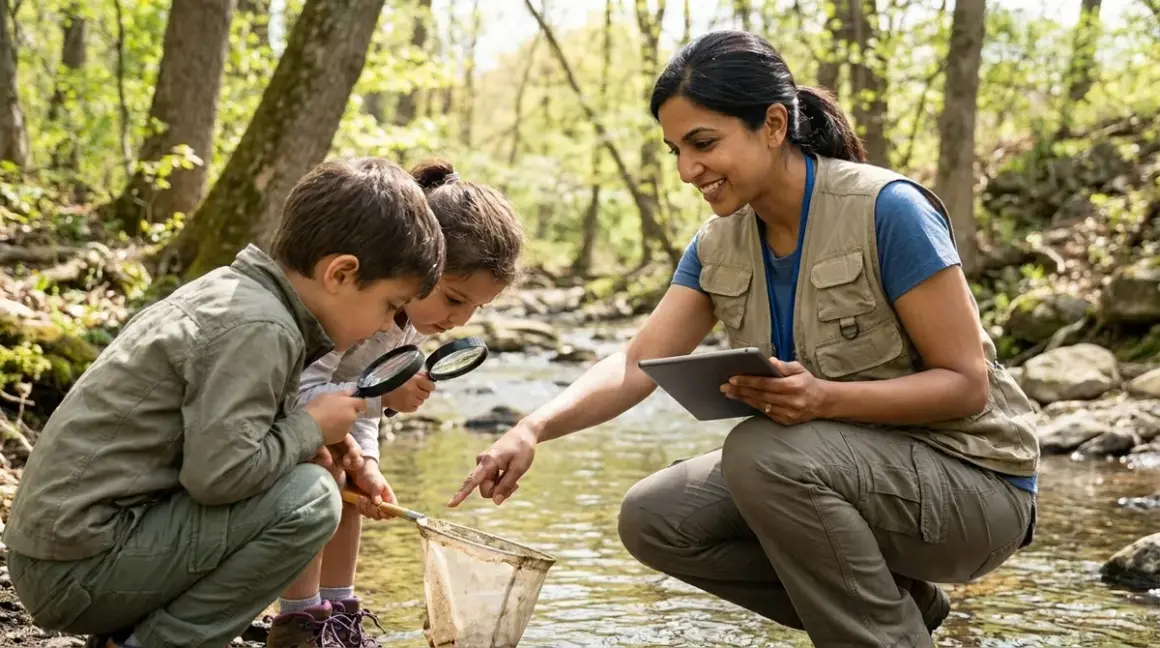

You've probably heard the term "citizen science" floating around in STEM education circles, but what is citizen science for kids, really? It's genuine scientific research conducted by people who aren't professional scientists—and yes, that includes your middle-schooler. When your child collects water quality data for a university study or tracks monarch butterfly migrations for a conservation database, they're not playing at science—they're doing it. This practice scaffolds authentic research methodology while contributing to datasets that researchers actually use to publish findings, inform policy, and advance scientific knowledge.
What Is Citizen Science for Kids?
Citizen science for kids is authentic scientific investigation where young learners contribute observational data, measurements, or analysis to real research projects coordinated by universities, museums, government agencies, or scientific institutions. Unlike simulated experiments or kitchen-table demonstrations, citizen science produces data that researchers aggregate across thousands of participants to answer questions too large-scale for any single lab to tackle.
Here's the critical distinction I emphasize to parents: your child isn't collecting data about science—they're collecting data for science. The difference matters pedagogically. When a student measures air quality in their neighborhood using standardized protocols and uploads results to the NASA GLOBE Program, that data enters a global database used by atmospheric scientists studying pollution patterns. The measurements must be accurate, the methodology must follow established protocols, and the outcomes have real-world consequences.
This shifts the learning dynamic entirely. Instead of working toward a grade or parental approval, students work toward methodological validity—the same standard professional researchers face. I've watched hundreds of sixth-graders struggle with this exact misconception: they assume "close enough" works in science projects. Citizen science dismantles that assumption quickly. Your protocol matters. Your calibration matters. Your observation timestamp matters.
The scope ranges widely. Elementary students might participate in eBird observations, recording species they identify in their backyard using field guides and submitting standardized checklists. Middle schoolers might deploy water quality sensors, calibrating pH and dissolved oxygen probes according to published protocols. High schoolers might analyze galaxy images for the Galaxy Zoo project, classifying spiral versus elliptical formations to help astronomers process telescope data faster than algorithms currently can.
What makes this citizen science for kids rather than general citizen science is the scaffolding. Youth-focused projects build in educational support: video tutorials explaining the "why" behind each measurement step, age-appropriate data collection interfaces, and mentorship structures that guide methodology without dictating conclusions.
How Citizen Science Works
The operational structure follows a consistent pattern, regardless of subject area. Understanding this framework helps you evaluate which projects will genuinely build research skills versus those that amount to glorified data entry.
Project Design and Research Question
Every legitimate citizen science project starts with a focused, answerable research question from professional scientists. These aren't vague explorations—they're hypotheses requiring specific data types collected under controlled conditions. For example, the FreshWater Watch project asks: "What is the relationship between detergent phosphate levels and algae bloom frequency in suburban watersheds?" That question demands standardized phosphate testing, GPS-tagged sampling locations, and consistent observation intervals.
When you're evaluating a project for your child, look for clearly articulated research questions in the project documentation. If the project website focuses more on "getting kids excited about nature" than on specific data needs, it's educational outreach, not citizen science. Both have value—but they build different skills.
Protocol Training and Standardization
This is where citizen science diverges from typical science fair projects. Before your child collects a single data point, they must complete protocol training. The SciStarter platform hosts hundreds of projects, most requiring completion of a training module before you gain data submission privileges.
Training covers measurement techniques, equipment calibration procedures, data recording formats, and quality control checks. For environmental monitoring projects using sensor kits, this might include calibrating dissolved oxygen probes in air-saturated water before field deployment, understanding temperature compensation factors, and logging calibration coefficients alongside field measurements.
The pedagogical value here is substantial. Your child learns that reproducibility requires documentation. A measurement without metadata—time, location, weather conditions, calibration status—is scientifically worthless. This builds data literacy foundations that transfer directly to any STEM career involving empirical research.
Data Collection and Submission
Most modern citizen science projects use standardized digital platforms for data submission. You'll typically work with either mobile apps (iOS/Android-compatible) or web portals requiring internet connectivity for upload, though some projects support offline data logging with batch uploads later.
Take air quality monitoring as an example. If your child participates using a project-provided sensor kit or a micro:bit-based citizen science platform, they'll follow a daily measurement protocol: power on the sensor, allow the 3-5 minute warm-up period specified in the protocol, record the PM2.5 particulate reading, note weather conditions, and submit via the project app. The app timestamps the submission, validates data ranges to catch obvious errors (like negative particulate counts that indicate sensor malfunction), and adds the data point to the aggregate database.
The technical requirements matter for sustainability. Before committing to a project, verify: Does it require continuous internet connectivity, or does it support offline operation? What's the minimum device compatibility—will it run on your family's existing tablets/computers, or does it require recent hardware? Are sensors included, or must you purchase compatible equipment? Some projects like iNaturalist require only a smartphone camera. Others, particularly those involving environmental sensor calibration, demand Arduino-compatible hardware, specific probe types, and calibration solutions that become consumable expenses.
Data Validation and Aggregation
After submission, most projects employ a validation layer. For observational data (species identification, cloud classification, galaxy morphology), this often involves redundant classification: multiple participants evaluate the same observation, and algorithmic consensus determines the accepted value. Your child might classify a bird species as a Cooper's Hawk, but the data only enters the research database after three other participants agree.
For sensor-based measurements, validation uses statistical methods. Outliers that fall beyond expected ranges trigger review. If your child's dissolved oxygen reading is 15 mg/L in a temperate stream (typical range: 7-11 mg/L), the system flags it for verification. This teaches an essential research skill: anomalous data requires documentation, not deletion. Maybe the reading is erroneous due to sensor drift. Or maybe your child discovered an algae bloom producing excess oxygen during photosynthesis—a legitimate finding worth investigating.
The aggregated dataset becomes available to researchers, often through open-access repositories. Many projects publish annual summary reports showing how participant data contributed to peer-reviewed publications, giving your child concrete evidence that their work mattered beyond the learning experience.
Why Citizen Science Matters for Young Learners
The pedagogical value extends far beyond "science is fun" engagement—though that's certainly a welcome outcome. Citizen science for kids develops capabilities that align directly with Next Generation Science Standards practices and prepare students for research-dependent STEM careers.
Authentic Scientific Practice
Standard classroom labs, even well-designed ones, operate in a consequence-free environment. If your child miscalculates molarity in a titration lab, they get corrective feedback and try again. The stakes are purely academic. Citizen science introduces real-world consequences: sloppy methodology produces unusable data that can't contribute to the research question. This isn't punitive—it's the actual standard professional researchers navigate daily.
I've seen this shift students' relationship with precision dramatically. When they understand that their water quality measurements might inform EPA decisions about stream protection status, suddenly proper probe calibration stops feeling like busywork. It's motivation you can't manufacture through grades alone.
Progressive Skill Development
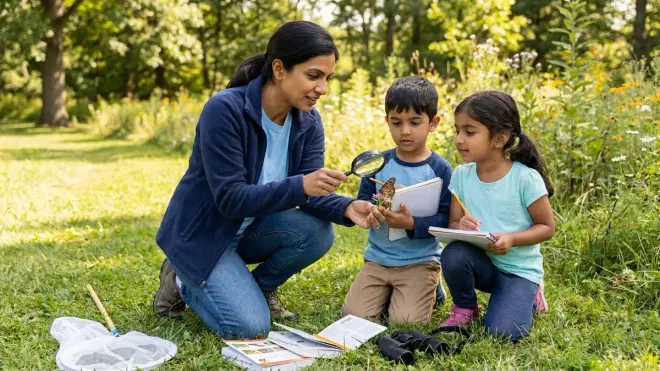
Well-designed citizen science participation creates a natural learning progression. Elementary students might start with observational projects requiring pattern recognition—identifying bird species, photographing insects, or documenting weather patterns. These build observational acuity and familiarity with field guides and taxonomic classification.
Middle schoolers can advance to quantitative measurement projects using calibrated sensors, which introduces experimental methodology: controlling variables, understanding measurement uncertainty, and distinguishing correlation from causation. A student tracking pH and temperature in a local pond across seasons must grapple with confounding variables: Is pH dropping because of temperature change, or are both responding independently to seasonal runoff patterns?
High schoolers ready for advanced work can tackle data analysis roles in computational citizen science. Projects like Zooniverse offer opportunities to classify tens of thousands of images, building statistical thinking as patterns emerge across large datasets. This progression mirrors the STEM learning path you'd construct with robotics or coding tools, but applied to empirical research skills.
Career-Relevant Competencies
Perhaps most importantly, citizen science exposes students to research workflows used across STEM professions. Environmental scientists, epidemiologists, ecologists, climate researchers, and conservationists all rely on distributed data collection networks that function identically to citizen science platforms.
Your child learning to use the iNaturalist mobile app for species identification is simultaneously learning the Cornell Lab of Ornithology's eBird data submission interface—the same tool professional ornithologists use for population monitoring. A middle schooler uploading air quality sensor data is building familiarity with environmental monitoring protocols that directly parallel professional ambient air quality networks operated by state environmental agencies.
These aren't approximations or educational simulations. They're the actual platforms, the actual protocols, and increasingly—especially for computational projects—the actual analytical tools researchers use. That's a remarkably efficient skill investment.
Types and Variations of Citizen Science Projects
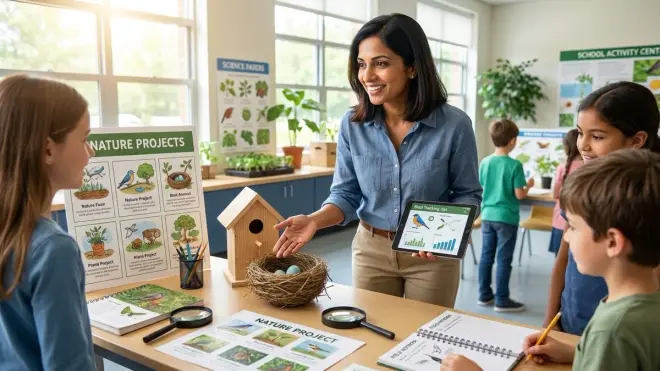
Understanding project categories helps you match opportunities to your child's current skill level and interests while planning progression toward more complex participation.
Observational and Classification Projects
These require pattern recognition, taxonomic knowledge, and careful documentation but minimal equipment. iNaturalist exemplifies this category: photograph organisms in nature, attempt identification using the app's AI suggestions and field guide references, and submit observations that experts verify. The learning outcome centers on biodiversity awareness and classification skills.
eBird operates similarly for bird observations. Your child learns to use field marks (plumage patterns, size, behavior) for species identification, estimates flock sizes, and submits standardized checklists noting observation duration and location. Over time, these observations build into a longitudinal dataset revealing migration patterns and population changes.
The progression pathway: start with common, easily identifiable species; advance to distinguishing similar species using subtle field marks; eventually contribute to rare species documentation requiring expert verification. This scaffolds observation skills beautifully—from "I see a bird" to "I see a juvenile Cooper's Hawk based on streaked breast pattern and proportionally longer tail relative to Sharp-shinned Hawks."
Sensor-Based Environmental Monitoring
These projects require equipment investment and calibration protocols but produce quantitative datasets. Common categories include:
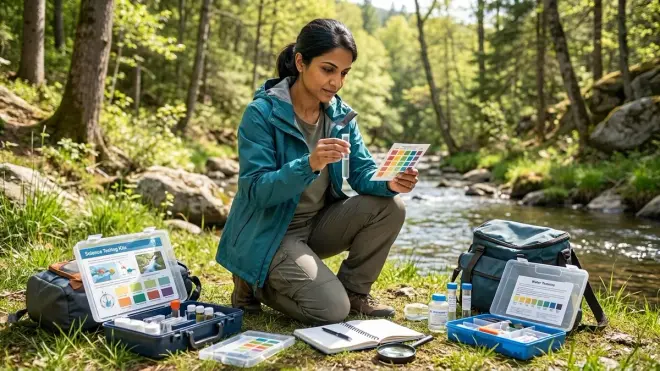
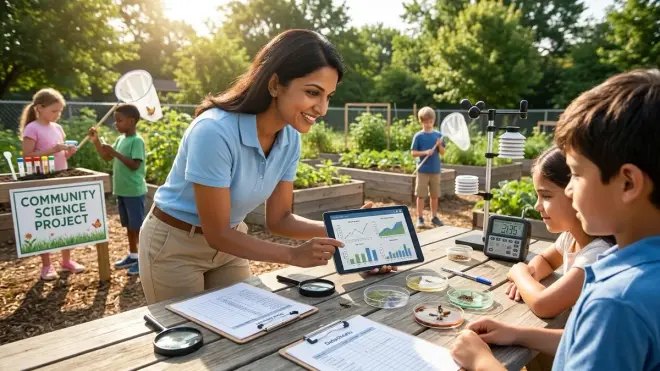
Water quality monitoring: pH, dissolved oxygen, turbidity, nitrate, and phosphate testing using chemical test kits or electronic probes. Projects like FreshWater Watch provide standardized kits and training. Students learn proper sampling technique (collecting mid-stream, avoiding sediment disturbance), reagent handling, and understanding how measurements relate to ecosystem health indicators.
Air quality tracking: Particulate matter sensors (PM2.5 and PM10) deployed at home locations contribute to pollution mapping projects. PurpleAir operates a global network where many participants are student researchers. The technical requirement: Arduino or micro:bit compatible sensors, WiFi connectivity for continuous data upload, and electrical outlet access for continuous operation.
Phenology observation: Recording first leaf emergence, first bloom dates, insect appearance timing, and migration arrival dates. Project BudBurst coordinates this work, correlating observations with climate data to track climate change impacts on plant and animal life cycles.
The lab specs for sensor-based work matter significantly. You need reliable power (USB or AC adapter with backup during brief outages), weatherproofing for outdoor deployment, and either continuous connectivity or local data logging with periodic uploads. Sensors require periodic calibration using known standard solutions, which become consumable expenses—budget for calibration solution replacement every 3-6 months depending on use frequency.
Computational and Data Analysis Projects
These projects shift participation from data collection to data processing. Students analyze images, audio recordings, or text that automated systems can't process accurately. Galaxy Zoo asks participants to classify galaxy morphology from telescope images. Chimp&See presents camera trap footage where volunteers identify and count animals, building behavioral ecology datasets.
The cognitive demand here is pattern recognition at scale. A single student might classify 500 galaxy images in an afternoon, developing intuition for morphological categories that took astronomers years to build through formal training. The redundancy model means no single classification is determinative—your child's work combines with others to create probabilistic classifications.
This category pairs exceptionally well with students interested in machine learning and AI, because many computational citizen science projects explicitly train machine learning models using human classifications as ground truth. Your child sees their work feeding directly into algorithm development—a tangible connection between human analysis and artificial intelligence capabilities.
Frequently Asked Questions
What age is appropriate to start citizen science projects?
Children as young as 5-6 can participate meaningfully in observational citizen science with parent support, particularly visual classification tasks like identifying cloud types or common backyard birds. The skill requirement centers on sustained attention and pattern recognition rather than reading ability—apps like iNaturalist work largely through image comparison. By ages 8-10, most students can handle independent observational projects that don't require equipment calibration. Sensor-based projects requiring calibration protocols and measurement precision typically suit ages 11-12 and up, aligning with the abstract thinking emergence that makes measurement uncertainty and experimental controls comprehensible. The progression mirrors general STEM toy skill development—match cognitive demand to developmental capability, not just age ranges.
Do we need to buy special equipment for citizen science participation?
Many high-quality citizen science projects require only a smartphone camera and internet connectivity for data submission, making them accessible without additional investment. Observational projects (eBird, iNaturalist, Project BudBurst) operate entirely through mobile apps available free on iOS and Android platforms. Sensor-based environmental monitoring projects do require equipment purchases—expect to invest anywhere from around $50 for basic water quality test kits to around $200-300 for Arduino-compatible air quality sensor packages with proper calibration equipment. Before purchasing, verify the project provides detailed equipment specifications, calibration protocols, and has active participant support—you want assurance the research team will still exist to use your data three years from now. Some institutions loan equipment to participating students; check project websites for equipment lending programs before buying.
How much time does citizen science require each week?
Time commitment varies dramatically by project type, from 15-minute weekly observations to daily sensor readings requiring 5-10 minutes. Phenology projects might need weekly check-ins during active growing seasons to note first bloom dates, then monthly maintenance observations afterward. Air quality monitoring with continuous sensors requires daily data verification (5 minutes) plus weekly calibration checks (15-20 minutes). Computational projects offer the most flexibility—your child can classify 10 galaxy images or 100, depending on available time and interest. I recommend starting with low-commitment observational projects to assess your child's sustained interest before investing in equipment-intensive projects requiring daily attention. The citizen science project checklist can help you evaluate time requirements before committing.
Will our data actually be used by real scientists?
Yes, if you choose projects operated by established research institutions with published data usage policies and peer-reviewed publication histories. Legitimate citizen science projects maintain open-access databases, publish annual reports detailing how participant data contributed to research findings, and cite citizen science datasets in peer-reviewed publications. Before committing, check the project's publication page—you should find evidence of scientific papers using participant data, presentations at professional conferences, or policy documents citing the research. Projects affiliated with universities, government agencies like NOAA or NASA, or major museums (Cornell Lab of Ornithology, Smithsonian) generally meet this standard. Be skeptical of projects that emphasize educational benefit but provide no evidence of research output—those are educational programs, not research platforms.
How does citizen science prepare kids for STEM careers?
Citizen science builds empirical research methodology, statistical thinking, and data literacy that transfer directly to laboratory sciences, environmental fields, epidemiology, and any profession requiring evidence-based decision-making. Students learn hypothesis testing, experimental controls, measurement precision, data validation, and peer review processes—the foundational practices used across scientific disciplines. The technical skills (sensor calibration, data logging, statistical analysis) map directly onto environmental monitoring careers, field biology, public health surveillance, and climate science. Perhaps equally important, students develop research epistemology: understanding how we know what we know, distinguishing quality evidence from weak evidence, and recognizing that scientific consensus emerges from aggregate data rather than single studies. These capabilities underpin scientific literacy regardless of eventual career path, and they're remarkably difficult to develop through textbook learning alone. The progression from simple sensor projects to advanced data analysis creates a natural bridge toward college-level research participation and eventually professional research roles.
Summary
What is citizen science for kids? It's the bridge between classroom simulations and professional research—genuine scientific investigation where young learners contribute to datasets used by researchers to answer real questions. Unlike typical hands-on activities focused on engagement and conceptual understanding, citizen science demands methodological rigor, builds data literacy through authentic practice, and produces outcomes with consequences beyond grades.
The learning progression it enables is remarkable: from observational pattern recognition with backyard bird counts, through quantitative measurement with calibrated sensors, to computational data analysis processing thousands of observations. Each stage scaffolds capabilities that transfer directly to research-dependent STEM careers while addressing Next Generation Science Standards practices that traditional curricula struggle to implement authentically.
Start with low-barrier observational projects to assess your child's sustained interest. If engagement persists, progress toward sensor-based work requiring equipment investment and daily protocols. The time and money investments pay dividends in research skills that no classroom simulation can replicate—because the data matters, the methodology matters, and the scientific community relies on the work your child contributes. That's a fundamentally different learning dynamic, and it transforms how students understand what science actually is.