


If you're wondering what are stem toys and whether they're genuinely different from regular playthings, you're asking exactly the right question. STEM toys are learning tools deliberately designed to build measurable skills in science, technology, engineering, and mathematics through structured, hands-on experiences that mirror real-world problem-solving. Unlike toys that entertain, STEM toys prepare children for specific competencies—from spatial reasoning at age three to Python programming at age eleven. You need to understand the progression because buying randomly without a learning path wastes money and confuses skill development.
What Are STEM Toys?
STEM toys are educational tools engineered to teach concrete skills in science, technology, engineering, and mathematics through age-appropriate, hands-on challenges. They differ from conventional toys in three critical ways: they target specific cognitive milestones aligned with developmental stages, they build sequentially on prior knowledge, and they prepare children for industry-standard tools used in actual STEM careers.

When I explain what are stem toys to parents during conferences, I emphasize that these aren't just blocks with "science" printed on the box. Real STEM toys scaffold learning progressively. A quality STEM toy for a four-year-old teaches spatial transformation and cause-effect relationships through tangible manipulation. By age seven, that same child should transition to tools that introduce algorithmic thinking and conditional logic. By ten, they're working with platforms like Arduino that professional engineers actually use.
The distinction matters because the market floods parents with products claiming STEM credentials without delivering genuine skill outcomes. A true STEM toy meets these criteria: it teaches a transferable technical skill, it includes clear success metrics (not just "exploration"), it connects to the next level in a learning path, and it doesn't require constant adult intervention to function. The Learning Resources Gears! Gears! Gears! set, for instance, teaches mechanical advantage and rotational motion to preschoolers—concepts that directly prepare them for understanding robotics kits years later.
I've watched hundreds of sixth-graders struggle with proportional reasoning in chemistry because they never built foundational measurement skills with age-appropriate tools. That's why understanding what are stem toys actually means can reshape your child's entire learning trajectory.
How STEM Toys Build Sequential Skills
STEM toys work by targeting specific cognitive development windows with activities that externalize abstract concepts into tangible experiences. Unlike passive learning, these tools require children to form hypotheses, test variables, observe outcomes, and iterate—the exact scientific method they'll use in formal education and professional contexts.
Ages 3-5: Spatial Reasoning and Physical Systems
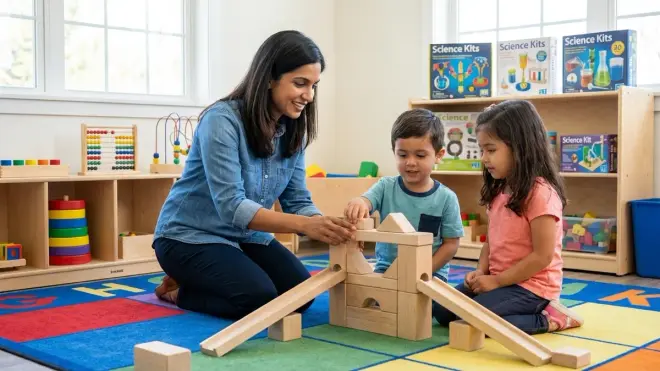
Preschool STEM toys focus on concrete operational skills—the physical manipulation that builds schema for abstract thinking later. Screen-free coding toys for preschoolers like the Learning Resources Code & Go Robot Mouse teach directional sequencing and step-by-step planning without requiring literacy or screen time. These tools externalize the invisible concept of sequential commands through physical movement.
Lab Specs for this stage: Products should run on standard AA batteries (easier for small hands to help install), have no cloud dependencies (four-year-olds don't need accounts), and survive drops from table height repeatedly. Look for offline functionality and pieces large enough to prevent choking hazards but small enough for developing fine motor control.
Skill outcomes at this level: By age five, children should demonstrate understanding of simple machines (lever, wheel-and-axle, inclined plane), predict motion outcomes before execution, and follow multi-step sequences up to seven commands. These capabilities directly prepare them for building foundation engineering skills in early elementary years.
Ages 6-8: Logic Structures and System Design
Early elementary STEM toys introduce conditional logic, variables, and modular system thinking. This is when children transition from "follow these steps" to "create your own sequence that solves this challenge." Tools like the ThinkFun Gravity Maze teach if-then reasoning through physical marble runs, while screen-free coding robots add loops and functions to their command vocabulary.
Lab Specs: Products should offer 50+ challenge levels spanning at least two years of skill growth, include clear progression markers (not just "easy/medium/hard"), and expand with add-on packs rather than requiring complete replacements. Check for cross-platform compatibility if digital components exist—some coding robots only work with specific tablet generations, which creates expensive upgrade cycles.
Skill outcomes: Seven-year-olds working with appropriate STEM toys should write basic algorithms (even physically), debug sequences independently, and understand that the same goal can have multiple valid solution paths. These exact skills prepare them for transitioning to screen-based programming languages around age eight or nine.
Ages 9-12: Industry-Standard Tools and Abstract Modeling
Pre-teen STEM tools shift from proprietary systems to platforms used by actual professionals. This is when children should access tools like Arduino IDE, Scratch, Python environments, and CAD software—the same tools that undergraduate engineering students use. The Arduino Starter Kit teaches text-based programming and circuit logic using C++, which appears in countless real-world applications from robotics to aerospace systems.
Lab Specs become critical here: You need to verify operating system requirements (does it need Windows 10+, or will it run on your older Mac?), expandability options (can they add sensors and motors as skills grow?), and community support (is there active documentation when they hit roadblocks?). Products requiring subscriptions for basic functionality should be carefully evaluated—some teach genuine skills, others just paywall content that's freely available elsewhere.
Skill outcomes: By age twelve, children should write basic programs in a text-based language, understand variables and data types, design and prototype physical objects in CAD software, and troubleshoot multi-component systems independently. These aren't "enrichment" skills—they're prerequisites for advanced robotics learning paths and high school AP Computer Science courses.
Why Progressive STEM Toy Selection Matters
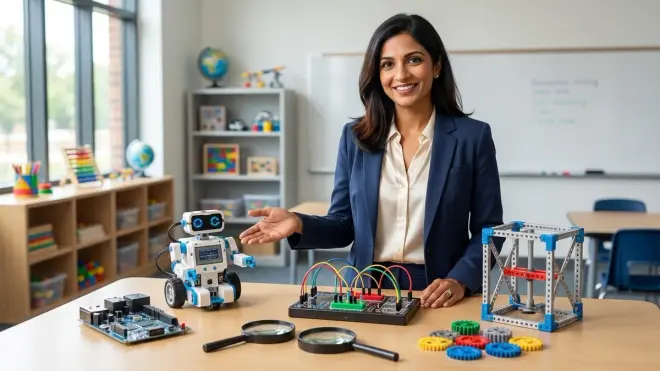
Choosing STEM toys without understanding skill progression wastes money and creates capability gaps that compound over time. I've consulted with families who owned thousands of dollars in STEM products but whose children couldn't demonstrate a single transferable technical skill because the tools didn't connect into a coherent learning path.
The practical stakes are significant. Children who build proper foundational skills between ages three and seven develop stronger spatial reasoning, which correlates directly with success in calculus, physics, and engineering disciplines. Students who learn algorithmic thinking through hands-on tools before age ten transition to text-based programming with 60-70% less frustration than peers who start cold with Python or JavaScript.
Beyond academics, progressive STEM skill-building creates genuine career preparedness. The Arduino board your eleven-year-old learns on isn't a toy version—it's the actual platform used in industrial automation, robotics competitions, and maker spaces worldwide. The CAD skills they develop with Tinkercad transfer directly to Fusion 360 and SolidWorks, industry-standard tools. When employers in 2026 survey the skills they need, they're asking for exactly what well-chosen STEM toys teach: systems thinking, debugging persistence, and comfort with iterative design.
This is why I always recommend parents establish a progressive STEM learning path before purchasing randomly. One quality robotics kit that grows with your child over three years delivers far more value than five disconnected products that sit unused after initial novelty fades.
Types and Variations of STEM Learning Tools
STEM toys cluster into distinct categories based on the primary skills they develop, though the best products integrate multiple domains simultaneously.
Construction and Engineering Systems focus on mechanical principles, structural design, and spatial reasoning. These range from simple gear sets for preschoolers to LEGO Mindstorms robotics platforms that combine building with programming. Lab Specs considerations: check piece counts (systems under 50 pieces limit complexity), compatibility with standard building platforms, and whether designs can be permanently saved or must be disassembled for next projects.
Coding and Computational Thinking Tools span from unplugged screen-free games that teach algorithms to full programming environments. The progression moves from directional sequencing (preschool) through block-based coding like Scratch (early elementary) to text-based languages like Python (pre-teen). Critical specs include offline vs. cloud-dependent functionality, compatibility with existing devices, and whether the learning platform continues to challenge them for multiple years or plateaus quickly.
Electronics and Circuit Design Kits teach electricity fundamentals, component behavior, and system integration. These progress from snap-circuit systems with pre-designed projects through breadboard prototyping to PCB design. Look for voltage safety features (all pre-teen kits should be low-voltage DC only), clear troubleshooting guidance (circuit debugging frustrates beginners), and expandability with standard electronic components available at any electronics supplier.
Scientific Investigation and Data Tools include microscopes, chemistry sets, renewable energy kits, and environmental monitoring systems. These teach the scientific method, measurement precision, and data interpretation. Spec priorities: actual magnification power vs. toy optics, whether chemistry sets include sufficient quantities for repeated experiments or just one-time demonstrations, and if data tools include storage and analysis features or just display readings.
The most effective STEM learning environments combine multiple tool types into a well-organized home lab space where projects can integrate skills from different domains—using coding skills to control a circuit that powers a mechanical system, for instance.
Frequently Asked Questions
What are STEM toys and how do they differ from regular educational toys?
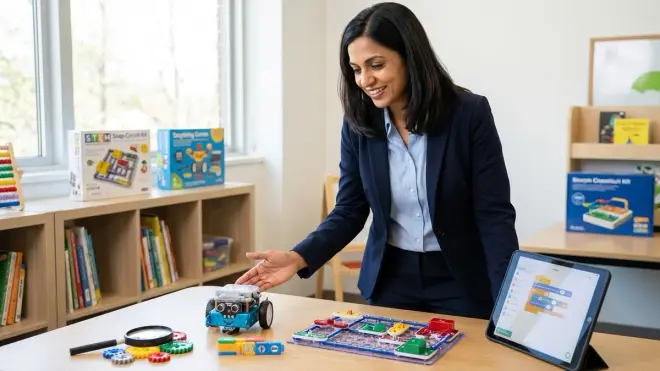
STEM toys are specialized learning tools that teach measurable technical skills in science, technology, engineering, and mathematics through hands-on problem-solving activities that mirror professional practices, whereas regular educational toys might teach letters, numbers, or social skills without building toward industry-standard technical competencies or progressive skill ladders.
At what age should children start using STEM toys?
Children can begin with age-appropriate STEM toys as early as age three, starting with screen-free tools that teach spatial reasoning, simple machines, and cause-effect relationships, then progressing through increasingly complex tools that introduce logic, programming, and system design as their cognitive development supports abstract thinking and multi-step planning capabilities.
Do STEM toys require computers or tablets to work?
STEM toys vary widely—preschool and early elementary tools should primarily be screen-free to build foundational spatial and logical thinking without digital dependence, while pre-teen tools increasingly integrate with computers running software like Arduino IDE, Scratch, or Python environments to prepare children for industry-standard programming platforms used in actual STEM careers.
How do I know if a STEM toy will keep my child engaged long-term?
Look for products offering 50-plus progressive challenge levels spanning at least two years of skill development, expandability through add-on components rather than requiring complete replacements, clear capability milestones that show measurable progress, and compatibility with next-level tools in the learning path so skills transfer rather than restart with each new product.
Are expensive STEM toys worth the investment compared to budget options?
Quality STEM toys justify higher costs when they deliver genuine skill progression toward industry-standard tools, offer durable construction for repeated use across multiple years or children, include comprehensive learning resources beyond basic instructions, and provide expandability that grows with developing capabilities rather than requiring full replacement when children advance.
Building Capability Instead of Collecting Toys
What are stem toys, fundamentally? They're investments in specific, measurable technical competencies that prepare children for both academic success and career readiness. The difference between a home filled with STEM toys and a home with STEM learning outcomes comes down to intentional progression.
Start by assessing your child's current skill level honestly—not their age, but their actual demonstrated capabilities. A seven-year-old who's never touched construction toys needs to build spatial reasoning before tackling coding robots, regardless of what the age label suggests. Then map a learning path that connects each tool to the next, ensuring skills compound rather than scatter.
I've seen remarkable transformations when families shift from random STEM toy accumulation to deliberate skill-building. The sixth-grader who started with preschool gear sets at age four, progressed through screen-free coding at six, and began Arduino programming at nine arrives in my classroom already comfortable with iterative design, systematic debugging, and technical documentation. That's not about being "gifted"—it's about consistent, progressive skill development that appropriate STEM toys facilitate beautifully when chosen with intentionality and clear learning outcomes in mind.