
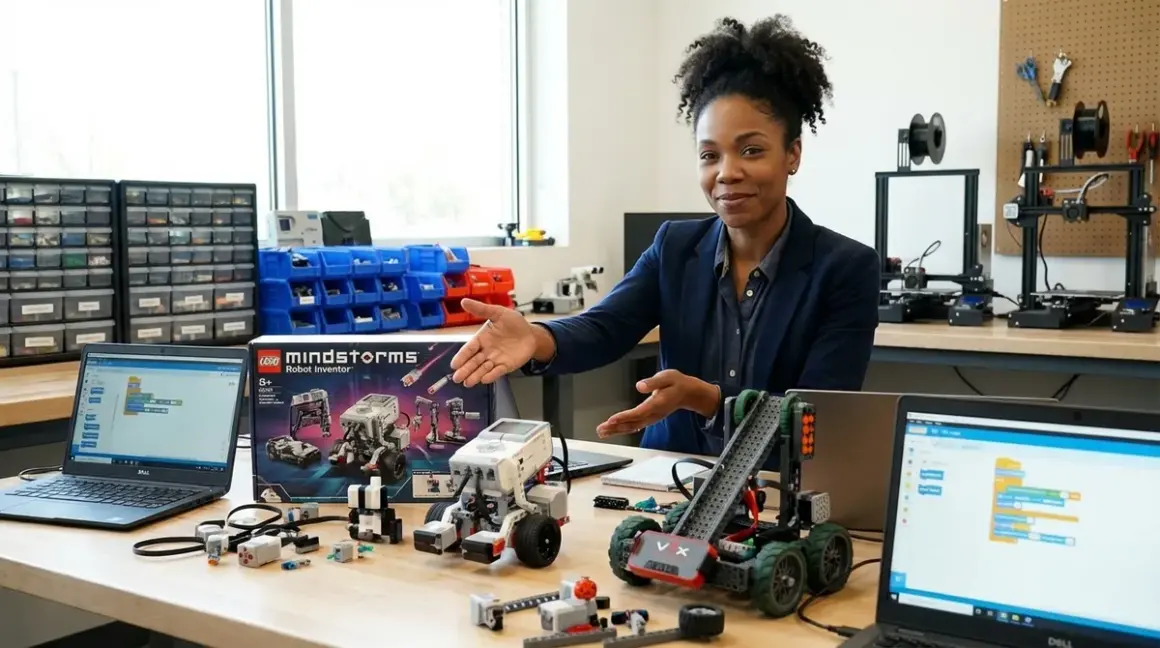

The verdict: VEX Robotics develops competition-ready mechanical engineering and industry-standard C++ skills, while LEGO Mindstorms excels at rapid prototyping and accessible Python/Scratch entry points—your choice hinges on whether you're building toward FRC competition pathways or iterative invention workflows.
When you're choosing between lego mindstorms vs vex robotics, you're not just picking plastic and motors—you're selecting the foundational language your young engineer will speak for the next decade. I've watched both platforms evolve since I started tinkering with solar-powered autonomous rovers in my garage, and the gap between them has widened in fascinating ways. LEGO's 2022 pivot to the Robot Inventor hub brought Python compatibility and Bluetooth LE, while VEX doubled down on aluminum extrusion systems that mirror what you'd find in NASA's Jet Propulsion Lab workshops. Both prepare kids for real engineering work, but they take radically different paths to get there.
This article dissects platform architecture, programming ecosystems, mechanical design philosophies, competitive robotics integration, and long-term skill progression. You'll see exactly which capabilities each system unlocks at which milestones, and how they connect—or don't—to the tools your daughter will use if she pursues aerospace, mechatronics, or sustainable automation engineering.
Quick Comparison
| Criterion | LEGO Mindstorms Robot Inventor | VEX IQ / V5 Robotics |
|---|---|---|
| Programming Pathways | Scratch → Python → (limited) C; cloud-dependent app; offline mode lacks full sensor suite | Block-based VEXcode → C++ (VEX V5); fully offline IDE; industry-standard text editors supported |
| Mechanical System | ABS plastic friction pins + Technic beams; rapid rebuild cycles; limited torque under load | Aluminum extrusion + steel hardware; permanent/semi-permanent builds; high-torque metal gearing |
| Competition Ecosystem | First LEGO League (FLL); age 9–16; standardized challenge sets; global but separate from FRC pipeline | VEX IQ (ages 8–14) → VEX V5 (high school) → direct FIRST Robotics Competition prep; 20,000+ annual events |
| Expandability & Longevity | Closed ecosystem; official LEGO parts only; hacking requires 3D-printed adapters; typical 2–4 year lifespan | Open architecture; accepts third-party sensors, pneumatics, custom-machined parts; 5–8 year progression |
| Skill Ceiling | Moderate—plateaus at intermediate Python; great for cross-disciplinary (robotics + visual art + storytelling) | High—reaches advanced C++, PID control loops, computer vision; prepares for Arduino/ROS transition |
Programming Ecosystem: Where Code Meets Steel
The LEGO Mindstorms Robot Inventor Building Set🛒 Amazon ships with a proprietary Scratch-based environment that feels delightfully intuitive—until you hit its walls. You'll drag-and-drop sensor blocks, build conditional loops, and watch your robot respond in real time through Bluetooth LE. The Python bridge, added in the 2022 firmware update, opens access to variables, functions, and object-oriented structures, but here's the friction: you're locked into LEGO's cloud-dependent app. Lose your internet connection mid-session, and you lose access to the advanced sensor libraries. I learned this the hard way during a power outage while debugging a solar-tracking turret—my Python script compiled, but the gyroscope calibration module vanished without Wi-Fi.
The progression feels natural for kids transitioning from screen-free coding kits to text-based languages. You start with icon-based "move forward 10 seconds" commands, graduate to Python loops that calculate motor rotations based on wheel circumference, and eventually write functions that poll ultrasonic sensors at 100Hz. But LEGO's Python implementation is a walled garden—you can't import numpy, you can't interface with external APIs, and you can't deploy code written in VS Code or PyCharm. It's Python-flavored training wheels, not the Python you'll use to program autonomous drones.
VEX takes the opposite approach. VEX Robotics V5 Clawbot Kit🛒 Amazon runs VEXcode, which supports block-based programming for beginners but pivots seamlessly to C++ with zero platform switching. The same IDE. The same project file. You literally click a tab to toggle between blocks and text, and the compiler shows you the C++ equivalent of every block you place. Imagine your son building a claw mechanism in blocks, then opening the text view to see Motor.spin(forward, 50, percent); staring back at him. That's the bridge from block-based to text-based robot programming that LEGO can't match.
VEXcode works entirely offline—download it once, code forever, no cloud dependencies. You can write in the native IDE or export to VS Code, Atom, or any text editor that supports C++. The V5 brain runs FreeRTOS, an industry-standard real-time operating system used in Tesla autopilot systems and Mars rovers. When your daughter debugs a PID loop on a VEX drivetrain, she's learning the same control theory that governs SpaceX's grid fins. LEGO teaches computational thinking; VEX teaches embedded systems engineering.
The skill ceiling is stark. LEGO plateaus around intermediate Python—conditionals, loops, basic object manipulation. VEX scales to advanced C++ with pointer arithmetic, multithreading, and sensor fusion algorithms. If your goal is breadth—robotics plus animation plus creative storytelling—LEGO's cross-disciplinary flexibility wins. If your goal is depth toward mechatronics or aerospace, VEX builds the foundation that connects directly to Arduino robotics kits and eventually ROS (Robot Operating System).
Mechanical Design Philosophy: Iteration vs Permanence
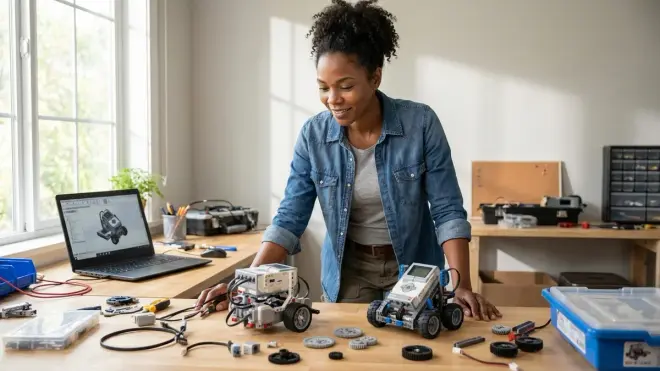
LEGO's friction-pin system is ingenious for one reason: you can rebuild from scratch in under an hour. Snap apart a rover, reassemble it as a hexapod, test, fail, redesign, and do it again before dinner. I've prototyped solar panel tracking systems faster with LEGO than with any other platform, precisely because the cost of failure is ten minutes and zero tools. The Technic beams and axles create sturdy frames for lightweight robots, and the gear ratios are intuitive enough that a ten-year-old can eyeball torque trade-offs without touching a calculator.
But here's where physics intervenes: ABS plastic flexes under load. Build a four-motor drivetrain, mount a heavy manipulator arm, and watch the chassis bow during high-speed turns. The friction pins slip when torque exceeds their grip strength—no amount of clever bracing fixes the material limits. I've reinforced LEGO frames with aluminum flat stock and 3D-printed brackets (which voids any competition legality), but at that point, you're fighting the platform instead of using it. LEGO tops out around 2–3 kg payloads for mobile robots; go heavier, and you need metal.
VEX IQ Super Kit🛒 Amazon starts kids with plastic components that mirror LEGO's ease of assembly—snap-together pins, no screws, colorful beams. It's the on-ramp. But VEX V5 graduates to aluminum extrusion channels and steel hardware. You're drilling, tapping threads, using hex keys and wrenches. Builds take longer—a competitive V5 robot might require 20–30 hours of assembly—but the result is a machine that withstands full-contact competition impacts. VEX robots compete in matches where 15-kilogram machines slam into barriers at 2 meters per second. LEGO robots would shatter.
The mechanical vocabulary differs radically. LEGO teaches spatial reasoning and gear ratios through intuitive, visual trial-and-error. VEX teaches mechanical advantage, structural load distribution, and tolerance stacking—concepts you'd encounter in first-year mechanical engineering. When your son calculates whether a 1:7 gear ratio will stall a 11-watt motor lifting a 5 kg load, he's doing the same math a Tesla drivetrain engineer does. VEX's metal gearing eliminates the slop and flex that plague LEGO under stress; you get repeatable, predictable performance.
Expandability tells the longer story. LEGO is a closed ecosystem—official parts only, unless you're willing to 3D-print custom adapters and void competition rules. VEX is open architecture by design. Third-party vendors sell pneumatic kits, computer vision sensors, custom-machined sprockets, even GPS modules. I've integrated a solar charge controller into a VEX rover using off-the-shelf electronics—try that with LEGO, and you're soldering wires to proprietary connectors. VEX V5's modular smart ports accept anything that speaks I2C or SPI; LEGO's hub accepts LEGO sensors, period.
The longevity gap is measurable. LEGO robots typically serve a child well for 2–4 years—from age 8 to 12, maybe stretching to 14 if you layer in Python projects. After that, the mechanical limitations become frustrating, and the programming ceiling looms close. VEX IQ bridges ages 8–14, then VEX V5 carries through high school and into college club teams. I know undergrads at Oregon State running VEX V5 mechanisms in their capstone renewable energy projects. LEGO ends; VEX transitions.
Competition Pathways: Structured Challenge vs Open Engineering
First LEGO League dominates the LEGO robotics competition space, and it's a beautifully scaffolded experience. Teams of 4–10 kids (ages 9–16) receive an annual challenge—maybe it's space exploration, maybe it's sustainable cities—and build an autonomous robot to complete specific tasks on a standardized mat. You get 2.5 minutes, your robot runs pre-programmed routines (no remote control), and judges score precision: Did the arm lift the cargo module? Did the rover cross the boundary line? It's structured, repeatable, and globally consistent. My niece's FLL team in Portland competed using nearly identical rules as a team in Berlin.
But FLL operates in its own universe. LEGO competition experience doesn't transfer directly to FIRST Robotics Competition (FRC), the high school league that uses full-scale robots with pneumatics, computer vision, and 120-pound weight limits. FLL alumni enter FRC with strong problem-solving habits and teamwork skills, but they're learning new mechanical systems, new programming languages (typically Java or C++), and new design constraints from scratch. It's a soft-skill bridge, not a technical one.
VEX, by contrast, is the pipeline. VEX IQ competitions (ages 8–14) use the same organizational structure, documentation standards, and engineering notebook expectations as VEX V5 (high school) and VEX U (college). A child who starts with VEX IQ at age 9 competes for six years in IQ divisions, transitions to V5 at 14, and walks into high school already fluent in the tournament formats, robot inspection checklists, and alliance selection strategies. Many FRC teams run parallel VEX programs because the mechanical and programming skills—C++, PID loops, autonomous pathing—overlap almost 1:1. VEX V5 is a direct FRC prep course.
The numbers underscore this: VEX hosts over 20,000 competitive events annually across 50 countries, from elementary-school scrimmages to the VEX Robotics World Championship, where 600+ teams converge for a week-long tournament that feels like the Olympics of teen engineering. Compare that to FLL's roughly 40,000 teams worldwide—larger in total participation, but siloed from the high-school progression.
If your child thrives on structured, mission-based challenges with clear scoring rubrics, FLL through LEGO Mindstorms is joyful and accessible. If your goal is a continuous competitive trajectory that culminates in college-level robotics or professional engineering internships, VEX is the deliberate path. I've mentored teams in both leagues; the VEX kids talk about gear ratios and sensor noise like it's second nature by age 12. The LEGO kids excel at creative problem-solving and collaboration, but they're relearning mechanical fundamentals when they age out.
Lab Specs and Ecosystem Infrastructure
Power requirements diverge meaningfully. The LEGO Mindstorms Robot Inventor hub runs on a rechargeable lithium-ion battery (2100 mAh, roughly 3–4 hours per charge), with USB-C charging that takes about 2 hours. You need one hub per robot, and swapping batteries mid-project isn't an option—it's a sealed unit. Budget for a second hub if you're running multi-robot projects or sustained lab sessions. The motors (four included) and sensors (distance, color, force) draw from that shared pool, and you'll quickly learn to write power-efficient code when your robot dies mid-run.
VEX V5 uses a removable, hot-swappable 1100 mAh battery that charges in 50 minutes via a dedicated fast-charger. Competition teams routinely own 4–6 batteries and rotate them throughout tournament days—one discharges, the next slots in, zero downtime. The V5 brain runs on 12V, allowing higher-torque motors (up to 11 watts each, versus LEGO's ~1 watt motors). You'll need a power strip and dedicated charging station in your home STEM lab, but the payoff is consistent, repeatable performance. VEX IQ uses AA batteries, which is convenient for beginners but costly over time—rechargeable NiMH packs are the sustainable upgrade.
Connectivity and OS compatibility expose another gap. LEGO Mindstorms demands Bluetooth LE and works on Windows 10+, macOS 10.14+, iOS 10+, Android 5.0+, and ChromeOS. The app-centric model means you're dependent on LEGO's update cycle; when they deprecated the older EV3 software in 2024, thousands of legacy users scrambled. VEXcode runs natively on Windows, macOS, ChromeOS, iOS, and Android, but critically, it's a downloadable executable, not a cloud app. You control the update schedule, and older versions remain available indefinitely. The V5 brain connects via microUSB or wirelessly via VEXnet (a proprietary 2.4 GHz system for competition-legal remote control).
Durability under repeated use is where VEX's metal construction justifies its premium. LEGO Technic axles wear down after hundreds of assembly cycles—the plastic develops play, gears don't mesh as crisply, and friction pins lose their snap. I've replaced axle sets on a well-loved Mindstorms kit after two years of weekly rebuilds. VEX's aluminum extrusion and steel shafts last indefinitely; the only consumables are motor cartridges (rated for ~500 hours) and occasionally stripped screws if you overtighten. A VEX V5 kit purchased in 2020 remains competition-viable in 2026 with minor part replacements. LEGO kits feel dated faster, partly due to wear and partly due to the closed software ecosystem's forced obsolescence.
Expandability and cross-platform integration matter if you're building a progressive STEM learning path. LEGO Mindstorms doesn't play well with other systems—you can't easily integrate Arduino sensors, you can't interface with renewable energy kits, and hacking the hub's firmware voids support. VEX V5's open smart ports accept third-party sensors; I've connected BME280 environmental sensors, GPS modules, and even DIY solar panels to log data during autonomous runs. The V5 brain exposes a serial API compatible with Raspberry Pi, meaning you can offload computer vision processing to external compute and retain VEX for motor control. That's the bridge to real-world embedded systems engineering.
Storage and workspace needs scale differently. A LEGO Mindstorms Robot Inventor kit fits in a 30×20 cm bin; you can run a full lab on a bedroom desk. VEX V5 kits expand across 60×40 cm toolboxes once you add spare parts, pneumatics, and competition field elements. If you're setting up a dedicated STEM room, VEX demands more real estate but rewards it with longevity and complexity. LEGO excels in space-constrained environments where rapid iteration matters more than heavy-duty builds.
Who Should Choose LEGO Mindstorms
Choose LEGO Mindstorms if your child is 8–13 years old, thrives on rapid iteration, and you're prioritizing accessible entry points over long-term competition pathways. LEGO shines for families who want robotics to coexist with other creative outlets—building a robot that paints, a rover that dances, a sorter that organizes recycling. The platform's low barrier to teardown and rebuild encourages fearless experimentation; your daughter will test ten designs in the time a VEX build requires two.
This is also the right choice if your household is multi-user and younger siblings might benefit from the same kit. A seven-year-old can build LEGO structures while a twelve-year-old codes the Python routines, and you won't cringe when the younger one dismantles yesterday's masterpiece. The cost of entry is lower—around $360 for the Robot Inventor set versus $500+ for VEX V5 starter kits—and replacement parts are abundant on the secondhand market. If you're already invested in LEGO Technic or have drawers full of beams and gears, Mindstorms integrates seamlessly.
Pick LEGO if your goal is breadth over depth: computational thinking, creative problem-solving, and cross-disciplinary tinkering. If you want your child to build robots that illustrate climate science concepts or automate a miniature hydroponic garden (guilty—I built both), LEGO's friendly aesthetics and plug-and-play sensors lower the friction between idea and prototype. It's the platform I recommend when parents ask how to transition from screen-free coding to Scratch and Python—LEGO bridges that gap beautifully.
But be honest about the ceiling. If your child shows signs of deep engineering obsession—drawing gear trains for fun, asking about torque calculations, devouring videos on autonomous vehicles—LEGO will satisfy them for 18–24 months before they outgrow it. Plan the next step in your progressive robotics learning path accordingly.
Who Should Choose VEX Robotics
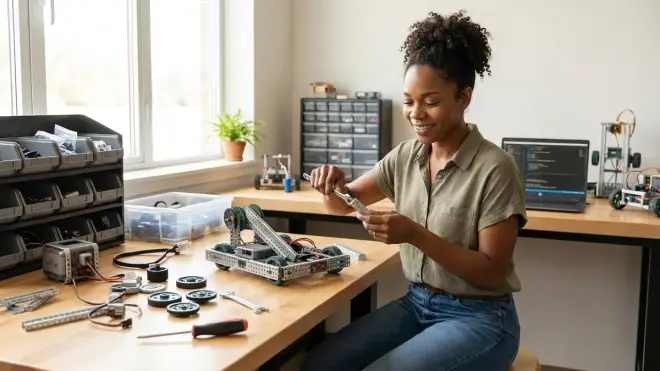
Choose VEX if your child is 10+ years old, demonstrates sustained interest in mechanical systems, or you're explicitly preparing them for competitive robotics and engineering careers. VEX is the platform for kids who obsess over why a mechanism failed, who iterate on designs not for novelty but for performance optimization. If your son spends an hour tuning a PID loop to shave 0.2 seconds off an autonomous routine, he's a VEX kid.
This is the deliberate choice for families committed to the competitive pipeline—VEX IQ through middle school, VEX V5 through high school, with eyes on FRC, college robotics clubs, or eventual internships in aerospace, mechatronics, or autonomous systems. The mechanical and programming skills transfer directly; the engineering notebooks and design documentation VEX requires mirror the standards used in professional R&D. When your daughter applies to engineering programs at MIT or Georgia Tech, her VEX portfolio demonstrates industry-adjacent competency in ways LEGO projects can't match.
VEX suits households with dedicated workspace and parental willingness to support longer build cycles. You're not snapping together a robot in an afternoon—you're measuring, drilling, adjusting, testing, and refining. If you have the space for a home STEM lab setup with a workbench, tool storage, and a practice field, VEX rewards that infrastructure. It's also the right choice if you're already thinking about best Arduino robotics kits as the next step—VEX's C++ foundation makes the Arduino IDE feel familiar, not foreign.
Pick VEX if sustainability and longevity matter. The upfront cost is higher, but a VEX kit lasts 5–8 years across multiple children or deepening skill levels. The open architecture means you can integrate renewable energy science projects—I've powered a VEX rover with a 10-watt solar array and capacitor bank for autonomous outdoor navigation. LEGO locks you into its ecosystem; VEX invites you to hack, extend, and integrate.
Finally, choose VEX if your child responds to real-world engineering contexts. VEX's metal construction, industrial fasteners, and competition scenarios mirror what professional engineers build. When your daughter reverse-engineers a planetary gearbox or debugs a sensor's I2C communication, she's learning transferable skills. LEGO teaches robotics; VEX teaches mechatronics.
Frequently Asked Questions
Can you mix LEGO Mindstorms and VEX Robotics parts in the same robot?
No, LEGO Mindstorms and VEX Robotics use incompatible mechanical and electronic systems—LEGO relies on friction pins and proprietary smart hub connectors, while VEX uses threaded metal hardware and modular smart ports. You can physically attach LEGO beams to VEX aluminum using 3D-printed adapter plates, but the electrical systems won't communicate; LEGO motors require LEGO hubs, and VEX motors require VEX brains. Some advanced builders create hybrid robots using separate control systems (one LEGO hub for one subsystem, one VEX brain for another), but this defeats the integrated programming experience both platforms offer and isn't legal in any competitive format.
Does VEX Robotics teach programming skills that transfer to real software engineering jobs?
Yes—VEX V5's C++ environment teaches syntax, control structures, object-oriented design, and debugging workflows identical to what embedded systems engineers use in automotive, aerospace, and IoT industries. The VEX V5 brain runs FreeRTOS, the same real-time operating system deployed in medical devices and industrial automation, so students learn concurrent programming, interrupt handling, and hardware abstraction layers. A teenager fluent in VEX C++ transitions seamlessly to Arduino, Raspberry Pi, and eventually frameworks like ROS (Robot Operating System) used for autonomous drones and warehouse robots. LEGO's Python implementation teaches computational thinking but lacks the memory management, pointer arithmetic, and low-level hardware control that define professional embedded development.
Which platform is better for homeschool STEM curricula focused on renewable energy and sustainability?
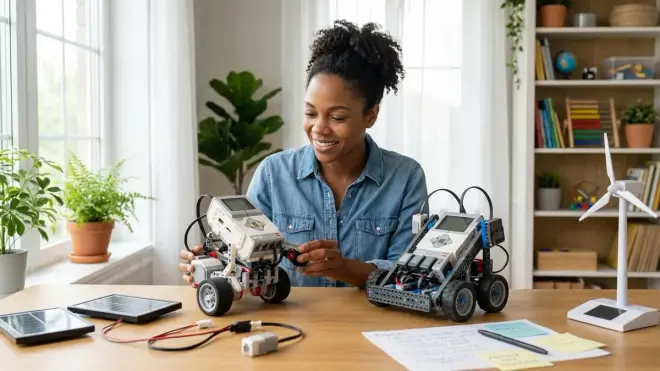
LEGO Mindstorms offers easier integration into cross-disciplinary renewable energy projects due to rapid prototyping speed and accessible sensors, but VEX V5's open architecture enables direct connection to solar panels, energy monitoring ICs, and custom environmental sensors. For conceptual demonstrations—building a robot that sorts recyclables or simulates a smart grid—LEGO's visual programming and modular builds let students iterate quickly and present results within a single week. For rigorous engineering projects—designing a solar-powered autonomous rover that logs GPS coordinates and soil moisture—VEX's durable construction, extended battery life, and compatibility with third-party I2C sensors provide the reliability and data precision required. I've built both; LEGO wins for storytelling and pedagogy, VEX wins for authentic engineering data collection that mirrors real climate tech R&D.
Bottom Line: Match the Platform to the Trajectory
Lego mindstorms vs vex robotics isn't a contest with a universal winner—it's a strategic choice between two valid, divergent paths. LEGO Mindstorms accelerates early creativity, teaching computational thinking and mechanical intuition through joyful, low-stakes iteration. It's the platform that sparks curiosity, the one that makes robotics feel accessible and fun, the bridge between screen-free coding kits and full programming environments. But it plateaus by mid-teens, and its closed ecosystem limits long-term growth.
VEX Robotics demands more upfront—more time, more space, more patience—but delivers a continuous trajectory from elementary school through college. It teaches the mechanical vocabulary, control theory, and text-based programming that prepare students for FRC, for engineering degrees, for internships at companies building electric vehicles and Mars rovers. It's not gentler or more forgiving, but it's real. The robots break in instructive ways. The code exposes complexity you can't abstract away. That's the point.
If you're choosing for a curious eight-year-old who might pivot to animation or environmental science, LEGO nurtures multi-directional exploration. If you're choosing for a focused eleven-year-old who sketches drivetrain designs during math class, VEX offers the depth to sustain that obsession for a decade. Both platforms build engineers—just different kinds, with different toolkits, prepared for different corners of the same sustainable future we're all trying to build.