


The critical difference between stem toys for 3 year olds vs 4 year olds isn't just age—it's the cognitive leap from parallel play to sequential problem-solving. This article breaks down the developmental markers that should guide your choice, covering motor skill requirements, abstract thinking readiness, independent vs. guided play needs, and how each stage builds toward foundational computational thinking—all with specific product recommendations and the lab specs parents actually need.
Quick Comparison: 3-Year-Old vs 4-Year-Old STEM Readiness
| Criteria | 3-Year-Old Stage | 4-Year-Old Stage |
|---|---|---|
| Motor Skill Requirements | Large-piece manipulation (2+ inches), two-hand coordination, chunky gears and levers | Small-piece handling (1 inch), precision placement, fine motor assembly, interlocking parts |
| Problem-Solving Approach | Trial-and-error with immediate feedback, single-step actions, cause-and-effect exploration | Multi-step sequences (2-3 actions), simple pattern recognition, basic "if-then" logic |
| Supervision Needs | Continuous adult presence for guidance and safety, co-play essential | Brief check-ins for complex tasks, increasing independent exploration (15-20 minutes) |
| Skill Outcome Focus | Spatial reasoning, color sorting, basic categorization, tactile sensory integration | Directional commands (forward/backward/turn), simple algorithms, hypothesis testing |
Motor Skills: The Foundation Everything Else Builds On
Your child's hand strength and coordination dictate which stem toys for 3 year olds vs 4 year olds will actually get used versus gathering dust. Three-year-olds are still developing the pincer grasp refinement needed for tiny components—they excel with chunky, palm-sized pieces that snap together with satisfying clicks or magnetic connections.
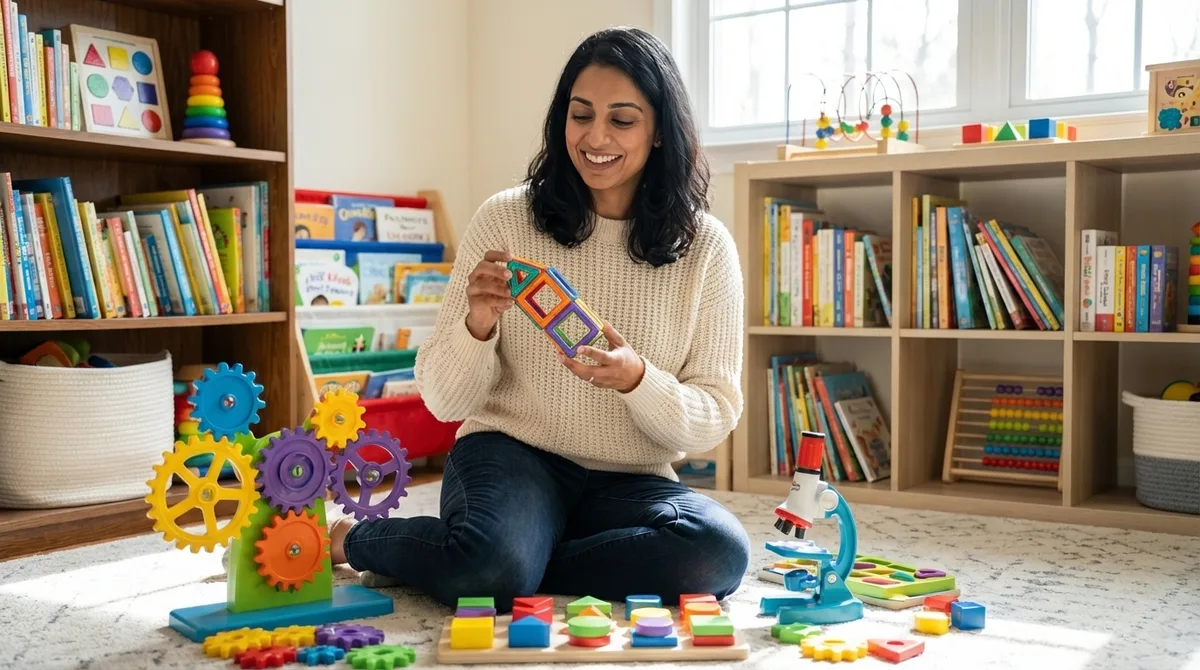
The Learning Resources Gears! Gears! Gears! Beginner's Building Set🛒 Amazon exemplifies ideal 3-year-old engineering: oversized interlocking gears (2.5-inch diameter) that require two-hand coordination to position and press together. Children at this stage master rotational cause-and-effect—turn one gear, watch the connected system move. The set requires no battery power, all components are dishwasher-safe ABS plastic rated for 500+ assembly cycles, and pieces are large enough to pass the toilet paper roll test for choking hazard screening. The main frustration here is that gears sometimes pop apart during vigorous cranking, which actually becomes a teaching moment about gear engagement rather than a deal-breaker.
Four-year-olds transition to precision manipulation. They can handle 1-inch components, align small pegs into corresponding holes, and manage connectors that require deliberate pressure. The Learning Resources Code & Go Robot Mouse Activity Set🛒 Amazon demonstrates this perfectly: children place directional arrow tiles (1.25 inches square) in sequence, then program a 4-inch robot to follow the path. The physical act of pressing each tile into place—and later retrieving them to correct errors—builds the fine motor control that transitions directly into pencil grip and eventually keyboard typing.
Lab Specs matter here. The Robot Mouse requires 3 AAA batteries (included, 15+ hours runtime), works entirely offline with no app dependency, and the maze wall components survive 200+ reconfigurations without warping. The tiles are rigid plastic rather than foam, which prevents bending but means they make noise when dropped on hardwood—something to consider in multi-purpose learning spaces. For more on integrating these tools into your home environment, see our guide on how to organize a home STEM lab.
By 4, children also develop the patience for multi-piece assembly that doesn't provide instant gratification. They're ready for screen-free coding toys that require 3-4 steps before seeing results, whereas 3-year-olds need immediate feedback loops. This distinction becomes crucial when choosing between simple building sets and early logic games.
Abstract Thinking: When Your Child Starts Solving Problems They Can't See

The cognitive milestone that most clearly separates stem toys for 3 year olds vs 4 year olds is mental representation—the ability to picture an outcome before manipulating objects to create it. Three-year-olds live in the concrete present. They explore what happens when they stack blocks higher, but they aren't yet planning "I'll build a tower tall enough to reach the shelf."
For 3-year-olds, STEM toys should emphasize sensory feedback and immediate results. Magnetic building tiles like Magna-Tiles Clear Colors 32-Piece Set🛒 Amazon work beautifully because every connection produces a tactile snap and visible geometric relationship. Children at this stage sort tiles by color, notice that triangles and squares connect along edges, and discover that some configurations stand while others collapse—all foundational geometry concepts delivered through hands-on trial. Each tile is 3-inch scale, made from non-toxic ABS plastic with neodymium magnets embedded in riveted edges (rated for 1000+ connection cycles). The tiles occasionally separate during aggressive building, particularly when younger children try to lift large structures by a single tile, but this actually reinforces structural integrity concepts.
These tiles require no consumables, no subscriptions, and zero connectivity—they're completely self-contained. The main compatibility consideration is that Magna-Tiles work with most generic magnetic tile brands but not with Magformers, which use a different edge geometry.
Four-year-olds begin experimenting with predictive thinking. They can follow 2-3 step visual instructions ("Place the blue block, then add the red one, then balance the yellow one on top") and increasingly hold those sequences in working memory. This is when screen-free coding games become genuinely useful rather than frustrating. The ThinkFun Robot Turtles Board Game🛒 Amazon uses this window perfectly: children lay down color-coded instruction cards (forward, turn left, turn right) to navigate a turtle token to a jewel on the board. They're learning sequential programming logic—the same "write the full sequence, then execute" approach used in actual coding—but through cardboard cards and plastic game pieces.
Robot Turtles accommodates 2-4 players, requires no batteries or power, and all components are standard board game materials (laminated cards, injection-molded plastic tokens) designed for 300+ play sessions. The cards do show wear at corners after extensive handling, which is why many parents sleeve them with standard card protectors. The game scales beautifully through five difficulty levels, but younger 3-year-olds typically hit a frustration wall around level 2 when obstacle tiles are introduced—they lack the working memory to mentally navigate around barriers they've placed themselves.
This is exactly where the 3-to-4 threshold lives. If your child can hold three instructions in mind while looking at the board state, they're ready for 4-year-old complexity. If they need you to physically point to each step as they execute it, stick with 3-year-old tools that don't demand mental sequence retention. For deeper exploration of how these skills build over time, see our article on how to build a progressive STEM learning path with age-specific toys.
Independent Play Duration: How Long Can They Actually Sustain Focus?
When evaluating stem toys for 3 year olds vs 4 year olds, consider how long your child can work through challenges without adult intervention. This isn't about attention span—it's about frustration tolerance and problem-solving persistence, which develop dramatically between 36 and 48 months.
Three-year-olds typically engage with STEM activities for 5-10 minute bursts before seeking adult reassurance or redirection. They need toys that permit partial success at every stage—building systems where even incomplete structures look impressive, or sorting games where every placement feels like an achievement. The Melissa & Doug Pattern Blocks and Boards🛒 Amazon delivers this beautifully: wooden geometric shapes (1.5-inch scale, six colors) fit into grooved template boards showing animals, vehicles, and patterns. A child can complete just the turtle's shell and feel accomplished, or fill in the entire 24-piece elephant over multiple sessions.
These blocks require no power, produce zero waste, and the 120-piece set includes component redundancy (extra triangles and squares) so nothing halts play when a piece goes missing temporarily. The basswood blocks are finished with non-toxic water-based stain and survive hundreds of drop cycles on hard floors. The grooves in the template boards do accumulate dust and require occasional cleaning with a damp cloth—a minor maintenance point worth noting if you're setting up in a dedicated STEM room vs multi-purpose learning space.
By four, children sustain focus for 15-20 minute problem-solving sessions and increasingly self-correct without prompting. They'll notice their robot went the wrong direction, back up the sequence mentally, identify which instruction card caused the error, and swap it out—all without asking for help. This is when coding toys with genuine debugging requirements become appropriate rather than rage-inducing.
The key difference is that 4-year-old toys should include designed failure points—scenarios where the wrong choice is obvious in retrospect, teaching iterative refinement. The Learning Resources Botley 2.0 Coding Robot🛒 Amazon introduces this through obstacle detection: children program movement sequences using a handheld remote (6 directional buttons, no screen required), but if Botley hits a wall, he stops and backs up, forcing kids to revise their code. The robot operates entirely offline, uses 5 AAA batteries (approximately 8 hours continuous use), and the remote features tactile button feedback so children confirm each press.
Botley's main weakness is that the remote's "clear" function isn't intuitive—children often don't realize they're adding to previous code rather than overwriting it, leading to unexpected 12-step sequences when they intended 3 steps. This confusion is actually developmentally appropriate for 4-year-olds who are just learning that computers store information persistently, but it does require initial adult explanation.
For 3-year-olds still building frustration tolerance, avoid coding toys entirely and focus on construction sets with immediate visual feedback. For 4-year-olds ready to debug their own work, screen-free coding tools teach the exact iterative thinking they'll use later when transitioning to Scratch and Python programming. Our screen-free coding toys for preschoolers guide offers additional options across this developmental range.
Skill Progression: What Your Child Should Actually Learn (Not Just "Have Fun")
The most important distinction in stem toys for 3 year olds vs 4 year olds is the concrete capability milestone each should achieve. These aren't toys—they're learning tools with measurable outcomes. At 3, you're building spatial reasoning and categorization schemas. At 4, you're introducing algorithmic thinking and hypothesis testing.
Three-year-olds should master:
- One-to-one correspondence (matching each object to one category)
- Relative size relationships (big/small, tall/short, more/less)
- Basic directional language (up, down, in, out, over, under)
- Simple machine observation (levers make things move, ramps make things slide)
The Educational Insights Design & Drill Activity Center🛒 Amazon targets these precisely: children use an oversized plastic drill (battery-powered, 2 AA, 6+ months typical use) to secure large colored bolts (1 inch diameter) into a pegboard following pattern cards or free-form designs. They're practicing the rotational motion that later transfers to screwdriver use in actual maker projects, while simultaneously matching colors and filling spatial arrays. The drill's forward/reverse switch introduces reversible operations—a foundational math concept—in purely physical terms.
The drill occasionally jams when children apply excessive pressure while the bit isn't aligned with the bolt, which becomes a teaching opportunity about mechanical alignment rather than a defect. All components are dishwasher-safe plastic designed for 400+ drilling cycles, and the set includes 60 bolts with color redundancy so temporary losses don't stop play.
Four-year-olds should demonstrate:
- Sequential instruction following (completing 3+ step tasks without reminders)
- Basic pattern extension ("If this pattern goes red-blue-red-blue, what comes next?")
- Cause-and-effect prediction ("If I turn the robot left here, where will it go?")
- Simple experimental iteration (trying variations to test hypotheses)
These are the foundational skills that make screen-free coding preparation for text-based programming languages effective rather than superficial. Children who manipulate physical directional cards before touching block-based coding interfaces develop stronger mental models of program flow—they've literally held the instructions in their hands and placed them in order.
The transition point between these stages isn't rigid. Some mature 3-year-olds show early pattern recognition, while some 4-year-olds still need support with multi-step sequences. But pushing a child into 4-year-old algorithmic thinking before they've mastered 3-year-old spatial concepts leads to frustration, not acceleration. For guidance on matching toys to your specific child's readiness, consult our how to choose age-appropriate STEM toys that build sequential skills article.
Supervision and Safety: What You Actually Need to Watch For
Beyond choking hazards, the real supervision difference between stem toys for 3 year olds vs 4 year olds involves task completion awareness and safe exploration boundaries. Three-year-olds don't yet recognize when they're stuck versus when they're still productively exploring. They'll repeat the same unsuccessful action eight times without varying their approach unless an adult redirects them.
This means 3-year-old STEM activities require co-play—you're sitting beside them, not hovering, but available to model alternative strategies: "I notice the gear won't turn. What if we take off that blue one and see what happens?" You're teaching problem-solving methodology as much as engineering concepts.
Four-year-olds increasingly self-monitor. They'll try an approach twice, realize it's not working, and independently attempt a variation. This emerging metacognition—thinking about their own thinking—allows genuinely independent 15-minute work sessions. You're still supervising for safety, but you're no longer required as the strategic guide for every roadblock.
Safety-wise, all 3-year-old toys should pass the American Academy of Pediatrics choking hazard test: components should not fit entirely within a 1.25-inch diameter by 2.25-inch depth cylinder. By 4, children have developed sufficient jaw strength and swallow control that 1-inch components are generally safe, though you know your child's mouthing behaviors best.
For screen-free coding toys specifically, ensure robots operate below 5V output and have sealed battery compartments requiring tools to open. Check that any magnetic components use encased magnets rather than exposed ones—if a magnet can be pried free, it's not safe for unsupervised play regardless of age rating.
Power requirements for STEM toys in this age range break down simply:
- No power needed: Building sets, pattern blocks, gears, magnetic tiles
- Battery-powered, no connectivity: Coding robots, electronic drills, motorized components (offline operation only)
- Avoid entirely for 3-4 year olds: App-dependent toys, cloud-connected devices, anything requiring tablet pairing
For comprehensive safety protocols when setting up learning spaces, reference the home STEM lab safety checklist covering power, ventilation, and storage requirements.
Who Should Choose STEM Toys for 3 Year Olds

Your child needs 3-year-old STEM tools if they:
- Still mouth objects during exploration or haven't fully moved past sensory-oral play
- Prefer parallel play (playing alongside others rather than cooperatively)
- Need immediate visual feedback to sustain engagement beyond 5 minutes
- Are developing pincer grasp refinement but struggle with precision placement of small components
This stage emphasizes foundational spatial skills and tactile exploration that you cannot skip. Magnetic tiles, large-piece gears, oversized pattern blocks, and chunky building sets aren't "too simple"—they're teaching geometric relationships, rotational mechanics, and cause-and-effect observation that later transfer directly to engineering thinking.
Three-year-olds benefit most from toys with zero consumables, no subscriptions, and no connectivity requirements. Everything should be self-contained, durable through hundreds of play cycles, and cleanable after the inevitable snack-hand handling. Expandability matters less than redundancy—you want extra pieces so temporary losses don't derail play.
Who Should Choose STEM Toys for 4 Year Olds
Your child is ready for 4-year-old STEM complexity if they:
- Follow 3+ step instructions without needing each step physically demonstrated
- Attempt alternative approaches independently when first attempts fail
- Show interest in "what will happen if" scenarios rather than just "what happens"
- Handle 1-inch components with deliberate precision and rarely mouth objects
Four is when algorithmic thinking tools become genuinely valuable. Screen-free coding robots, multi-step pattern games, and construction sets requiring sequential assembly all teach the program-execute-debug cycle that defines computational thinking across all later STEM learning.
You're investing in toys that build toward industry-standard logical frameworks—the same sequential reasoning used in Python programming, Arduino projects, and robotics competitions that appear in the next developmental stages. For context on how these early skills progress, see our guide on the complete robotics learning path from beginner kits to competition-level builds.
Frequently Asked Questions
Can a 3-year-old use coding toys designed for 4-year-olds if they seem advanced?
Three-year-olds who seem "ready" for 4-year-old coding toys typically succeed at the mechanical manipulation but miss the cognitive point—they'll push buttons on a coding robot without understanding they're creating a sequence the robot will execute later. The mental model of "write first, execute second" requires working memory development that happens between 36-48 months for most children. You're better off providing advanced 3-year-old tools (complex magnetic tile challenges, intricate gear systems) that deepen spatial reasoning rather than jumping to algorithmic thinking before the foundation is solid. Rushing this transition often creates frustration that makes children resistant to coding concepts when they're developmentally ready.
How do I know if my 4-year-old should still use 3-year-old STEM toys?

If your 4-year-old struggles to follow three-step instructions without physical demonstration of each step, or if they repeat failed approaches without trying variations independently, they'll benefit from continuing with 3-year-old spatial reasoning tools while you gradually introduce simple pattern-extension games as bridge activities. Developmental timelines vary widely—some children need additional time building fine motor precision and frustration tolerance before multi-step problem solving feels achievable rather than overwhelming. Watch for sustained independent engagement (15+ minutes) with cause-and-effect exploration as the signal they're ready for algorithmic thinking toys. There's zero disadvantage to "staying back" developmentally—children who master foundational spatial skills thoroughly show stronger computational thinking later than those pushed prematurely into sequencing activities.
Are screen-free coding toys actually teaching programming or just following patterns?
Screen-free coding toys for 4-year-olds teach genuine program flow concepts: writing a complete instruction sequence before execution, debugging by identifying which specific instruction caused unexpected behavior, and iterating through test-revise cycles to achieve goals. These are the exact cognitive processes used in text-based programming, delivered through physical cards and robot movement instead of screens and syntax. The National Association for the Education of Young Children recognizes this as developmentally appropriate computational thinking instruction that transfers directly to digital coding environments when children reach 6-7 years old. The key is choosing tools that require debugging (where wrong sequences produce obviously wrong outcomes) rather than toys that just execute whatever children input without meaningful feedback—genuine learning tools create designed failure points that teach iterative refinement.
Bottom Line: Match the Toy to Your Child's Actual Readiness, Not Their Birthday
The twelve months between 3 and 4 represent a massive cognitive leap from concrete exploration to abstract problem-solving. Stem toys for 3 year olds vs 4 year olds aren't interchangeable—they target fundamentally different developmental capabilities. Three-year-olds need spatial reasoning tools with immediate sensory feedback, large-scale manipulation, and co-play support. Four-year-olds are ready for sequential thinking challenges, multi-step problem solving, and independent debugging.
The best choice? Watch your child work through challenges for fifteen minutes. If they seek help at every roadblock, they need 3-year-old tools that build persistence. If they problem-solve independently through two or three attempts before asking for input, they're ready for 4-year-old algorithmic complexity. Your child's capabilities matter infinitely more than the age range printed on the box.
Build the foundation thoroughly now, and computational thinking follows naturally—no screens required.