
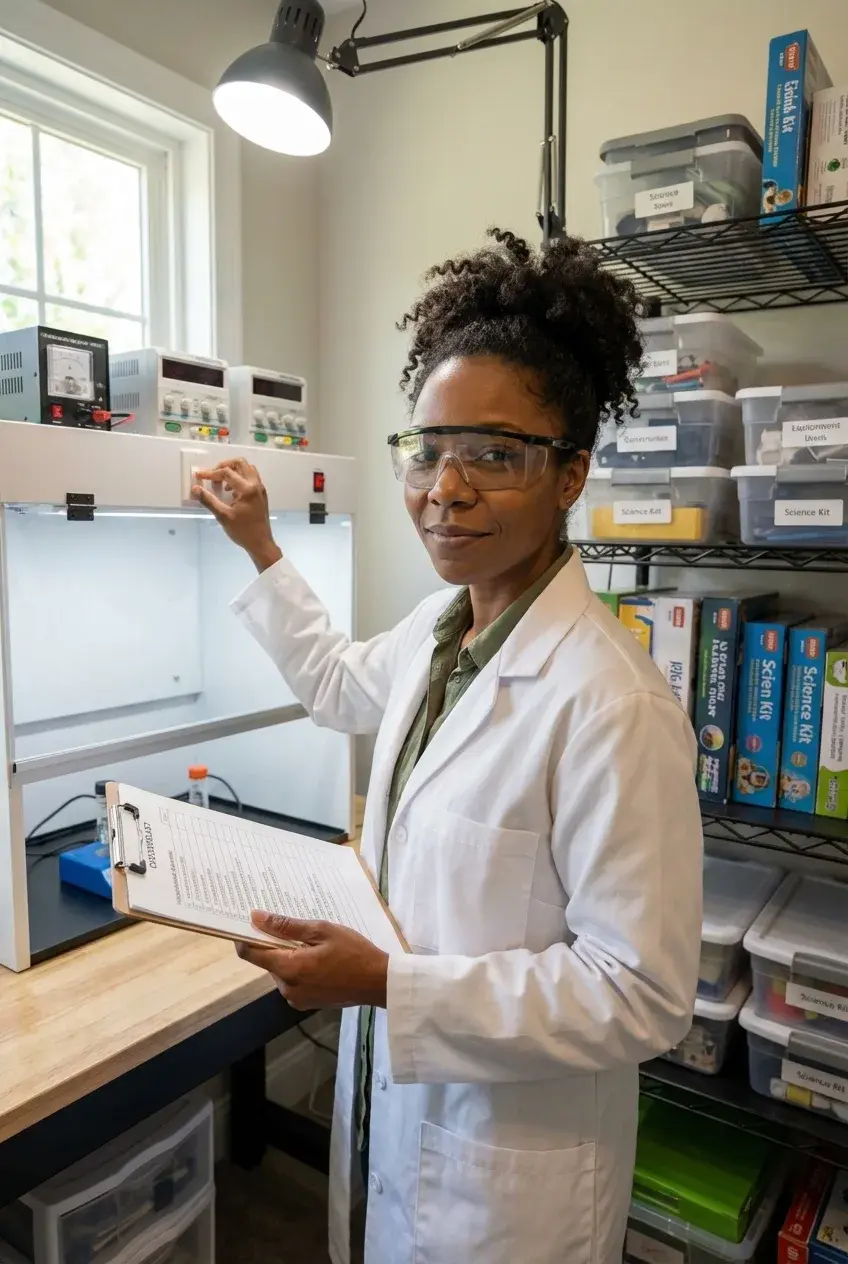

You've gathered the Arduino boards, the 3D printer, the soldering station, and the renewable energy kits—but before your daughter powers up that first circuit or your son loads filament into the extruder, you need to ensure the space itself won't become a hazard. Home STEM lab safety requirements aren't about bubble-wrapping curiosity; they're about creating an environment where experimentation can scale without fear. This checklist covers the foundational infrastructure—power, ventilation, storage, and emergency protocols—that transforms a corner of your home into a legitimate learning lab. If you're still deciding on your space, check out our guide on dedicated STEM room vs multi-purpose learning space first.
Power and Electrical Safety
Electrical capacity is the hidden constraint in most home STEM labs. You'll notice it the moment you try to run a Creality Ender 3 V3 SE 3D Printer (200-300W draw), a soldering station (50-80W), and an oscilloscope simultaneously on a single 15-amp circuit. That's not just inconvenient—it's a fire risk.
Dedicated 20-amp circuit for high-draw equipment: If you're running FDM 3D printers, laser cutters, or bench power supplies, a single 20-amp circuit (2400W capacity at 120V) gives you headroom for multiple devices. Standard 15-amp circuits max out at 1800W, and you should never exceed 80% continuous load (1440W). A 3D printer alone can consume 250W during heated bed warm-up. Learn more about 3D printer power requirements in our station setup guide.
GFCI protection for any workbench near water sources: Ground Fault Circuit Interrupter outlets trip within milliseconds if current leaks—critical for chemistry experiments, hydroponic setups, or any wet lab work. The National Electrical Code requires GFCI in bathrooms and kitchens, but your STEM space needs it too if you're working with conductive liquids.
Surge protection rated for data lines, not just power: Cheap power strips absorb maybe one surge before failing. Look for surge protectors with joule ratings above 2000J and data line protection (Ethernet, USB). When your teen is running experiments controlled by a Arduino Mega 2560 with hours of unsaved sensor data, a lightning strike shouldn't wipe the project.
Individual power switches for each workstation: You want the ability to kill power to the 3D printer zone without shutting down the Raspberry Pi running a 48-hour environmental data logger. Switched outlet strips or wall-mounted switches give you zone control and enforce shutdown protocols.
Labeled breaker panel with STEM lab circuits clearly marked: Imagine your child needs to emergency-stop equipment but you're not home. A clearly labeled breaker—"STEM Lab East Wall," "3D Printer Circuit"—turns a panicked moment into a manageable one.
No extension cords as permanent wiring solutions: Extension cords are temporary tools, not infrastructure. If you need power where an outlet isn't, install one. Daisy-chained extension cords under desks are how house fires start, especially when hidden beneath flammable materials like cardboard project boxes.
Voltage-compatible equipment for your region: Most Arduino kits and robotics platforms are globally compatible (5V DC via USB), but some imported lab equipment, older oscilloscopes, or specialty tools may expect 220-240V. A step-up transformer works, but it's another point of failure. Verify input voltage specs before purchase.
Accessible emergency shutoff: A large red switch—commercial "emergency stop" buttons are around $15—mounted within arm's reach of your primary workbench. It should cut power to high-risk equipment (soldering stations, 3D printers, heat guns) with a single palm-strike. Train every lab user on its location.
Ventilation and Air Quality
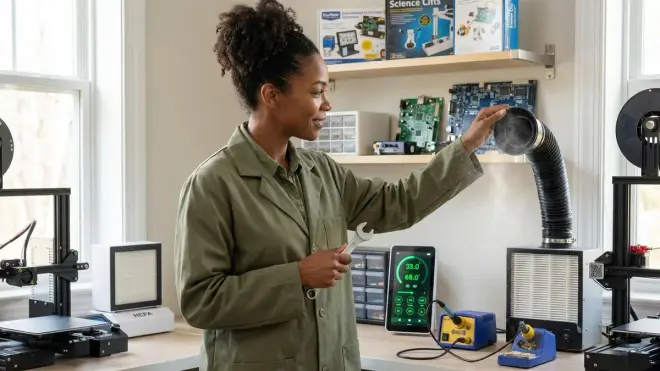
3D printing with PLA smells like maple syrup or corn—pleasant, even—but it's still releasing ultrafine particles and volatile organic compounds. Home STEM lab safety requirements extend beyond "open a window." You're managing cumulative exposure over months and years.
Active ventilation rated for the room volume: A bathroom exhaust fan won't cut it. Calculate room volume (length × width × height in feet, then divide by 60) to determine CFM (cubic feet per minute) needed for 4-6 air changes per hour. A 10×12 room with 8-foot ceilings is 960 cubic feet; you need 64-96 CFM minimum. Inline duct fans or dedicated air purifiers with HEPA filters do the work.
Fume extraction for soldering and electronics work: A simple benchtop fume extractor with activated carbon filters (around $40-$120) positioned 6-8 inches from the soldering tip captures flux smoke before it reaches your teen's lungs. Lead-free solder still releases irritants. If you're teaching electronics seriously, this isn't optional. See our robotics learning path for progression into PCB soldering.
Separate ventilation for filament printing: Enclosed 3D printers like the Flashforge Adventurer 5M Pro contain fumes better than open-frame models, but you still need exhaust. A flexible dryer vent hose ($10) ducted to a window works for occasional printing. For daily use, consider a HEPA air purifier with activated carbon rated for VOCs—place it within 3 feet of the printer. Our guide on enclosed vs open-frame 3D printers breaks down emission differences.
Air quality monitor with VOC and particulate sensors: Devices like the Awair Element or similar air quality monitors (around $150-$200) give real-time PM2.5, VOC, and CO₂ readings. You'll discover that PLA printing spikes PM2.5 for 20-30 minutes post-print, ABS is worse, and poor ventilation during soldering pushes VOCs into the yellow zone. Data makes invisible hazards visible.
No STEM work in bedrooms without extraordinary ventilation: Kids metabolize chemicals differently than adults. Even "safe" materials like PLA release nanoparticles that settle on bedding, carpets, and stuffed animals. If your only option is a bedroom setup, restrict activities to low-emission work (coding, robotics assembly, breadboard circuits) and relocate 3D printing, soldering, and chemistry to a garage or basement.
Carbon monoxide detector if using any combustion or gas-powered experiments: Rare in most home STEM labs, but if you're exploring internal combustion engines, gas-powered rockets, or fire-based chemistry, a CO detector is non-negotiable. Place it at breathing height, not on the ceiling.
Fresh air makeup for high-CFM exhaust systems: If you're pulling 200+ CFM out of a room (e.g., multiple fume extractors running simultaneously), you need makeup air—a passive vent or slightly opened window—so the room doesn't go negative pressure and start pulling exhaust back through cracks or other vents.
Storage and Material Handling
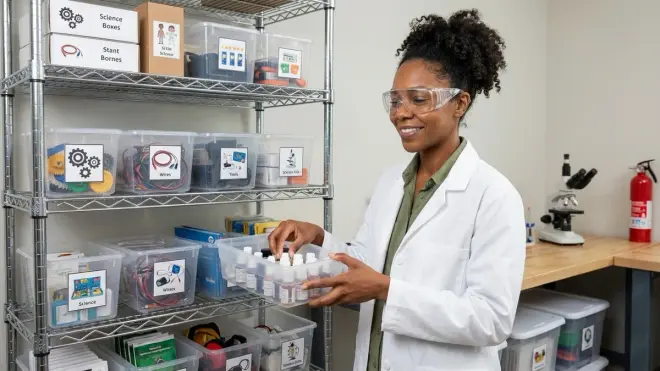
Poor storage compounds every other safety risk. A toppled shelf can dump a gallon of isopropyl alcohol onto a powered circuit board. Loose filament spools become trip hazards. Chemistry reagents stored at eye level with no labels? That's how accidents happen.
Flammable liquids in metal safety cabinets below waist height: Isopropyl alcohol for cleaning prints, acetone for ABS smoothing, contact cement for craft projects—all need ventilated metal cabinets, ideally OSHA-compliant (around $200-$400 for a 4-gallon capacity). Plastic bins melt in fires. Glass bottles shatter when dropped. Store below waist height so a fall doesn't rain flammable liquids onto your face.
Battery storage in fire-resistant containers with individual cell isolation: LiPo batteries for RC projects and drones are high-energy density, which is engineering-speak for "they burn hot and fast if punctured or overcharged." Store in LiPo-safe bags or ammo cans (around $15-$30), never fully charged (storage charge is 3.8V per cell), and away from conductive materials.
Shelving rated for actual load, anchored to wall studs: Wire shelving says "250 lbs per shelf"—that's evenly distributed, not a 3D printer cantilevered on one corner. Use plywood-backed industrial shelving and anchor L-brackets to studs with 3-inch lag bolts. I've seen a $400 3D printer face-plant because someone trusted drywall anchors.
Clear labeling system with hazard symbols and age restrictions: Use a label maker or printable stickers with GHS hazard symbols (available as free PDFs from OSHA) for anything corrosive, toxic, or flammable. Color-code by hazard type. Mark age restrictions: "Soldering—12+ with supervision," "Chemistry reagents—Adult use only." It's a teaching tool and a safety net.
3D printer filament stored in airtight containers with desiccant: PLA, PETG, and especially nylon absorb moisture from the air, leading to brittle prints and clogged nozzles. Vacuum-sealed bags or airtight bins with silica gel packets (reusable; dry them in the oven at 200°F) keep filament printable for years. Our filament types guide explains hygroscopic behavior in detail.
Small parts organizers with anti-tip bases for resistors, LEDs, fasteners: Imagine 500 assorted resistors dumped across your workbench because someone bumped a plastic drawer tower. Heavy-base organizers or wall-mounted bins prevent this. Sort by value and label clearly—it's a time-saver and a safety measure when you're mid-project and need the right component now.
Chemical inventory log with purchase dates and expiration tracking: Some reagents degrade (hydrogen peroxide loses potency, acids concentrate as water evaporates). A simple spreadsheet or notebook tracks what you have, when you bought it, and when to dispose of it. Also helps you realize you've been storing a bottle of unmarked clear liquid for three years—get rid of it.
Emergency Preparedness and Protocols
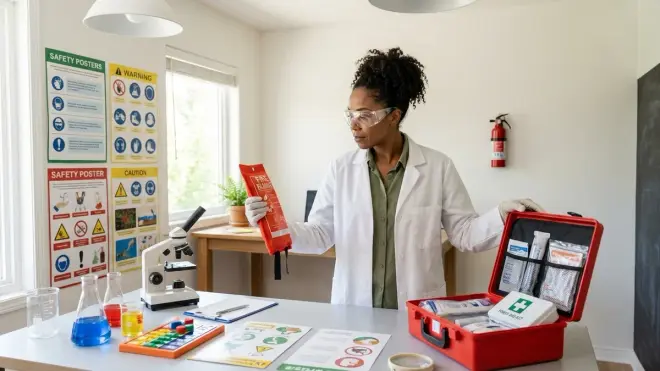
You're teaching your kids to manipulate electricity, heat, and chemistry. That's the point. But home STEM lab safety requirements include preparing for the moment something goes sideways—because eventually, it will.
ABC-rated fire extinguisher mounted within 10 feet of the primary workbench: Class A (wood/paper), B (flammable liquids), C (electrical)—you need all three. A 5-pound extinguisher (around $30-$50) handles most small lab fires. Mount it visibly, train everyone on PASS (Pull, Aim, Squeeze, Sweep), and check the pressure gauge annually.
First aid kit stocked for burns, cuts, and chemical exposure: Beyond the standard adhesive bandages, you need burn gel, sterile saline for eye irrigation, nitrile gloves, and tweezers for splinters or debris. If you're doing chemistry, add a bottle of pH-neutral eyewash solution. Store it in a clearly marked wall-mounted case, not buried in a drawer.
Eyewash station or portable solution for chemistry work: Bench-mounted eyewash stations ($100-$300) are overkill unless you're running a full chemistry curriculum, but portable eyewash bottles (around $10-$20 for 16 oz) are not. If your teen gets a splash of dilute acid in their eye, those first 15 seconds matter. Water works in a pinch; buffered saline is better.
Posted emergency contact numbers and lab-specific safety rules: Laminate a sheet with Poison Control (1-800-222-1222), your local emergency number, and any relevant product hotlines (e.g., the number on your 3D printer filament's SDS). Include lab rules: "No food or drink," "Goggles required for soldering," "Never operate equipment alone." Post it at eye level.
Clear floor egress paths with no trip hazards: In an emergency, you don't want to hurdle a power supply or trip over a filament spool on your way to the door. Maintain a 3-foot-wide clear path from every workstation to the exit. Use cable management raceways, not loose cords across walkways.
Safety goggles with side shields for every lab user: Cheap safety glasses fog, scratch, and get abandoned in a drawer. Spend around $15-$25 per pair for ANSI Z87.1-rated goggles with anti-fog coating and adjustable straps. Make them non-negotiable for 3D printer bed leveling (heated nozzles at eye level), soldering, and any work with spring-loaded components or rotating tools.
Emergency procedure walkthroughs every six months: Actually practice. Simulate a small fire: "The filament caught. What do you do?" (Unplug the printer, use the extinguisher, evacuate if it spreads.) Simulate a chemical spill: "You knocked over the isopropyl. What's first?" (Ventilate, avoid flames, clean with absorbent pads, dispose properly.) Rehearsal converts panic into process.
Organization and Workflow Safety
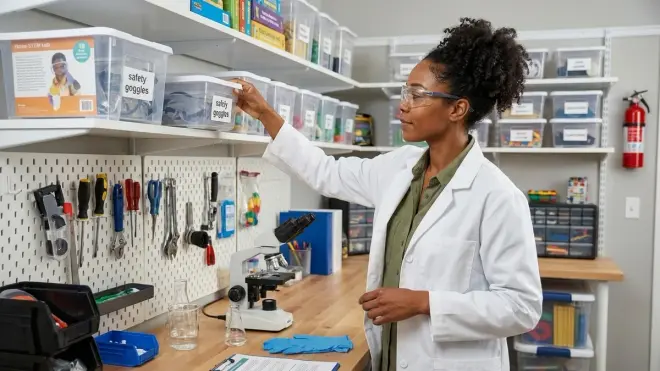
How you arrange the space determines how safe it is under real-world conditions—tired kids, simultaneous projects, the chaos of creative momentum. Home STEM lab safety requirements include designing for human behavior, not ideal behavior.
Separate hot and cold work zones with 4+ feet clearance: Soldering irons, 3D printers, heat guns—anything that gets hot—should be physically separated from PLA filament spools, paper project plans, and cardboard prototyping materials. A dropped soldering iron rolling across a desk shouldn't land on a pile of documentation.
Anti-fatigue mats in standing work areas: Standing for hours while assembling a robot or monitoring a long print leads to fatigue, which leads to mistakes. A simple foam mat (around $20-$40) reduces leg strain and keeps focus sharp. Safer, more comfortable work means better outcomes.
Tool shadowing or silhouette boards for frequently used equipment: Outline tools on pegboard with a marker or paint. It's immediately obvious when something's missing (was the wire stripper left near the 3D printer?), and it enforces a "return after use" habit. Reduces clutter and the chance of stepping on a rogue utility knife.
Project bins with lids for work-in-progress containment: Open projects sprawl. Use stackable bins with lids to isolate each project—Arduino circuit in one, solar panel assembly in another. Prevents cross-contamination (metal shavings in the 3D printer filament) and limits the scope of a spill.
Anti-static mats and wrist straps for sensitive electronics work: A static discharge won't hurt your kid, but it will kill a $40 Arduino Mega or a $200 Raspberry Pi. An anti-static mat (around $15-$30) and grounding strap (around $5-$10) are cheap insurance if you're working with bare PCBs or ICs. See our Arduino robotics kits guide for platforms worth protecting.
Moisture control in basements and garages: Humidity above 60% degrades filament, rusts metal components, and encourages mold on cardboard storage. A dehumidifier (around $150-$250 for 50-pint capacity) keeps the space safe for electronics and materials. Monitor with a hygrometer ($10-$15).
Final Check Before You Go
Run through this condensed checklist before each major project session. It takes two minutes and catches 90% of preventable hazards:
- All high-draw equipment on dedicated circuits or surge protectors
- Ventilation system operational (fan on, window open, air purifier running)
- Flammable materials stored in metal cabinets, away from heat sources
- Fire extinguisher accessible, pressure gauge in green zone
- Safety goggles and first aid kit within arm's reach
- Clear egress path to exit
- All users briefed on emergency shutoff locations
- No food or open drinks in the work area
- Battery charging supervised, not left overnight
Frequently Asked Questions
What are the minimum home STEM lab safety requirements for 3D printing with kids?
At minimum, you need active ventilation (HEPA air purifier or exhaust to outdoors), a stable surface that won't tip if bumped, a dedicated surge-protected power circuit, and mandatory safety goggles during printer operation—especially when leveling the bed or clearing jams near the hot end. Store filament in airtight containers with desiccant, keep the printer 3+ feet from flammable materials, and never leave heated equipment unattended with children under 10 in the room. For detailed setup, see our 3D printing station checklist.
Do I need special electrical work to meet home STEM lab safety requirements?
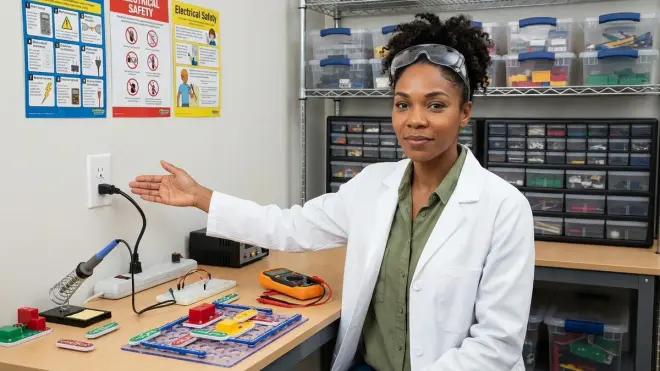
Most homes can support basic STEM work on existing 15-amp circuits if you limit simultaneous high-draw equipment. However, if you plan to run FDM 3D printers, laser cutters, or bench power supplies regularly, a dedicated 20-amp circuit prevents nuisance breaker trips and fire risk from sustained high loads. GFCI outlets are essential near any water-based experiments (chemistry, hydroponics, aquaponics). Consult a licensed electrician to assess your panel capacity and install additional circuits safely.
How much ventilation is required for safe soldering and electronics work at home?
For occasional soldering (under 2 hours per week), a benchtop fume extractor with activated carbon filters positioned 6-8 inches from the work surface captures most flux smoke. For daily or intensive soldering, add whole-room ventilation achieving 4-6 air changes per hour—calculate by dividing room volume in cubic feet by 60 to find the required CFM rating for your exhaust fan or air purifier. Lead-free solder still releases irritants; pregnant individuals and children under 8 should work in exceptionally well-ventilated spaces or outdoors.
Final Thoughts
Safety infrastructure isn't the flashy part of STEM learning—nobody writes glowing reviews about their GFCI outlet or fire extinguisher. But it's the difference between sustainable, scaling experimentation and a single incident that shuts down curiosity for good. When your teen confidently powers up a multi-board Arduino project because they know the circuit can handle it, when they instinctively reach for goggles before approaching the 3D printer, when they store LiPo batteries in the fire-safe container without being asked—that's when you know the space is doing more than housing equipment. It's teaching responsibility as a prerequisite to capability. Build the foundation right, and the projects your kids dream up won't be constrained by safety fears—they'll be amplified by confidence in the space itself.
For next steps, review our complete home STEM lab setup guide to integrate these safety protocols into your larger infrastructure plan, then explore how to organize progressive skill development once the space is secure.