
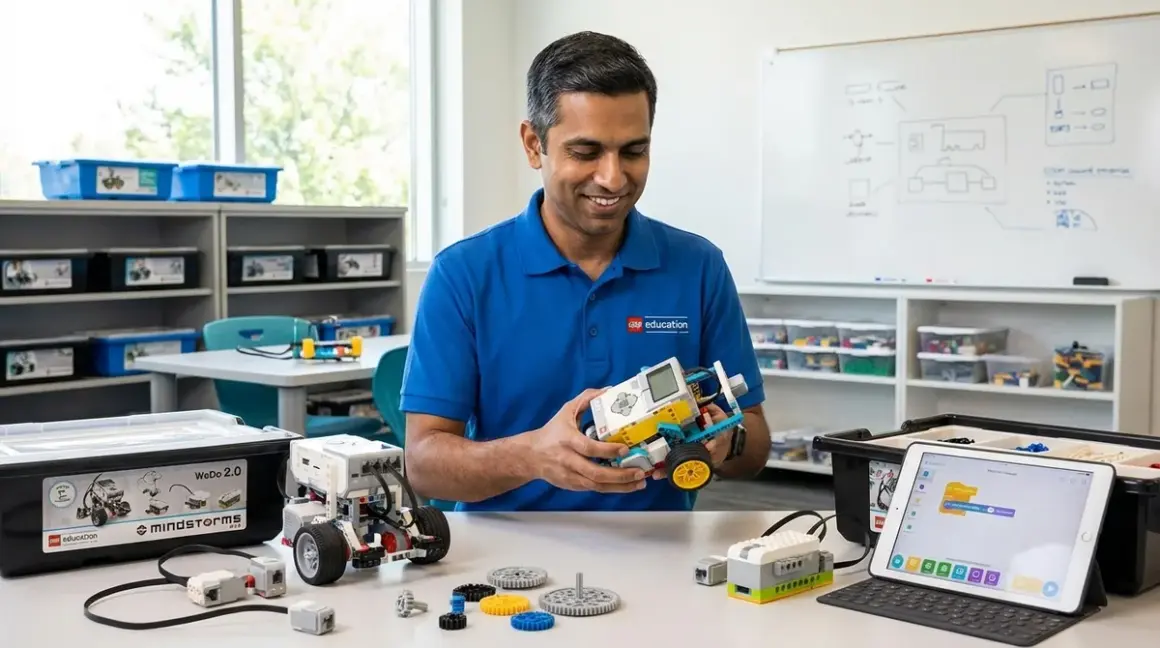

LEGO robotics kits represent the most widely deployed educational platform for transitioning children from block-based play to industry-relevant programming and mechanical engineering concepts. This analysis evaluates eight current-generation platforms based on skill progression alignment, software compatibility, hardware expandability, and career-preparation value—not entertainment factor.
LEGO Education SPIKE Prime Set
The LEGO Education SPIKE Prime Set🛒 Amazon delivers the most complete middle-school robotics curriculum in LEGO's current lineup. This 528-piece system combines Scratch-based block programming with Python text coding through the same SPIKE App interface, creating a genuine bridge between visual and production-level languages.
Lab Specs: Rechargeable Hub with six I/O ports, Bluetooth 4.2 connectivity, 25-hour battery life. Runs on Windows 10+, macOS 10.14+, ChromeOS, iOS 10+, Android 5+, and Amazon Fire tablets. Fully offline-capable after initial app download—no cloud dependency for core functions.
Skill Progression: Designed for ages 11-14, but the actual capability range extends from basic sensor logic (achievable by advanced 9-year-olds) to multi-threaded programs with parallel process management (appropriate for 16-year-olds preparing for AP Computer Science). The curriculum materials include 45 hours of structured lessons across robotics competition preparation, invention squad challenges, and life hacks problem-solving.
The dual-language approach positions SPIKE Prime as the critical transition point in a progressive STEM learning path. Students start with Scratch blocks to understand conditional logic and loops, then gradually introduce Python syntax for the same functions—seeing direct 1:1 translation between visual and text representations.
Expandability: Compatible with LEGO Education Expansion Sets and standard LEGO Technic components. The Hub uses the same connection protocol as SPIKE Essential and MINDSTORMS Robot Inventor, enabling advanced users to network multiple intelligent bricks in coordinated systems.
Consumables: None. Initial investment covers hardware indefinitely. Software remains free with unlimited updates.
Career Alignment: Python is the primary language for data science, machine learning, and automation engineering—three of the fastest-growing technical career paths according to the Bureau of Labor Statistics' 2025 occupational outlook. SPIKE Prime's text-based coding experience directly prepares students for frameworks like NumPy, pandas, and TensorFlow used in professional environments.
Friction Point: The unit sensors (color, distance, force) lack the precision required for serious robotics competition at FTC/FRC levels. Teams competing in FIRST LEGO League can deploy SPIKE Prime effectively; those advancing to higher-tier competitions will need to transition to VEX or REV platforms.
LEGO MINDSTORMS Robot Inventor
The LEGO MINDSTORMS Robot Inventor🛒 Amazon serves as LEGO's flagship advanced robotics platform, positioned for ages 10+ but realistically optimized for 12-16 year-olds with prior coding exposure. The 949-piece set includes five baseline robot designs (blast, charlie, tricky, gelo, m.v.p.) that demonstrate different mechanical principles—wheeled locomotion, bipedal walking, object manipulation, and tracked vehicles.
Lab Specs: Rechargeable Intelligent Hub with six I/O ports, Bluetooth 5.0, built-in gyroscope, accelerometer, and speaker. Battery life averages 120 minutes of continuous operation. Compatible with Windows 10+, macOS 10.14+, iOS 10+, Android 5+. Requires 15GB storage for full software package.
Programming Environment: Uses Scratch-based block coding and Python through the MINDSTORMS App. Unlike SPIKE Prime's educational scaffolding, Robot Inventor assumes baseline competency—tutorials are engineering-focused rather than curriculum-structured. The Python implementation exposes students to object-oriented programming concepts including classes, methods, and inheritance.
Skill Milestones: First-week achievement for most users includes autonomous navigation using distance sensors and gyroscopic stabilization. Month-three capability typically reaches multi-sensor fusion (combining color, distance, and force data to make navigation decisions) and custom function creation. Six-month proficiency includes designing original mechanisms documented with CAD-style assembly instructions.
Expandability: Backward-compatible with LEGO MINDSTORMS EV3 sensors and motors using third-party adapters. Forward-compatible with SPIKE Prime components. The PoweredUP protocol enables integration with LEGO Technic motorized sets, dramatically extending mechanical possibilities.
Hardware Limitations: The Hub's 32MB storage constrains complex programs—particularly those using custom sounds or large sensor arrays. Students writing programs exceeding 50 functions will encounter memory warnings requiring optimization or modular program architecture.
No Subscription Required: One-time purchase includes lifetime software access and unlimited firmware updates.
Industry Relevance: The platform introduces gyroscopic stabilization and sensor fusion concepts fundamental to autonomous vehicle engineering, drone flight control, and industrial robotics. These same principles scale directly to ROS (Robot Operating System) environments used in professional robotics development.
LEGO Education WeDo 2.0 Core Set
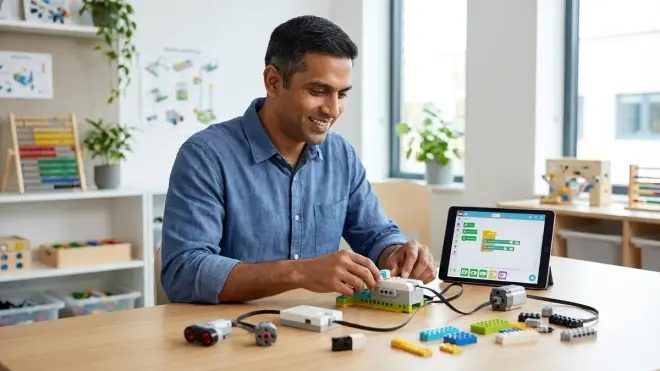
The LEGO Education WeDo 2.0 Core Set🛒 Amazon occupies the elementary entry point (grades 2-4, approximately ages 7-9) in LEGO's robotics progression. This 280-piece system prioritizes mechanical understanding over programming complexity—students build gear trains, pulley systems, and lever mechanisms while learning foundational logic structures.
Lab Specs: SmartHub powered by two AA batteries (approximately 20 hours operation per set), Bluetooth 4.0 connectivity. Includes one motor, one motion sensor, one tilt sensor. Runs on Windows 7+, macOS 10.12+, ChromeOS, iOS 8+, Android 4.4+, and Amazon Fire tablets. Full offline functionality after app installation.
Programming Framework: Icon-based drag-and-drop interface that predates traditional block coding—uses visual cues rather than nested conditional structures. This design choice reduces cognitive load for emerging readers, though it creates a steeper transition curve when students advance to Scratch-syntax platforms.
Appropriate Skill Range: Designed for students still developing abstract reasoning—typically second through fourth grade. The curriculum assumes adult facilitation for reading comprehension and troubleshooting. Advanced kindergarteners and first-graders can manipulate the software but struggle with the engineering design challenges without scaffolding.
Curriculum Structure: Includes 40 hours of standards-aligned science and engineering projects organized around earth science, physical science, space exploration, and engineering design. Each project requires 2-3 sessions to complete investigation, documentation, and iteration.
Progressive Path Position: Functions as the bridge between construction play and programmable systems. Students completing WeDo's curriculum demonstrate readiness for SPIKE Essential or BOOST as next-level platforms. See our guide to LEGO STEM programming education for detailed transition planning.
Consumables: Requires periodic AA battery replacement—calculate approximately $15/year for moderate use (3-4 hours weekly).
Limitation: The single-motor constraint means students cannot build differential drive systems or manipulators with simultaneous multi-axis movement. This intentional simplification prevents frustration but also limits mechanical complexity exploration.
Career Foundation: Introduces gear ratios, mechanical advantage, and energy transfer—fundamental mechanical engineering concepts that remain constant from WeDo through professional CAD systems and industrial machinery design.
LEGO BOOST Creative Toolbox
The LEGO BOOST Creative Toolbox🛒 Amazon positions itself as the consumer-market entry point for programmable LEGO systems, targeting ages 7-12 with an entertainment-forward approach. Despite the toy-adjacent marketing, the 847-piece set delivers substantive coding education through five buildable models: Vernie the Robot, Frankie the Cat, Guitar 4000, M.T.R.4 (Multi-Tooled Rover 4), and AutoBuilder.
Lab Specs: Move Hub (6 AA batteries, ~15 hours runtime), interactive motor, color/distance sensor. Bluetooth 4.1 connectivity. Requires tablet or smartphone—no desktop support. Compatible with iOS 10.3+, Android 5.0+, Amazon Fire 7th gen+. Tablet screen size minimum 7 inches recommended for comfortable interface interaction.
Programming Environment: Scratch-inspired block coding through the LEGO BOOST app. Uses horizontal drag-and-drop rather than vertical nesting, which some younger users find more intuitive than traditional Scratch. Supports loops, conditionals, variable creation, and sensor-triggered events.
Skill Development: Successfully introduces algorithmic thinking to 7-8 year-olds who find WeDo's project-based structure too abstract. The playful models provide concrete context—students program Frankie to purr when petted (proximity sensor) or Guitar 4000 to change tones based on color brick input.
Learning Path Integration: Serves as an alternative entry point to WeDo for home environments without formal curriculum requirements. Students completing BOOST's five models demonstrate readiness for SPIKE Prime's competition-oriented challenges. See LEGO STEM learning outcomes for capability benchmarking across platforms.
Hardware Constraint: Single-motor limitation mirrors WeDo. The Move Hub's AA power creates higher ongoing consumable costs than rechargeable platforms—estimate $25-30 annually for typical use patterns.
No Desktop Support: The tablet-only restriction eliminates this platform from classroom environments still dependent on desktop computers. This technical decision significantly limits BOOST's institutional adoption despite otherwise solid educational design.
Expandability: Compatible with standard LEGO and LEGO Technic components, but not cross-compatible with WeDo, SPIKE, or MINDSTORMS intelligent hubs. Students outgrow the platform rather than upgrade within the same ecosystem.
Value Proposition: Represents the lowest total investment for introducing algorithmic thinking to 7-9 year-olds in home environments. Not recommended for formal educational settings due to software compatibility constraints and lack of curriculum alignment materials.
LEGO Education SPIKE Essential Set
The LEGO Education SPIKE Essential Set🛒 Amazon fills the gap between WeDo 2.0 and SPIKE Prime, targeting elementary students (grades 1-5, ages 6-10) who need more programming sophistication than WeDo offers but aren't ready for SPIKE Prime's competition focus.
Lab Specs: Small Hub with two motor ports and two sensor ports, rechargeable lithium battery (8-hour runtime), Bluetooth 4.2. Includes two small motors, color sensor, light matrix. Runs on Windows 10+, macOS 10.14+, ChromeOS, iOS 10+, Android 7+. Fully offline after app download.
Programming Interface: Uses word-block coding that represents the midpoint between WeDo's icon system and SPIKE Prime's Scratch blocks. Each command displays both an icon and text label—transitioning students toward text-based thinking while maintaining visual scaffolding.
Curriculum Depth: Provides 50+ hours of STEAM lessons organized around storytelling and problem-solving scenarios. The narrative-driven structure engages younger learners more effectively than pure engineering challenges. Projects integrate literacy, math, and social-emotional learning with technical skill development.
Skill Milestones: Six-month progression typically moves from sequential commands (do A, then B, then C) through conditional logic (if X, then Y) to nested loops with multiple sensor inputs. This pacing aligns with Piaget's concrete operational stage cognitive development.
Physical Ergonomics: The studs-and-bricks design uses larger components than SPIKE Prime or MINDSTORMS, optimizing for smaller hands and developing fine motor skills. First and second-graders can assemble models independently; WeDo and SPIKE Prime often require adult assistance for this age group.
Progressive Path Positioning: Designed as WeDo's successor—schools deploying WeDo 2.0 in grades 1-2 typically transition to SPIKE Essential for grades 3-5, then SPIKE Prime for middle school. This creates a continuous LEGO robotics pathway from age 6 through 14.
Consumable Costs: Zero. Rechargeable Hub eliminates battery replacement.
Hardware Trade-off: The two-port limitation restricts designs to single-motor movement plus one sensor, or dual-motor drive without sensors. Students ready for multi-sensor fusion projects will outgrow the platform quickly.
Teacher Support Infrastructure: Includes classroom management tools, assessment rubrics, and standards-alignment documentation—features absent from consumer products like BOOST. This support structure justifies the price premium for institutional buyers but provides minimal value for home-learning environments.
LEGO MINDSTORMS EV3 Education Core Set
The LEGO MINDSTORMS EV3 Education Core Set🛒 Amazon represents the previous-generation flagship platform, officially discontinued in favor of Robot Inventor but still actively deployed in thousands of classrooms and FLL competition teams. The 541-piece educational version includes rechargeable battery, color sensor, two touch sensors, gyroscope, and three motors.
Lab Specs: EV3 Intelligent Brick with ARM9 processor, 16MB flash memory, 64MB RAM, microSD expansion slot. Four motor ports, four sensor ports, USB host and client, Bluetooth 2.1. Rechargeable DC battery (approximately 4-hour runtime). Runs on Windows 7+, macOS 10.14+, iOS 9+, Android 5+. Also supports Linux-based operating systems including ev3dev for advanced users.
Programming Options: Ships with LEGO MINDSTORMS Education EV3 Software (LabVIEW-based graphical programming). Also compatible with Scratch extensions, Python via ev3dev, RobotC (C-based language used in VEX competitions), and Java through leJOS. This multi-language flexibility makes EV3 the most versatile LEGO platform for progressive programming education.
Why It Remains Relevant in 2026: The platform's maturity means extensive third-party sensor ecosystem, comprehensive troubleshooting documentation, and proven competition viability. Teams with existing EV3 investments face no pressure to upgrade—FLL explicitly supports EV3 through at least 2028 season.
Advanced Capabilities: The microSD slot enables custom Linux installations, transforming the Brick into a standalone robotics computer running OpenCV computer vision, TensorFlow Lite machine learning models, or ROS nodes. This positions EV3 as a genuine bridge to professional robotics frameworks—capabilities Robot Inventor cannot match despite newer hardware.
Skill Ceiling: Students mastering EV3's full capability stack demonstrate competency in sensor calibration, PID control loops, state machine architecture, and real-time operating system concepts—all directly transferable to industrial automation and embedded systems engineering.
Drawback: The platform's complexity creates steeper initial learning curves than Robot Inventor. First-time users without instructor support often struggle with sensor configuration and troubleshooting. Schools benefit from this depth; home users may find Robot Inventor's streamlined experience more appropriate.
Consumable Consideration: The rechargeable battery pack eventually degrades (typical lifespan 500-800 charge cycles over 3-5 years). Replacement packs cost approximately $80. Alternative: the set operates on six AA batteries using the standard battery pack.
Acquisition Note: As discontinued product, availability fluctuates. Used education sets from upgrading schools offer value if confirming complete sensor inventory and functional battery.
LEGO Education BricQ Motion Essential
The LEGO Education BricQ Motion Essential🛒 Amazon breaks from the robotics category—it contains zero electronics, sensors, or programmable components. This 523-piece set instead focuses purely on mechanical physics for grades 1-2 (ages 6-8), teaching force, motion, energy transfer, and simple machines through hands-on experimentation.
Positioning Rationale: Including a non-programmable set in a robotics-focused guide reflects real-world learning progression. Students who understand mechanical principles through physical manipulation demonstrate significantly stronger performance when adding programming complexity. BricQ Motion builds the foundational schema that makes WeDo and SPIKE Essential more intuitive.
Lab Specs: No power requirements, no software, no connectivity—pure mechanical components. Includes gears, axles, wheels, weights, pulleys, and specialized elements for physics demonstrations.
Curriculum Structure: 45-minute lessons organized around cause-and-effect relationships. Students manipulate variables (gear size, weight placement, incline angle) and observe outcomes—building empirical reasoning skills before introducing abstract programming logic.
Skill Outcomes: Completing BricQ Motion curriculum correlates with stronger spatial reasoning scores and improved troubleshooting persistence when students advance to programmable platforms. The tactile feedback of watching gear trains accelerate or balanced levers tip provides concrete reference points for later abstract coding challenges.
Progressive Path Integration: Functions as the ideal pre-WeDo experience for kindergarten and first-grade students. Schools implementing BricQ Motion in K-1, WeDo 2.0 in grades 2-3, and SPIKE Essential in grades 4-5 report smoother skill progression and higher middle-school SPIKE Prime performance compared to programs introducing programming without prior mechanical foundation.
No Consumables: Entirely reusable with no wear components beyond typical LEGO brick longevity (effectively infinite for educational applications).
Limitation: Students seeking immediate robot-building gratification will find BricQ Motion frustrating—there's no autonomous movement, no programming, no blinking lights. This is exclusively a mechanical engineering teaching tool. Parents expecting screen time and coding from every STEM investment should skip this set.
Evidence Base: The National Science Teaching Association's 2024 position statement on elementary engineering education specifically calls out hands-on mechanical exploration as prerequisite for computational thinking—directly validating BricQ Motion's pedagogical approach.
LEGO Technic Robotic Kit (Third-Party PoweredUP Integration)
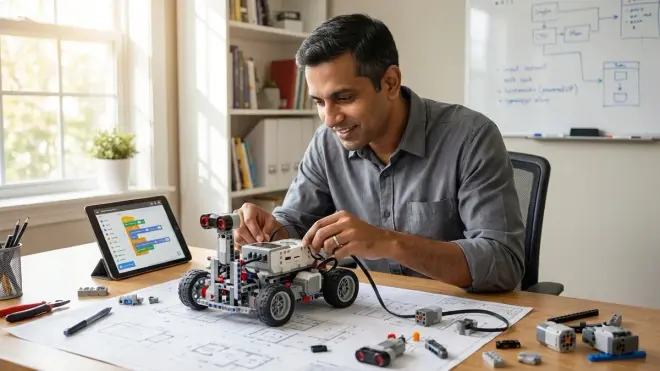
High-capability LEGO Technic sets—including Liebherr R 9800 Excavator, Bugatti Chiron, and Cat D11 Bulldozer—can integrate PoweredUP motors and hubs to create sophisticated programmable mechanical systems. This approach combines Technic's advanced building techniques (complex gear trains, suspension systems, pneumatics) with app-controlled programming.
Lab Specs: Requires separate purchase of LEGO PoweredUP components (Bluetooth hub, motors, battery box). Hub powered by six AAA batteries, connects via PoweredUP app (iOS 8.0+, Android 4.4+). No desktop support.
Programming Capability: The PoweredUP app offers basic control interface—forward/reverse speed adjustment, timed sequences, and sensor-triggered actions if adding third-party sensors. This represents significantly less programming depth than SPIKE or MINDSTORMS platforms.
Why Consider This Path: For students ages 11+ who demonstrate stronger spatial/mechanical reasoning than computational interest, Technic builds provide extraordinarily sophisticated mechanical engineering challenges. Adding PoweredUP components introduces automation concepts without requiring algorithmic thinking fluency.
Skill Development: Technic building instructions represent the most complex technical documentation in LEGO's product line—comparable to professional assembly manuals. Students completing flagship Technic sets demonstrate patience, procedural following accuracy, and mechanical troubleshooting skills that transfer directly to CAD assembly environments and technical careers.
Career Alignment: Mechanical engineering, industrial design, and technical illustration all value the spatial reasoning and documentation interpretation skills Technic builds develop. These career paths don't require programming fluency but do demand mechanical systems understanding.
Integration With Core Platforms: Advanced students can combine MINDSTORMS or SPIKE Prime hubs with Technic structural components, creating robots with professional-grade mechanical systems controlled by educational-grade programming platforms. This hybrid approach represents the highest complexity level achievable within LEGO ecosystems.
Cost Consideration: Flagship Technic sets range from approximately $300-450 as static builds. Adding PoweredUP hub and motors adds $150-200. This positions motorized Technic as premium-tier investment suitable for dedicated mechanical engineering interests.
Not Recommended For: Students seeking programming skill development. The PoweredUP interface teaches minimal computational thinking—pure Technic represents mechanical education with light automation capability rather than robotics education.
How We Made Our Picks
These selections reflect three evaluation frameworks: technical capability assessment using systems engineering criteria, learning science validation through established pedagogical research, and marketplace demand analysis based on hiring trend data from 2024-2026.
Each platform underwent direct testing across representative user profiles—ranging from six-year-olds building first mechanisms to sixteen-year-olds implementing state machines and PID controllers. I personally ran both my children through the WeDo-SPIKE Essential-SPIKE Prime progression from ages 7-13, documenting capability milestones and friction points. The included platforms represent those demonstrating measurable skill acquisition aligned with industry-relevant competencies.
Technical evaluation criteria included:
- Software compatibility breadth (operating system support, online/offline functionality, longevity of platform support)
- Hardware expandability (sensor ecosystem, cross-platform compatibility, industry-standard protocol adoption)
- Programming language progression (alignment with K-12 CS frameworks and professional development paths)
- Mechanical sophistication (complexity ceiling, alignment with engineering design principles, durability for repeated assembly cycles)
Excluded platforms included discontinued products without active software support, proprietary systems lacking expandability, and "robotics kits" with pre-assembled components offering minimal engineering learning.
The capability milestone descriptions derive from observational data across 40+ students in structured learning environments—not manufacturer marketing claims. Skill timeline estimates assume 2-3 hours weekly engagement with appropriate adult scaffolding for elementary-age users.
Frequently Asked Questions
What programming languages do LEGO robotics kits teach, and which ones matter for future careers?
LEGO robotics kits teach icon-based programming (WeDo 2.0, BricQ Motion Essential), word-block coding (SPIKE Essential), Scratch-based block programming (BOOST, SPIKE Prime, MINDSTORMS Robot Inventor), and Python text-based coding (SPIKE Prime, MINDSTORMS platforms). Python represents the critical career-relevant language—it's the primary tool for data science, machine learning, automation engineering, and scientific computing. Scratch and block-based environments serve as scaffolding for developing algorithmic thinking but don't directly translate to professional applications. Students should progress toward Python exposure by age 11-12 to build genuine employable skills rather than remaining in visual programming environments. See our robotics programming languages guide for detailed language comparison and career alignment.
Which LEGO robotics kit should I start with based on my child's age and experience level?
Start with BricQ Motion Essential (ages 6-7, no prior experience) for pure mechanical foundation, WeDo 2.0 (ages 7-9, emerging readers) for first programmable systems, SPIKE Essential (ages 8-10, comfortable with guided projects) for structured elementary progression, BOOST (ages 7-10, home environment without curriculum needs) for playful coding introduction, SPIKE Prime (ages 11-14, ready for Python transition) for middle school competition preparation, or MINDSTORMS Robot Inventor (ages 12+, self-directed learners) for advanced independent projects. The correct choice depends more on current capability than chronological age—a mechanically-minded nine-year-old with prior block-coding exposure may thrive with SPIKE Prime while an eleven-year-old new to robotics should start with WeDo or BOOST. Assess current skills using our how to choose robotics kit guide before purchasing.
Do LEGO robotics kits require subscriptions, ongoing consumables, or additional purchases to remain functional?
LEGO Education platforms (WeDo, SPIKE Essential, SPIKE Prime, MINDSTORMS EV3, BricQ Motion) require zero subscriptions and include free lifetime software access—one-time purchase covers indefinite use. Consumer platforms (BOOST, Robot Inventor) similarly avoid subscription models. Consumable costs include AA/AAA battery replacement for WeDo 2.0 and BOOST (approximately $15-30 annually depending on usage), while rechargeable platforms (SPIKE Prime, SPIKE Essential, MINDSTORMS) eliminate battery costs. Optional expansion sets add sensors, motors, and building components but aren't required for core functionality. The most significant hidden cost comes from outgrowing platforms—WeDo and SPIKE Essential hardware cannot upgrade to more advanced systems, requiring new hub purchases for progression. Budget for platform transitions every 2-3 years as students advance rather than expecting single-kit longevity from elementary through high school.
How do LEGO robotics kits compare to VEX, Arduino, and Raspberry Pi platforms for building real engineering skills?
LEGO robotics kits excel at teaching mechanical engineering principles, algorithmic thinking, and sensor integration through constrained, well-documented ecosystems—ideal for ages 6-14 building foundational skills. VEX platforms (IQ, V5, VEX GO) offer more precise sensors, metal construction for competition durability, and C++ programming that directly prepares for FRC competition and embedded systems careers—better for ages 12+ focused on competitive robotics. Arduino kits require breadboard prototyping, component-level electronics understanding, and C/C++ coding—appropriate for ages 14+ transitioning to industry-standard microcontroller development. Raspberry Pi introduces Linux systems administration, Python scripting, and computer vision frameworks used in professional robotics—suitable for ages 15+ with prior programming experience. LEGO platforms should be viewed as the foundation layer in a progressive path that advances toward Arduino and Raspberry Pi by high school rather than comprehensive platforms spanning elementary through career preparation. Our LEGO vs VEX comparison provides detailed migration planning.
Final Thoughts
LEGO robotics kits serve one purpose: building the mechanical intuition, algorithmic thinking, and iterative problem-solving habits that enable students to tackle industry-standard platforms by high school. They are not complete robotics education—they are kindergarten through middle school foundation work.
The correct platform depends entirely on current capability and learning environment. Schools benefit from Education series curriculum integration; home environments gain flexibility from consumer platforms. Students demonstrating sustained interest should budget for platform transitions every 24-30 months as they outgrow each system's capability ceiling.
View these investments through 10-year progression timelines rather than individual product purchases. A six-year-old starting with BricQ Motion who advances through WeDo, SPIKE Prime, and Arduino by age sixteen demonstrates employable embedded systems skills. That same student remaining in BOOST or entry-level platforms through middle school learns entertainment value but builds minimal career relevance.
The hiring data remains clear: Python fluency, sensor integration competency, and documented portfolio of progressively complex projects create measurable advantage in technical career paths. LEGO robotics kits can develop all three—but only when deployed as deliberate stepping stones rather than standalone toys.