
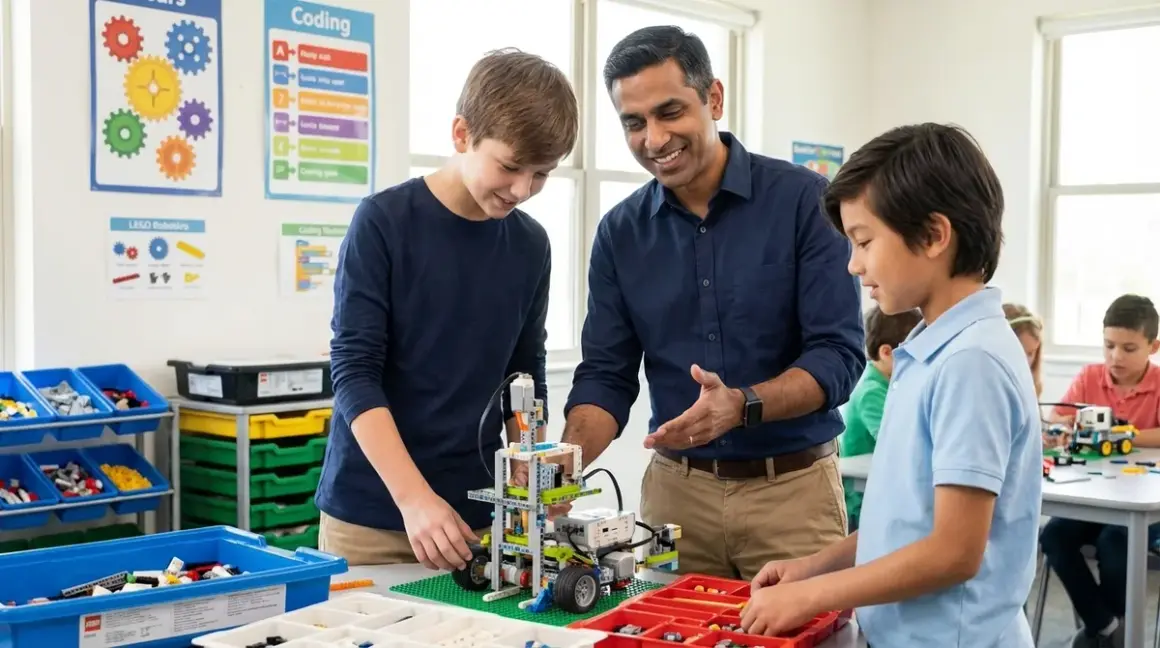

Parents invest thousands in LEGO STEM platforms without understanding measurable lego stem learning outcomes. This analysis maps concrete skill milestones to hiring requirements, breaking down what learners actually acquire versus what marketing claims suggest. Evidence-based assessment of capability progression through LEGO's robotics ecosystem.
What Are LEGO STEM Learning Outcomes?
Lego stem learning outcomes represent quantifiable competencies learners develop through structured engagement with LEGO Education platforms—specifically WeDo 2.0, SPIKE Prime, and MINDSTORMS systems. These outcomes span mechanical engineering fundamentals, computational thinking patterns, and systems integration capabilities.
The distinction matters: generic "coding exposure" differs fundamentally from demonstrated ability to implement PID control loops or debug sensor fusion conflicts. LEGO's tiered platform architecture enables progression from icon-based sequencing (ages 6-8) through Scratch-style block coding (ages 8-12) to Python text programming (ages 12+). Each transition introduces industry-relevant abstractions—variables, functions, conditional logic, event handling.
From a hiring perspective, lego stem learning outcomes align with entry-level requirements in automation, robotics integration, and industrial IoT roles. The tactile feedback loop—physical mechanism responds to code changes—accelerates debugging intuition faster than pure software environments. Students encounter real constraints: torque limitations, sensor noise, latency in motor response. These friction points mirror production engineering challenges.
Critical context: LEGO platforms teach system behavior prediction and iterative refinement—competencies that transfer directly to CAD simulation workflows, API integration testing, and hardware-software troubleshooting. The brick-based construction method forces explicit understanding of load paths, gear ratios, and structural reinforcement—concepts engineers apply daily in mechanical design roles.
How LEGO STEM Platforms Deliver Measurable Skills
LEGO's learning architecture operates through three interconnected mechanisms: tactile assembly constraints, visual programming feedback loops, and incremental complexity scaffolding. Understanding this structure clarifies why certain outcomes emerge reliably while others require supplemental curriculum.
Mechanical Engineering Foundations
The LEGO Education SPIKE Prime Set introduces structural engineering through trial-and-error iteration. Students discover that cantilevered arms require diagonal bracing, that 1:3 gear ratios trade speed for torque, and that center-of-gravity placement determines mobility. These aren't abstract lessons—a poorly designed chassis tips during turns, forcing immediate redesign.
Key capability milestones in mechanical competency:
Ages 7-9 (WeDo 2.0 phase): Understanding simple machines (lever classes, pulley advantage, wheel-and-axle mechanics). Students can identify which gear configuration produces faster/slower output and select appropriate structural elements for load-bearing versus lightweight applications.
Ages 10-13 (SPIKE Prime phase): Multi-stage gear trains, linkage mechanisms (four-bar, slider-crank), and differential drive systems. Learners calculate mechanical advantage ratios, predict kinematic motion paths, and troubleshoot binding/friction issues in complex assemblies.
Ages 14+ (MINDSTORMS EV3/Robot Inventor phase): Integrated mechanical-electrical systems with sensor placement optimization, cable management for reliability, and modular subsystem design. Students document design decisions, perform load analysis, and iterate based on performance metrics.
This progression mirrors actual engineering practice: concept sketching → functional prototype → performance optimization → documentation. The constraint that all components must physically connect enforces spatial reasoning that CAD software later formalizes.
Computational Thinking Patterns
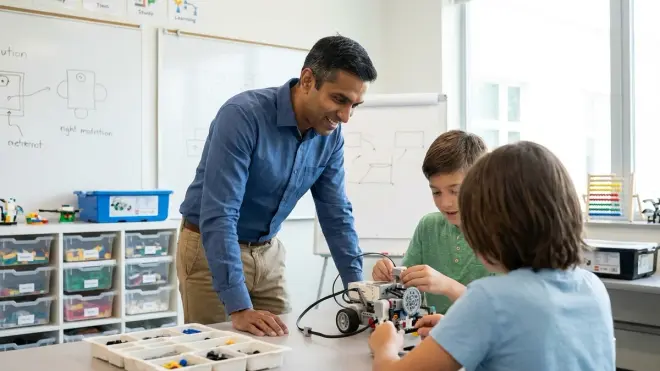
Programming progression follows established pedagogy but benefits from immediate physical feedback. When a student writes code that should make a robot travel 50cm but it only moves 30cm, the failure mode is visceral—not an abstract unit test failure.
Icon-based programming (ages 6-8): Sequencing, pattern recognition, and cause-effect relationships. Students learn that instruction order matters, that loops repeat actions, and that specific inputs trigger specific outputs. This phase builds executive function skills as much as programming concepts.
Block-based programming (ages 9-12): Variables, conditional logic, sensor-based decision making, and concurrent processes. The LEGO Education SPIKE software (Scratch-based) introduces event-driven programming, where multiple code blocks run simultaneously responding to sensor inputs. Students debug timing conflicts, manage state changes, and implement feedback control.
Text-based programming (ages 12+): Python implementation via LEGO MINDSTORMS Robot Inventor or third-party firmware like EV3Dev. Learners write functions, import libraries, handle exceptions, and work with hardware APIs. This transition exposes students to actual development environments—syntax errors, documentation lookup, version control concepts.
The critical learning outcome: students develop debugging methodology that transfers across languages. They learn to isolate variables (test one sensor at a time), validate assumptions (print sensor values before acting on them), and systematically eliminate failure modes. These patterns apply identically to web development, data science, and embedded systems work.
Systems Integration Competencies
LEGO platforms force students to navigate the hardware-software interface—a skill gap I encounter repeatedly when interviewing junior engineers. Academic computer science programs often produce graduates who've never debugged why a sensor returns inconsistent values or why motor performance degrades under battery voltage drop.
LEGO's integrated environment teaches:
- Sensor fusion: Combining ultrasonic distance, color detection, and gyroscope data to make navigation decisions
- Actuator control: Managing multiple motors with coordinated timing and appropriate power levels
- Power management: Understanding how battery state affects performance and building in voltage-dependent behavior adjustments
- Wireless communication: Implementing Bluetooth command protocols between hub and controller devices
Students working through competition challenges (FIRST LEGO League structure) encounter authentic constraints: 2.5-minute autonomous periods, 25cm starting zone restrictions, scoring objectives requiring precision positioning. These parameters mirror industrial automation specifications—takt time requirements, footprint limitations, repeatability tolerances.
The outcome: learners develop systems-level thinking. They understand that optimizing one subsystem (faster motor speed) may degrade another (reduced positional accuracy). They learn to make engineering trade-offs with measurable criteria rather than subjective preferences.
Why These Learning Outcomes Matter for Career Preparation
Lego stem learning outcomes map directly to skills gaps in current hiring pipelines. Based on 2026 data from engineering recruitment channels, entry-level candidates consistently lack three competencies that LEGO platforms specifically develop:
Spatial Reasoning and Mechanical Intuition
Manufacturing, robotics integration, and mechanical design roles require immediate recognition of how forces transfer through structures. Candidates who've only worked in pure software environments struggle with physical debugging—why a robotic arm oscillates, why a mechanism jams at certain angles, how to reinforce a structure without adding excessive weight.
LEGO's construction system builds this intuition through hundreds of assembly iterations. Students internalize that diagonal bracing resists racking forces, that gear backlash accumulates through multi-stage transmissions, and that asymmetric mass distribution causes unpredictable motion. These aren't textbook concepts—they're experiential knowledge gained through immediate physical feedback.
The career relevance: automation engineers troubleshoot industrial robots, quality engineers analyze fixture failures, and integration specialists specify mounting hardware. All require spatial reasoning developed through hands-on mechanical iteration.
Hardware-Software Integration Troubleshooting
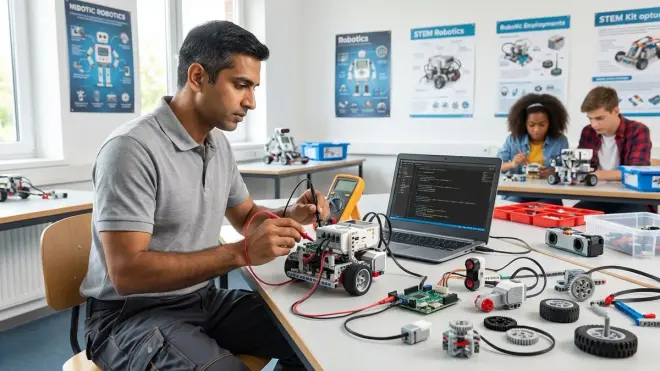
The aerospace, automotive, and industrial automation sectors desperately need engineers comfortable working across the hardware-software boundary. LEGO platforms uniquely position students at this interface—their code directly controls physical systems with observable failure modes.
When I assess candidates, I present integration scenarios: "The sensor returns clean values on the bench but noisy data when motors run—diagnose the issue." Candidates with pure software backgrounds default to code-based explanations. Those with LEGO robotics experience immediately recognize electrical noise from motor PWM signals—a hardware phenomenon requiring physical solutions (shielding, filtering, sensor relocation).
This diagnostic instinct develops through LEGO platform engagement because students can't retreat into pure software debugging. If the robot doesn't perform correctly, the problem might be mechanical (gear slippage), electrical (loose connection), or software (timing error)—and students must systematically isolate the failure mode. That methodology applies identically to production systems.
Iterative Development Under Constraints
Real engineering occurs under constraints: budget limits, timeline pressure, component availability, physical space restrictions. Academic projects often lack these parameters, producing graduates who optimize for elegance rather than deliverability.
LEGO competition environments (FLL, World Robot Olympiad formats) impose authentic constraints. Students must complete multiple autonomous missions within a fixed time window, using a robot that fits dimensional limits, built from a constrained parts inventory. They learn to prioritize high-value objectives, build in failure recovery, and optimize for reliability over complexity.
I've observed this learning outcome directly: my own children progressed from attempting elaborate mechanisms that rarely worked to implementing simpler, robust solutions that scored consistently. That shift—from impressive failure to unglamorous success—represents actual engineering maturity. It's the same transition junior engineers make when moving from academic projects to production systems.
For detailed guidance on building this progression systematically, see how to design a progressive STEM learning path that incorporates LEGO platforms alongside complementary tools.
Types of LEGO STEM Learning Outcomes: A Taxonomy
Not all lego stem learning outcomes carry equal career relevance. This framework categorizes competencies by transferability to professional engineering contexts:
Tier 1: Directly Transferable Technical Skills
Programming fundamentals: Variables, loops, conditionals, functions, event handling—syntax may change across languages, but these constructs remain constant. Students who master these concepts through LEGO's Scratch-based environment transition to Python, JavaScript, or C++ with reduced cognitive load.
Control system logic: PID tuning, sensor-based state machines, and feedback loop implementation. These patterns apply identically whether controlling a LEGO motor or an industrial servo. The mathematical relationships (proportional response, integral accumulation, derivative prediction) transfer completely.
Debugging methodology: Systematic isolation of failure modes, hypothesis testing through controlled experiments, and iterative refinement. This process applies universally—whether troubleshooting LEGO sensor conflicts or diagnosing API integration failures in enterprise systems.
Tier 2: Conceptually Transferable Engineering Principles
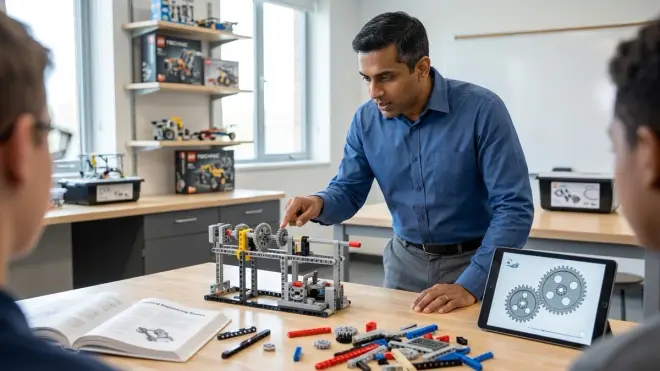
Mechanical advantage calculations: Understanding gear ratios, lever classes, and pulley systems. While professional engineers use more sophisticated tools (CAD simulation, FEA), the underlying physics remains identical. LEGO provides the intuition that formal education later quantifies.
Structural analysis fundamentals: Recognizing tension versus compression members, understanding load paths, and identifying stress concentration points. These concepts transfer to any mechanical design context but require translation to professional CAD/simulation workflows.
Systems architecture planning: Breaking complex challenges into manageable subsystems, defining interfaces between components, and managing interdependencies. This competency applies across engineering disciplines but requires adapting to domain-specific tools and methodologies.
Tier 3: Foundational Soft Skills
Iterative problem-solving: Comfort with failure as information rather than defeat. Students learn that initial attempts usually fail, that debugging is where learning occurs, and that persistence through multiple iterations produces results. This mindset shift determines long-term engineering career success more than raw technical aptitude.
Documentation habits: Recording design decisions, noting what worked versus what failed, and building personal knowledge bases. LEGO competition teams that maintain engineering notebooks develop habits that translate directly to professional documentation requirements (design reviews, technical specifications, troubleshooting guides).
Collaborative troubleshooting: Articulating problems clearly, accepting input from others, and building on collective knowledge. These social competencies often receive insufficient attention in technical education but determine actual workplace effectiveness.
For specific age-appropriate skill expectations, reference what skills 10 year olds learn from STEM toys to calibrate capability milestones against developmental readiness.
Lab Specs: Infrastructure Requirements for LEGO STEM Learning
Quantifiable lego stem learning outcomes require appropriate infrastructure. These specifications ensure platform capabilities match learning objectives:
Software and Compatibility Requirements
LEGO Education SPIKE Prime: Windows 10+, macOS 10.14+, Chrome OS, iOS 10+, Android 5.0+. Browser-based environment (Chrome/Edge) eliminates installation friction. Python programming requires app download (200MB). Offline functionality available after initial setup—critical for locations with unreliable connectivity.
LEGO MINDSTORMS Robot Inventor: Same OS requirements, Python-first programming model. Supports MicroPython implementation with direct hardware access. Third-party firmware (EV3Dev) enables full Python standard library access and SSH remote control—essential for advanced students transitioning to professional development tools.
WeDo 2.0: More restrictive—requires LEGO Education WeDo 2.0 software (Windows/Mac/iPad/Android tablets/Chrome). Icon-based interface doesn't support Python extension. Students typically outgrow this platform within 12-18 months, making it a bridge investment rather than long-term solution.
Power and Connectivity Specifications
All current LEGO Education platforms use rechargeable lithium batteries (LiPo or Li-ion depending on model). Runtime ranges 120-180 minutes under typical use—adequate for 60-90 minute learning sessions with reserve capacity. USB-C charging (SPIKE Prime, Robot Inventor) requires 5V/2A minimum. Full charge cycle: 3 hours.
Bluetooth connectivity (4.1 or higher) provides 10m range in clear environments. Interference from multiple concurrent devices (classroom scenarios with 15+ active hubs) causes pairing instability. Mitigation: stagger device startup, maintain roster of assigned hub identifiers, implement connection verification protocols in lesson plans.
No cloud dependency for core programming functions—an often-overlooked advantage. Students work entirely locally, eliminating Wi-Fi prerequisite and privacy concerns. Optional cloud features (lesson content, curriculum guides) require LEGO Education accounts but don't impact hands-on programming capability.
Expandability and Consumables
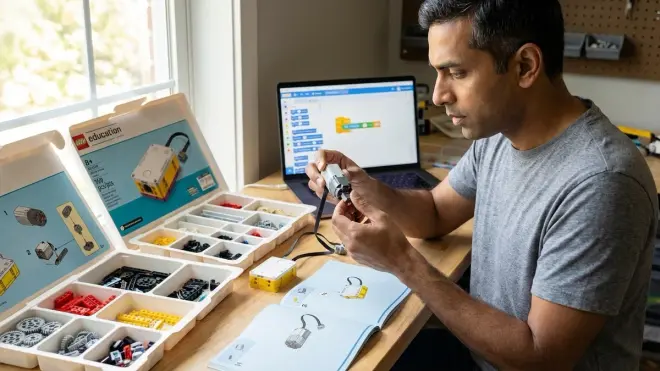
Expansion sensors and motors: Available individually through LEGO Education channels. Medium angular motor ($20), large angular motor ($25), color sensor ($25), ultrasonic sensor ($25), force sensor (~$20). This modular approach enables gradual investment but creates long-term cost accumulation. Budget for 2-3 additional sensors minimum over 18-month learning cycle.
Structural components: LEGO Technic pieces universally compatible across platforms. Third-party bulk beam/pin sets extend building options economically (200-piece Technic-compatible sets around $15-25 versus LEGO Education expansion packs around $40-60). Verify gear compatibility—some third-party gears use slightly different tooth profiles causing mesh issues under load.
No consumables: Critical advantage over chemistry kits or electronics breadboard systems. LEGO elements withstand hundreds of assembly cycles without degradation. Primary failure mode: lost pieces (inevitable with younger users). Budget replacement allocation: around 5-10% of original set cost annually for piece replacement.
Software updates: Delivered automatically (when online) or manually downloadable. LEGO maintains backward compatibility well—programs written for earlier firmware versions typically run on updated systems. Exception: major platform transitions (EV3 to Robot Inventor) broke compatibility, requiring code migration. This occurs on 5-7 year cycles.
For comprehensive infrastructure planning, consult the LEGO STEM lab setup checklist covering workspace layout, storage systems, and multi-user equipment management.
Durability and Longevity Analysis
Electronic hubs withstand typical educational use (drops from desk height, repeated port connections, exposure to classroom environments). Primary failure modes in order of frequency:
- USB port mechanical failure (150-200 charge cycles): The most common hardware failure. Implement cable strain relief and horizontal charging orientation to extend lifespan.
- Button mechanism degradation (500-800 press cycles): Power/Bluetooth buttons become less tactile. Still functional but requires deliberate pressure.
- Motor encoder drift (300-400 hours operation): Position tracking becomes less accurate. Recalibration procedures exist but require manual reset procedures.
- Battery capacity fade (300-400 full charge cycles): Expected lithium battery behavior. Plan for battery replacement at 24-month intervals under regular use (2-3 sessions weekly).
Structural LEGO elements exhibit exceptional durability—bricks manufactured in 1960s still clutch properly with 2026 production. This longevity supports sibling hand-me-down scenarios and resale value retention (complete used SPIKE Prime sets maintain 60-70% of original value).
Platform Progression: Capability Milestones Across LEGO Ecosystems
Different LEGO platforms deliver distinct lego stem learning outcomes. This progression framework maps age ranges to capability development and identifies transition indicators:
Entry Level: WeDo 2.0 (Ages 6-8)
Concrete learning outcomes:
- Assemble 15-25 piece mechanisms following visual instructions
- Create 4-8 step icon-based programs implementing sequencing and simple loops
- Identify cause-effect relationships between sensor inputs and motor outputs
- Troubleshoot basic mechanical failures (disconnected elements, misaligned gears)
Transition indicators to next platform:
- Student completes programs independently without step-by-step guidance
- Requests functionality beyond icon interface capabilities ("Can I make it go until it sees blue?")
- Builds modifications beyond instruction manual specifications
- Demonstrates frustration with simplified interface constraints
Career skill foundation: Basic algorithmic thinking (step sequence matters), mechanical cause-effect understanding, comfort with iterative testing.
Platform limitations: No variables, limited sensor options (motion, tilt, distance), no conditional logic beyond simple "when" triggers. Students ready for conditional statements (if-then logic) outgrow this platform rapidly.
For context on where this fits developmentally, see STEM skill milestones for 10 year olds comparing capabilities across platform types.
Intermediate: SPIKE Prime (Ages 8-14)
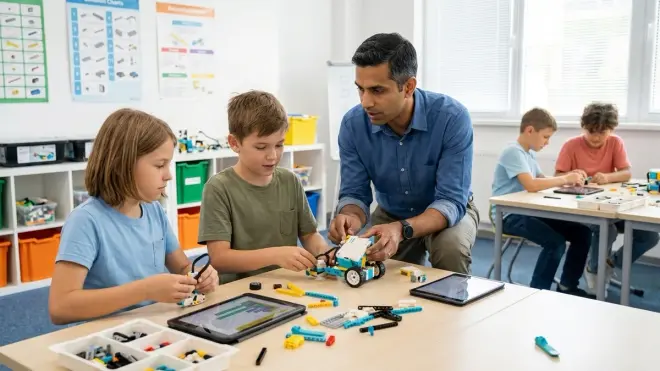
Concrete learning outcomes:
- Design and build 50-150 piece mechanisms incorporating multiple motion types (rotation, linear, grasping)
- Write 20-50 block programs using variables, operators, conditional logic, and nested loops
- Implement sensor-based decision trees (if-then-else structures with 3-5 branches)
- Debug timing conflicts in programs with concurrent execution blocks
- Calculate and implement gear ratio modifications to meet specific performance requirements
- Document design intent and testing results in structured formats
Key capability milestone: State machine implementation. Students create programs where robot behavior changes based on current conditions—autonomous navigation that switches between obstacle avoidance and line following based on sensor inputs. This represents significant cognitive advancement beyond linear programming.
Python transition point: SPIKE Prime supports text-based Python programming via downloadable app. Students typically ready for this transition after 12-18 months block programming experience, indicated by:
- Comfortable with variables, functions, and conditional logic in block format
- Frustrated by visual programming interface limitations (scrolling through long block sequences)
- Curious about "real" programming after exposure to text-based coding contexts
Career skill foundation: Computational thinking fluency, systematic debugging methodology, hardware-software integration basics, documented iterative development.
Platform limitations: Processing power constraints limit complex algorithms (computer vision, advanced pathfinding), single-hub architecture restricts multi-robot coordination projects, sensor selection narrower than professional robotics platforms.
This platform delivers maximum lego stem learning outcomes per dollar invested—it spans the widest capability range and supports 3-4 year learning progression before students require more advanced systems. For detailed programming curriculum strategies, reference how to teach Python and block coding using LEGO robotics.
Advanced: MINDSTORMS Robot Inventor/EV3 (Ages 12+)
Concrete learning outcomes:
- Architect multi-subsystem robots with 200-400+ piece counts incorporating mechanical, electrical, and software integration
- Write 100-300 line Python programs using functions, classes, libraries, and exception handling
- Implement control algorithms (PID loops, state machines, sensor fusion) with quantified performance metrics
- Design, test, and refine solutions to complex multi-objective challenges within defined constraints
- Collaborate using version control concepts (even if informal) and technical documentation standards
- Troubleshoot hardware-software integration issues across mechanical, electrical, and code domains
Key capability milestone: Systems-level optimization. Students make informed trade-offs between competing objectives (speed vs. accuracy, complexity vs. reliability, capability vs. build time) using data-driven decision frameworks. This represents engineering maturity beyond feature implementation.
Industry tool transition point: Students working comfortably in MINDSTORMS Python environment ready for professional development tools:
- Arduino IDE for embedded systems programming (see Arduino robotics kits for migration path)
- Raspberry Pi for Linux-based robotics and computer vision
- CAD software (Fusion 360, OnShape) for custom mechanical design beyond LEGO brick constraints
- Git/GitHub for collaborative programming and portfolio building
Career skill foundation: Professional-grade debugging capability, technical documentation habits, systems integration thinking, constraint-based design methodology, collaborative technical problem-solving.
Platform limitations: LEGO brick system constrains mechanical design options compared to custom fabrication (3D printing, machining), processing power insufficient for advanced AI/ML applications, ecosystem lock-in limits integration with industry-standard sensors/actuators.
Students reaching MINDSTORMS platform limits typically transition to VEX Robotics, FIRST Tech Challenge platforms, or custom Arduino/Raspberry Pi builds. For competitive analysis, see LEGO MINDSTORMS vs VEX Robotics examining this transition.
Measuring and Validating Learning Outcomes

Lego stem learning outcomes require evidence beyond completed builds or running programs. This assessment framework quantifies skill acquisition:
Mechanical Competency Validation
Assessment method: Present a mechanical problem with specific requirements (build a lifting mechanism that raises 500g load 15cm within 25x25cm footprint). Observe approach, not just final success.
Indicators of genuine understanding:
- Student sketches solution concept before building (planning vs. random assembly)
- Identifies gear ratio requirements and selects appropriate configuration
- Tests incrementally (verifies gear train operation before adding load)
- Recognizes structural failure modes and implements reinforcement
- Modifies design based on testing results rather than starting over
Red flags suggesting surface-level learning:
- Follows instruction manuals exclusively without modification
- Cannot explain why specific structural elements were chosen
- Rebuilds from scratch when encountering problems rather than debugging
- Succeeds with one design but cannot generalize approach to new challenges
Programming Competency Validation
Assessment method: Provide a programming challenge requiring skills supposedly learned (create program that follows black line until detecting object, then reverses 20cm and turns 90 degrees). Allow debugging but don't provide solutions.
Indicators of genuine understanding:
- Uses systematic debugging (tests sensor readings before implementing logic)
- Implements incremental approach (gets line following working before adding object detection)
- Explains code logic clearly when asked to walk through program
- Recognizes opportunities to use functions for repeated code sequences
- Debugs issues independently using available resources (documentation, previous working examples)
Red flags suggesting surface-level learning:
- Cannot start without step-by-step guidance
- Makes random code changes hoping for different results
- Unable to explain what specific code blocks do
- Doesn't connect physical robot behavior to code execution
- Requires adult intervention for every problem encountered
I implement these assessments with my own children quarterly. The gap between "completed X lessons" and demonstrated independent capability often surprises parents who equate curriculum progress with skill acquisition. Genuine lego stem learning outcomes manifest as transfer capability—applying learned concepts to novel contexts without scaffolding.
Documentation and Communication Competency
Often overlooked: technical communication skills develop through LEGO STEM engagement—but only if deliberately cultivated. Expect these milestones:
Ages 8-10: Can verbally explain what their robot does and identify major components Ages 11-13: Maintain engineering notebook documenting design decisions, test results, and problems encountered Ages 14+: Produce technical documentation (design specifications, assembly instructions, troubleshooting guides) comprehensible to peers without direct explanation
This progression requires explicit instruction—students don't spontaneously develop documentation habits. Parents must frame documentation as integral to the engineering process, not supplemental busywork. The career relevance: every engineering role requires technical writing, whether design reviews, integration specifications, or incident reports.
For comprehensive learning path design incorporating assessment milestones, review how to integrate LEGO STEM kits into progressive curriculum with concrete capability checkpoints.
Frequently Asked Questions
What specific programming skills do kids actually learn with LEGO SPIKE Prime?
LEGO SPIKE Prime students learn sequencing, variables, conditional logic (if-then-else), loops (counting and conditional), operators (mathematical and logical), sensor input handling, concurrent execution (multiple code blocks running simultaneously), functions for code organization, and event-driven programming responding to specific triggers, progressing from Scratch-style blocks to text-based Python with the same underlying concepts, which provides direct transfer to professional programming languages and establishes debugging methodology through immediate physical feedback when code doesn't perform as expected.
At what age should kids transition from LEGO WeDo to SPIKE Prime?
Children should transition from WeDo 2.0 to SPIKE Prime when they demonstrate independent program creation without step-by-step guidance, express frustration with icon interface limitations, request conditional logic functionality ("make it do X until Y happens"), and successfully modify builds beyond instruction manual specifications, which typically occurs between ages 8-10 depending on prior exposure, making chronological age less relevant than demonstrated capability indicators since cognitive readiness for variables and conditional logic determines optimal transition timing more accurately than birthday milestones.
Do LEGO robotics skills actually help with real engineering careers?
LEGO robotics platforms develop three competencies directly relevant to engineering hiring requirements: hardware-software integration troubleshooting that translates to automation engineering and industrial robotics roles, spatial reasoning and mechanical intuition essential for mechanical design and manufacturing positions, and systematic debugging methodology applicable across all engineering disciplines, with the caveat that students must eventually transition to industry-standard tools including Arduino for embedded systems, CAD software for mechanical design, and professional development environments, making LEGO platforms effective foundation builders rather than complete career preparation.
How long does a LEGO SPIKE Prime set remain educationally valuable?
A LEGO SPIKE Prime set provides 3-4 years of progressive learning value for students ages 8-14 who engage 2-3 hours weekly, supporting capability development from basic block programming through intermediate Python text coding and mechanical design complexity from 50-piece mechanisms to 150+ piece integrated systems, with educational lifespan extending further through expansion sensors and competition challenge participation, though advanced students ages 14+ typically require transition to MINDSTORMS platforms or Arduino/Raspberry Pi systems for continued challenge, making SPIKE Prime the longest-duration single LEGO Education investment for most families.
What's the difference between LEGO STEM outcomes and regular LEGO building?
LEGO STEM platforms deliver quantifiable computational thinking skills, systematic debugging methodology, sensor-based programming logic, and mechanical engineering fundamentals through structured challenges with measurable performance criteria, whereas traditional LEGO building develops spatial reasoning and creative problem-solving without programming concepts or iterative testing against defined requirements, making STEM platforms specifically prepare students for technical career skills including coding, robotics, and engineering design while standard LEGO sets provide general cognitive benefits without explicit STEM competency progression or capability milestones that transfer to professional engineering contexts.
Summary
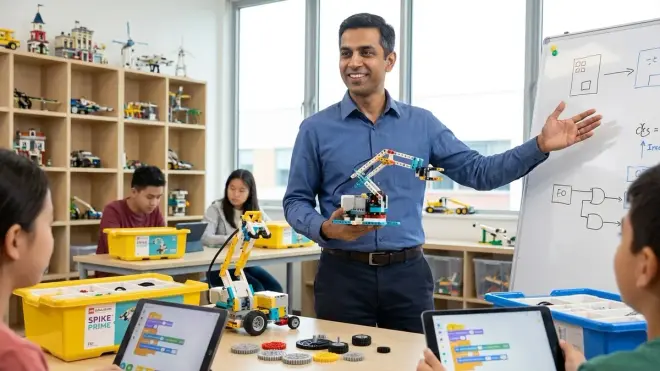
Lego stem learning outcomes extend far beyond "coding exposure"—they encompass mechanical engineering fundamentals, computational thinking patterns, systems integration capability, and professional debugging methodology. The quantifiable skills acquired through structured LEGO Education platform engagement map directly to entry-level engineering competencies including spatial reasoning, hardware-software troubleshooting, and constraint-based design.
Platform selection determines outcome quality: WeDo 2.0 establishes foundational algorithmic thinking for ages 6-8, SPIKE Prime delivers maximum capability development spanning ages 8-14 from block programming through Python text coding, and MINDSTORMS platforms prepare ages 12+ for transition to industry-standard tools. Assessment requires validation beyond completed builds—genuine understanding manifests through independent problem-solving and transfer to novel contexts.
Infrastructure matters: offline functionality, rechargeable power systems, modular expandability, and universal brick compatibility affect long-term learning trajectory. Budget for expansion sensors, replacement pieces, and eventual platform progression. The ROI calculation centers on years of progressive skill development, not initial purchase price.
Parents evaluating lego stem learning outcomes should prioritize demonstrated capability over curriculum completion, implement quarterly skill assessments, require engineering documentation, and plan multi-year learning paths transitioning to professional tools. LEGO platforms establish foundation—career preparation requires subsequent migration to Arduino programming, CAD software, and industry-standard development environments.