

You're watching your ten-year-old navigate increasingly complex challenges, and you're wondering: what STEM skill milestones for 10 year olds should I actually expect at this stage? Not vague "exposure to science" outcomes, but concrete capabilities that map to real-world competencies. This is the age where foundational play transitions into genuine skill acquisition—where block-based programming evolves into reading code, where building kits become platforms for original engineering problem-solving, and where scientific observation matures into hypothesis-driven experimentation. Understanding these milestones helps you invest in learning resources that build sequential capabilities rather than just entertaining your child.
What Are STEM Skill Milestones for 10 Year Olds?
STEM skill milestones for 10 year olds are the measurable competencies children at this developmental stage can realistically master with appropriate scaffolding and practice. These aren't arbitrary age-based suggestions—they're grounded in cognitive development research, Next Generation Science Standards progressions, and what I've observed in hundreds of fifth and sixth graders transitioning from concrete to abstract reasoning.

At ten, children typically demonstrate formal operational thinking in controlled contexts. They can hold multiple variables in mind simultaneously, understand cause-and-effect chains across three or four steps, and begin to think hypothetically about outcomes they haven't directly observed. This cognitive leap fundamentally changes what they can accomplish in STEM domains.
These milestones cluster around four core dimensions: computational thinking, engineering design practices, quantitative reasoning, and scientific modeling. Each dimension has observable benchmarks—specific things your child should be able to do, not just conceptually understand.
In computational thinking, ten-year-olds should transition from dragging pre-built blocks to understanding what those blocks represent in text-based syntax. In engineering, they move from following assembly instructions to modifying designs for specific performance criteria. In quantitative reasoning, they shift from collecting data to analyzing patterns and calculating rates of change. In scientific modeling, they progress from describing observations to constructing explanations using evidence and mechanism.
The specificity matters. When you understand that "learning programming" at this age means your child should successfully debug a 40-50 line Scratch program with nested loops and conditionals—or read simple Python functions with parameters—you can evaluate whether a programming kit truly delivers skill progression or just superficial engagement.
How These Skill Milestones Develop
The development of STEM skill milestones for 10 year olds follows a predictable sequence, though individual children progress at different rates. Understanding this progression helps you recognize when your child is ready for the next challenge and when they need more time consolidating current capabilities.
Computational Thinking Progression
Most ten-year-olds arrive with block-based programming experience from earlier grades. The milestone at this age is syntax awareness—the ability to see patterns in code structure and predict what modifications will produce specific outcomes.
Concretely, this means your child should be able to:
- Debug programs by identifying which block or line causes unexpected behavior
- Explain what a loop or conditional statement does in plain language
- Modify existing code to change program behavior in specific ways
- Write original programs that combine 3-4 programming constructs (loops, variables, conditionals, functions)
The transition from visual blocks to text-based code typically begins around age 10-11. You're not looking for Python fluency yet, but your child should be able to read simple Python or JavaScript syntax and recognize structures they've used in block form—understanding that for i in range(10): accomplishes the same thing as a "repeat 10 times" block.
Engineering Design Milestones
In engineering, ten-year-olds develop constraint-based problem-solving. Earlier, they built what instructions told them to build. Now they should design solutions that meet specific performance criteria within given limitations.
Observable benchmarks include:
- Identifying which design variable affects which performance outcome (e.g., gear ratio impacts torque vs. speed)
- Testing designs iteratively with controlled changes between versions
- Selecting appropriate materials or components based on functional requirements
- Explaining trade-offs between competing design goals
I've watched this develop across hundreds of students in my robotics elective. Early in fifth grade, they ask "What should I build?" By the end of the year, they're asking "Which motor configuration will give me enough torque to climb this incline while staying under the weight limit?"
That shift from instruction-following to criterion-driven design is the milestone. Quality robotics kits scaffold this by providing challenges with clear constraints but multiple valid solutions.
Scientific Reasoning Development
The critical milestone in scientific thinking at age ten is mechanistic explanation—moving beyond describing what happens to explaining why it happens at the level of underlying mechanisms.
Your child should demonstrate:
- Constructing cause-and-effect explanations that span multiple steps
- Distinguishing between correlation and causation in simple contexts
- Identifying which variables need to be controlled in an experiment
- Using models (drawings, diagrams, physical representations) to explain phenomena
This is where hands-on science kits become genuinely educational rather than just demonstrative. A solar panel kit that helps your child measure voltage output under different lighting conditions and explain the mechanism converting photons to electrical current hits this milestone. A kit that just lights an LED without investigating variables doesn't.
Quantitative Reasoning Benchmarks
Mathematical thinking at ten should transition from arithmetic operations to proportional reasoning and basic statistical thinking. Your child should be capable of:
- Calculating rates (speed, efficiency, concentration) from raw measurements
- Creating and interpreting line graphs showing relationships between variables
- Recognizing linear patterns in data tables
- Estimating orders of magnitude and checking whether calculations produce reasonable results
These capabilities unlock authentic STEM work. When your child builds a wind turbine project and calculates power output in watts from voltage and current measurements, they're demonstrating genuine quantitative reasoning—not just copying numbers into a formula.
Why These Milestones Matter for Your Child's STEM Development
Understanding STEM skill milestones for 10 year olds matters because this age represents a critical branching point in STEM education. The capabilities your child develops now determine which pathways remain accessible in middle school and beyond.
Students who master debugging and algorithmic thinking by age 11 find text-based programming languages approachable in middle school. Those who don't often perceive programming as incomprehensibly abstract. Students who develop constraint-based engineering thinking can tackle open-ended design challenges in robotics competitions and maker projects. Those stuck in instruction-following mode struggle when problems don't come with step-by-step guides.
These aren't just academic concerns. The ability to decompose complex problems, test solutions iteratively, analyze quantitative evidence, and explain mechanisms using models—these are foundational workplace competencies across engineering, technology, data science, research, and applied sciences.
From a practical perspective, identifying where your child sits relative to these milestones helps you make better investment decisions. If your child has mastered block-based programming, buying another Scratch-based kit wastes money on redundant practice. They're ready for platforms that introduce text syntax. If they're still developing debugging skills, jumping to Python will frustrate rather than challenge.
The progressive learning path approach requires honest assessment of current capabilities and intentional selection of next-step challenges. You can't build that progression without understanding the milestones.
Types of STEM Milestones by Domain
STEM skill milestones for 10 year olds vary significantly across domains. While some cognitive capabilities transfer, each STEM field has domain-specific progressions worth understanding.
Computer Science & Programming Milestones
Beyond the computational thinking progression covered earlier, ten-year-olds should develop computational artifact creation—making programs that serve genuine purposes rather than just executing examples.
Specific milestones include creating simple games with scoring and win/loss conditions, building interactive quizzes or tutorials, programming robots to navigate obstacle courses autonomously using sensors, or developing data visualizations from collected measurements. The [LEGO Mindstorms Robot Inventor](AMAZON: LEGO Mindstorms Robot Inventor) system scaffolds many of these milestones particularly well with its combination of Scratch-based and Python programming modes.
Lab Specs Consideration: Programming platforms at this level need offline capability for basic functions (not cloud-dependent for every session), cross-platform compatibility (Windows, macOS, ChromeOS), and clear migration paths to text-based languages. Products requiring ongoing subscriptions for core features create financial barriers to sustained practice.
Engineering & Robotics Milestones
Engineering milestones center on systems thinking—understanding how components interact within assemblies and how changing one element affects overall performance.
Observable capabilities: designing mechanical systems with intentional gear ratios for torque or speed advantages, implementing sensor-driven automation (e.g., line-following, obstacle avoidance), troubleshooting assemblies by isolating which subsystem causes failure, and optimizing designs through iterative testing with controlled variable changes.
These milestones require platforms with expandability. A fixed-function kit your child builds once and never modifies doesn't develop systems thinking. Open platforms like Arduino-based robotics systems or modular construction kits support this progression but require more parental facilitation initially.
Physical Science Milestones
In physical sciences, ten-year-olds should master quantitative investigation—designing experiments that produce measurable data and drawing conclusions from numerical evidence.
Benchmarks include measuring energy transformations and calculating efficiency percentages, investigating relationships between variables and graphing results, testing materials under controlled conditions and comparing quantitative properties, and using mathematical models to predict outcomes before testing.
Renewable energy projects naturally scaffold these milestones. Comparing solar panel output under different angles, measuring wind turbine efficiency with different blade designs, or calculating energy storage in capacitor banks all require quantitative investigation at age-appropriate complexity.
Life Science Milestones
Life science at this age emphasizes systems modeling—understanding organisms and ecosystems as interconnected systems where changes propagate through multiple levels.
Capabilities include constructing food web models showing energy flow, explaining physiological processes at the organ system level, investigating how environmental variables affect organism growth or behavior quantitatively, and designing fair experiments with living organisms including proper controls.
Many life science concepts at this level require sustained observation over weeks, which doesn't align well with one-time kits. Setting up a dedicated learning space with ongoing experiments supports this better than discrete projects.
Frequently Asked Questions
What STEM skills should a 10-year-old specifically be able to demonstrate by the end of the year?
By the end of age 10 or fifth grade, your child should demonstrate five concrete capabilities across STEM domains. First, they should write or modify a 40-50 line program with loops, conditionals, and variables to accomplish a specific purpose, then debug it when it doesn't work as intended. Second, they should design a mechanical system (simple machine, robot, or structure) that meets specific performance criteria and explain trade-offs in their design choices. Third, they should plan and conduct a quantitative experiment with controlled variables, collect measurements systematically, graph the results, and draw evidence-based conclusions. Fourth, they should calculate rates, ratios, and percentages from real measurements and check whether their calculations produce sensible results. Fifth, they should construct explanatory models using diagrams or physical representations that show mechanism, not just outcomes. These aren't theoretical understandings—these are things your child should actually be able to do with their hands and document in a lab notebook or portfolio. If they're not there yet, they need more hands-on practice time with appropriately challenging materials rather than exposure to more topics.
How do I know if my 10-year-old is ready to transition from block-based to text-based programming?
Your child is ready for text-based programming when they consistently demonstrate three specific behaviors in block-based environments. First, when they encounter bugs, they systematically check their code block by block rather than randomly changing things or asking for help immediately—this shows they've internalized debugging logic. Second, when they want to accomplish something new, they can break it into smaller steps and explain what programming constructs they'll need, even if they don't know the exact implementation—this demonstrates algorithmic thinking independent of specific syntax. Third, they express curiosity about what's "inside" blocks or ask questions suggesting they understand blocks represent underlying code—comments like "how would I do this if I didn't have this block?" signal readiness. You'll also see them working with increasingly complex programs (30+ blocks) without getting lost in the logic. If your child shows these patterns, introducing Python or JavaScript syntax with a transitional platform that shows block and text views side-by-side helps bridge the gap. If they're still struggling to debug 15-block programs or need help planning every step, they need more time in block-based environments building that foundational logic.
What's the difference between age-appropriate STEM activities and activities that actually build skills at this level?
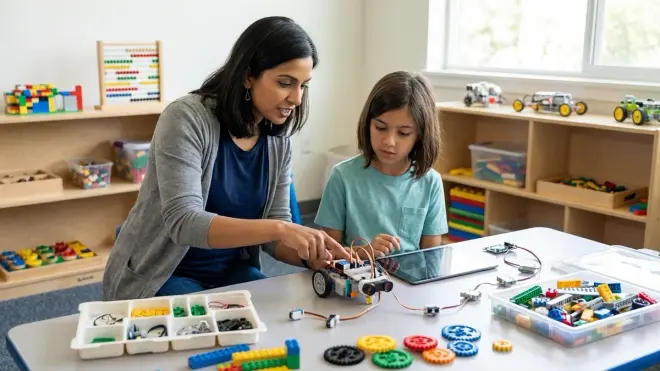
Age-appropriate STEM activities at ten match cognitive and motor abilities—the child can physically manipulate components and intellectually understand instructions. But many age-appropriate activities don't build skills because they provide no opportunity for problem-solving, iteration, or transfer to new contexts. Building a model following step-by-step instructions is age-appropriate but doesn't develop engineering skills because there are no decisions, trade-offs, or design challenges involved—you're just following assembly directions. The same model becomes skill-building when you challenge your child to modify it to achieve different performance criteria, like increasing speed, carrying a load, or navigating obstacles, then test and refine their modifications. Similarly, running a demonstration where vinegar and baking soda produce gas is age-appropriate chemistry, but it doesn't build scientific reasoning unless your child designs variations testing how different ratios affect gas production, measures results quantitatively, and explains the mechanism. Skill-building activities at this level always include decision points where your child must choose an approach, measurable outcomes they can evaluate, and iteration opportunities to improve based on results. Products that support progressive learning build these elements into their design rather than just providing materials and instructions.
Should I focus on breadth across all STEM domains or depth in one area for my 10-year-old?
At age ten, you want structured breadth with emerging depth—exposure to enough domains that your child discovers genuine interests, but sustained practice in those areas to build competence rather than superficial familiarity. Concretely, this might mean maintaining a rotating focus: spend 6-8 weeks on a robotics project that goes through multiple design iterations and programming challenges, then shift to a renewable energy investigation for the next period, then tackle a coding project, then explore biological systems. Within each focus period, go deep enough that your child develops actual capability in that domain—not just completing one kit and moving on, but working through a progression that builds complexity. I've seen too many families collect dozens of STEM kits that each get built once, creating breadth without any depth. Your child ends up having "done" robotics without being able to design or program anything independently. The opposite extreme—focusing exclusively on one domain at this age—risks missing the discovery phase where children identify what resonates with them. The middle path means building a progression within domains over weeks or months, then transitioning to different domains for variety, rather than bouncing between unrelated activities weekly. This develops both genuine competence and informed preference.
What equipment do I actually need at home to support these STEM skill milestones effectively?
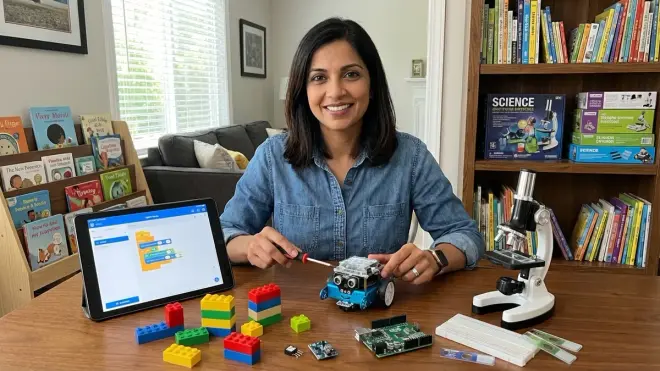
Supporting STEM skill milestones for 10 year olds at home requires surprisingly minimal equipment if you choose strategically, but the specific items matter more than quantity. You need three categories of resources: a programmable platform that supports progression from blocks to text (like [LEGO Mindstorms](AMAZON: LEGO Mindstorms Robot Inventor), Arduino-based robotics kits, or micro:bit systems), hands-on science equipment for quantitative investigation (multimeter for electrical measurements, graduated cylinders and scales for physical science, pH meters or microscopes for life science depending on interests), and fabrication or construction materials that allow iterative building (modular robotics components, Arduino kits with breadboards and sensors, or basic maker supplies like cardboard, motors, and LEDs if your child likes prototyping). Beyond materials, you need appropriate infrastructure: a dedicated work surface where projects can remain set up between sessions rather than requiring complete teardown daily, adequate power outlets with surge protection since most platforms need charging or wall power, stable internet for software downloads and updates though core functions should work offline, and organized storage where components don't get lost or mixed. Setting up this infrastructure properly prevents frustration from missing parts or incompatible platforms more effectively than buying more kits. One well-chosen robotics platform used intensively over months builds more capability than five different kits each used once. Focus on expandable ecosystems rather than one-off toys, compatibility with industry-standard software (Python, Arduino IDE, CAD programs), and durability for repeated assembly and disassembly since skill-building requires iteration, not single builds.
Summary
The STEM skill milestones for 10 year olds center on four concrete transitions: from executing code to debugging and modifying it intentionally, from following assembly instructions to constraint-based engineering design, from describing observations to constructing mechanistic explanations with evidence, and from arithmetic calculations to proportional reasoning with real measurements. These aren't abstract learning goals—they're observable capabilities your child either can or cannot demonstrate through hands-on work.
Recognizing where your child currently sits relative to these milestones lets you invest in learning resources that provide the right level of challenge—not repeating skills they've mastered or jumping to complexity that frustrates rather than extends their thinking. The age itself matters less than the progression. Some nine-year-olds demonstrate these capabilities; some eleven-year-olds still need scaffolding to reach them.
What matters is matching challenge to current ability and providing enough sustained practice within each milestone that capabilities become fluent, not just occasionally demonstrated with maximum effort. That requires honest assessment, strategic resource selection, and patience to let your child work through complexity rather than rushing to the next topic. These milestones form the foundation for everything that follows in STEM learning—get them solid now, and middle school pathways stay wide open.