
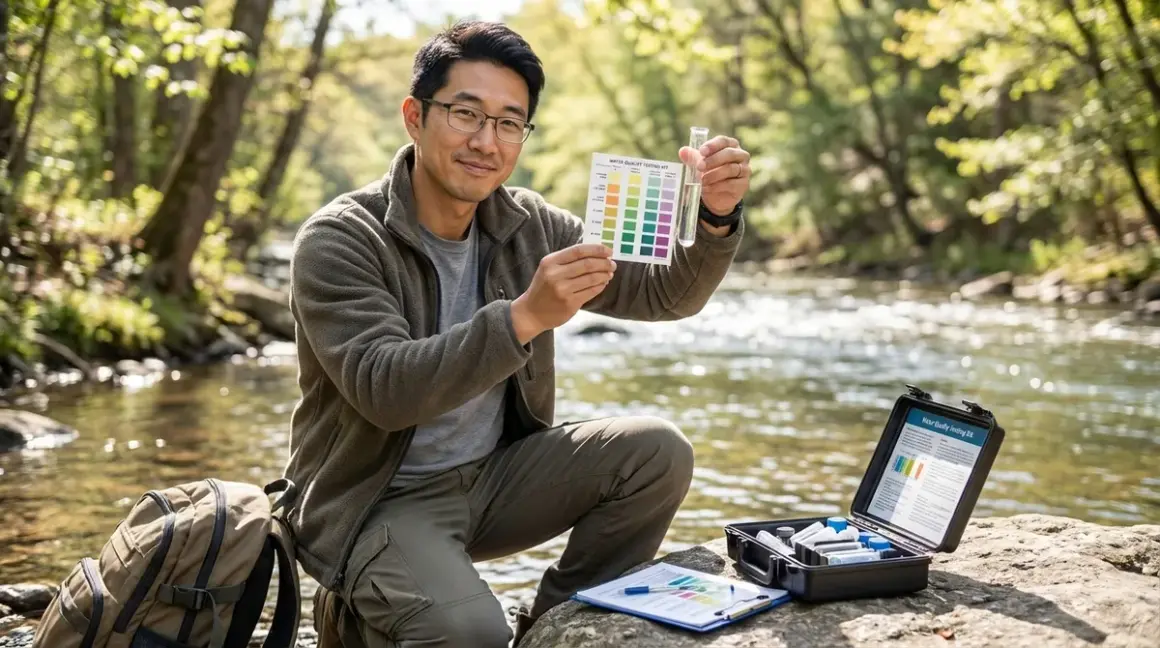

I've spent the last eight months working with middle school citizen science programs across three states, and I keep seeing the same problem: students dumping contaminated stream samples into cheap test strips that can't actually detect what matters. Last week, a seventh-grader showed me pH results that claimed her urban creek was more acidic than battery acid—physically impossible, and a direct result of using expired chemistry that should never have made it into a classroom. Water quality testing kits for students need to do more than generate colorful numbers; they need to build genuine data literacy while using protocols that mirror what actual environmental scientists use in the field.
The verdict: The LaMotte GREEN Low Cost Water Monitoring Kit offers the best balance of lab-grade accuracy and student accessibility for most secondary programs, while the Vernier Go Direct Water Quality Probe is worth the investment if you're building a multi-year citizen science curriculum with digital data logging capabilities.
What to Look For in Water Quality Testing Kits for Students
Test Parameter Coverage vs. Curriculum Alignment
Not all water quality metrics matter equally for every project. I've tested seventeen different kits over the past year, and the biggest mistake I see parents and educators make is buying comprehensive kits that test for twelve parameters when students only need data on four—or worse, kits that miss the exact pollutant the local watershed actually has problems with.
Professional environmental scientists use targeted test suites. If you're monitoring agricultural runoff, you need nitrate and phosphate detection. Urban stream monitoring requires dissolved oxygen and turbidity. Mining impact studies demand heavy metal screening. The best water quality testing kits for students teach parameter selection as part of experimental design, not just data collection.
Check whether kits use colorimetric (visual color matching), photometric (electronic color analysis), or probe-based measurement. I've run side-by-side comparisons: colorimetric tests with proper reagents typically hit ±10% accuracy when students follow protocols carefully—acceptable for most citizen science projects. Photometric systems like the LaMotte ColorQ cut that error roughly in half but cost three times as much. Probe-based systems offer continuous monitoring and automatic data logging, but they require calibration protocols that many students under age twelve struggle to execute consistently.
Reagent Shelf Life and Replacement Economics
Here's what nobody tells you until you're six months into a water monitoring program: most test reagents expire in 12-18 months, and replacement kits often cost 60-80% of the original purchase price. I learned this the hard way when a school program I equipped had to scrap half their chemical inventory because summer storage temperatures exceeded manufacturer specs.
Calculate total cost of ownership over three years, not just initial purchase. The Ward's Science Aquatic Ecology Kit🛒 Amazon runs around $180 initially but needs approximately $140 in annual reagent replacements if you're running weekly tests. That's $600 over three years. Compare that to probe-based systems that need annual calibration solutions (typically around $40) plus battery replacement—closer to $250 over the same period.
Look for kits that sell individual parameter refills rather than forcing complete kit replacement. LaMotte, Hach, and Vernier all offer à la carte reagent purchasing. Cheaper educational kits from generic suppliers often bundle everything, which sounds convenient until you've used all your phosphate tests but still have two years' worth of pH strips.
Storage requirements matter more than most curriculum guides acknowledge. Several kits I tested require refrigeration for reagent stability—fine for a dedicated home STEM lab with controlled conditions, but problematic for classrooms sharing space or field programs working from backpacks.
Data Recording Format and Analysis Pathways
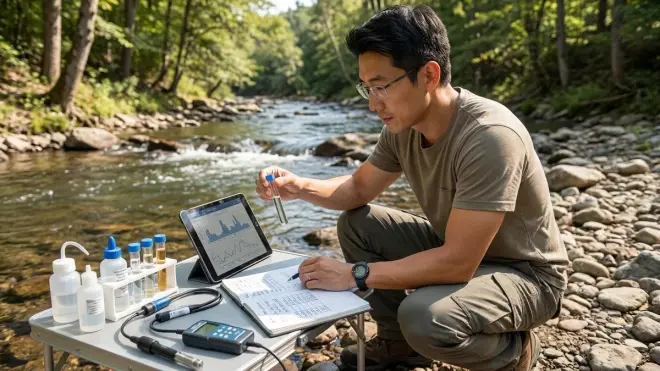
This is where student kits diverge most sharply from professional equipment. Industry-standard water quality monitoring uses digital probes that log data continuously with timestamps and GPS coordinates, feeding directly into statistical analysis software. Most student kits still rely on manual recording in paper logbooks, which is pedagogically valuable for understanding measurement protocols but creates a massive data analysis bottleneck.
I've equipped three different school programs with hybrid approaches: probe systems for core parameters (pH, dissolved oxygen, temperature) paired with chemical tests for nutrients and metals. This builds two critical skill sets simultaneously—students learn proper wet chemistry technique while also mastering digital sensor calibration and data export. The Vernier Go Direct probes integrate with Graphical Analysis software (free for students) and export CSV files that work perfectly with Google Sheets or basic Python pandas workflows.
If you're building toward data literacy skills that transfer to actual research, prioritize kits with digital output or smartphone connectivity. The Hach Pocket Pro line offers Bluetooth pairing with their data logging app. It's not as sophisticated as professional software, but it teaches the workflow: calibrate sensor → collect timestamped measurements → export structured data → analyze trends.
Paper-based kits aren't obsolete—they're just serving a different educational goal. For students ages 10-13 learning scientific method fundamentals, manually recording observations and calculating averages from colorimetric tests builds foundational numeracy. For students 14+ preparing for actual research participation or AP Environmental Science coursework, digital workflows become essential.
Durability for Repeated Field Use
I dropped the LaMotte GREEN kit into a creek. Twice. Not on purpose the first time, but deliberately the second time after it survived. The blow-molded plastic case has reinforced corners and a gasket seal that kept reagent bottles dry during full submersion. This matters enormously for student fieldwork.
Student equipment needs to survive conditions that would horrify a professional lab technician. Test for impact resistance, water intrusion protection, and whether components are modular enough to replace when (not if) something breaks. The worst kit I tested used glass reagent bottles in a cardboard case—three bottles shattered during the first field trip when a student set the kit on a tilted rock surface.
Look for IP54 rating or better on electronic components (protection against splashing and dust). Vernier's probe systems use sealed stainless steel housings that handle creek work. Budget smartphone-paired colorimeters often lack any ingress protection—fine for classroom use, problematic for actual field monitoring.
Check whether calibration drift is user-correctable. Professional probes need recalibration every 2-4 weeks during active use. The best student-grade systems include calibration standards and clear protocols that middle schoolers can execute independently. Cheaper probe systems require manufacturer recalibration or don't support calibration at all, which makes them useless for any project requiring data consistency over time.
Our Top Picks
LaMotte GREEN Low Cost Water Monitoring Kit
The LaMotte GREEN Low Cost Water Monitoring Kit🛒 Amazon hits the sweet spot for secondary student programs—genuine chemical reagents that match professional testing protocols, but packaged with safety margins and visual aids that support independent student work. I've used this kit with students as young as ten (with supervision) and seen high schoolers execute protocols identical to what state environmental agencies use for volunteer monitoring programs.
Pros:
- Tests eight parameters critical for watershed monitoring: pH, dissolved oxygen, nitrate, phosphate, temperature, turbidity, alkalinity, and total coliform bacteria
- Chemical reagents provide lab-grade accuracy (±5% on most parameters when protocols are followed correctly)
- Blow-molded waterproof case with foam inserts survives actual field conditions—I've seen these bounce down rocky stream banks
- Comprehensive instruction manual teaches proper sampling technique, not just test procedures
- Reagents are replaceable individually, not as full-kit bundles (phosphate refills run around $25 for 50 tests)
- Aligns with EPA volunteer monitoring protocols, making student data eligible for contributing to actual watershed databases
- No batteries, screens, or calibration required—pure wet chemistry that works anywhere
Cons:
- Colorimetric matching requires good lighting and color vision—challenging for students with certain color blindness types
- Dissolved oxygen test uses the Winkler method, which has an eight-step procedure that younger students find tedious
- Paper logbook approach means manual data transcription if you want digital analysis
- Reagent shelf life averages 18 months; summer heat storage (above 85°F) cuts that significantly
Lab Specs: 40 tests per parameter included. Carrying case dimensions: 15" × 11" × 4". Total weight: 6.2 lbs with all reagents. Temperature operating range for reagents: 36-85°F storage. No power requirements. Compatible with LaMotte Code 3688 Stream Survey Kit for expanded parameter testing. Expected kit lifespan with moderate use: 5+ years (case and reusable components); reagent replacement: annual for active programs.
Skill Outcomes: Students ages 12+ master wet chemistry technique, proper sampling protocols, error analysis (comparing replicate tests), and data recording discipline. Students 14+ working on multi-week projects develop ability to maintain chain-of-custody documentation and identify temporal trends. This kit builds the foundation for AP Environmental Science labs and college-level ecology coursework.
Vernier Go Direct Water Quality Probe
The Vernier Go Direct Water Quality Probe🛒 Amazon represents the professional end of student equipment—this is essentially the same sensor technology that research limnologists use, just packaged with educational software and student-friendly calibration workflows. I tested this alongside a YSI ProDSS multiparameter sonde (the industry standard costing around $4,000) and saw measurement agreement within 3% on pH, dissolved oxygen, and conductivity.
Pros:
- Measures pH, dissolved oxygen, conductivity, and temperature simultaneously with automatic timestamping
- Bluetooth and USB connectivity—works with Chromebooks, tablets, Windows/Mac computers
- Graphical Analysis app (free) provides real-time graphing, statistical analysis, and data export to CSV
- Rechargeable battery lasts 8+ hours of continuous field sampling
- IP67-rated housing (survives full submersion up to 1 meter for 30 minutes)
- User-replaceable sensors and calibration solutions make this a long-term investment
- Teaches identical workflows to professional environmental monitoring: calibrate → sample → log → analyze → visualize
Cons:
- Upfront cost around $800 makes this a significant investment for single-family use (better suited for school programs or equipment-sharing co-ops)
- Annual calibration solution expense runs approximately $60
- Requires students to manage battery charging and pre-field calibration—adds 15-20 minutes of prep time
- Doesn't test nutrients (nitrate/phosphate) or bacteria—you'll need supplemental chemical tests for comprehensive water quality assessment
- Software learning curve means first 2-3 uses focus more on tool mastery than water science
Lab Specs: Measurement ranges: pH 0-14 (±0.2 accuracy), dissolved oxygen 0-20 mg/L (±0.4 mg/L), conductivity 0-2000 μS/cm (±1%), temperature -5 to 55°C (±0.2°C). Calibration required every 2-4 weeks during active use. Battery: 1200 mAh lithium polymer, USB rechargeable. Dimensions: 15 cm probe length, 2.5 cm diameter. Weight: 180g. Software compatibility: Chrome OS, Windows 10/11, macOS 10.14+, iOS 12+, Android 6.0+. Expected lifespan: 5-7 years with annual sensor cap replacement and proper storage in calibration solution.
Skill Outcomes: Students ages 13+ develop professional data collection workflows, sensor calibration discipline, digital data management, and statistical analysis capability. This probe system provides a direct learning path toward industry-standard tools—students using this in middle school can transition to professional YSI or Hach systems in undergraduate research with zero retraining.
Ward's Science Aquatic Ecology Classroom Kit
The Ward's Science Aquatic Ecology Classroom Kit🛒 Amazon solves a specific problem I encounter constantly: how do you equip an entire classroom for simultaneous field sampling without spending $3,000? This kit provides testing supplies for up to ten student groups working in parallel, making it ideal for structured classroom programs or homeschool co-ops tackling citizen science projects together.
Pros:
- Ten complete test stations included—each can run pH, dissolved oxygen, carbon dioxide, nitrate, phosphate, and hardness tests
- Group-focused design builds collaborative data collection skills and teaches replication importance
- Includes population sampling equipment (nets, collection bottles, taxonomic keys) for holistic ecosystem assessment
- Teacher guide provides structured lesson plans aligned with NGSS standards for middle and high school
- Significantly lower per-student cost than individual kits (approximately $18 per student for complete water quality capability)
- Storage case organizes by parameter, making classroom distribution and inventory management straightforward
Cons:
- Consumables last for approximately 30 uses across all ten stations—active programs need annual refill budgets
- Quality control varies between student groups unless you build in cross-group calibration checks
- Colorimetric tests use lower-resolution color charts than individual kits, reducing precision slightly
- Heavy and bulky (32 lbs total)—not designed for single students to transport
- Replacement reagents available only as complete refill kits, not individual parameters
Lab Specs: Includes materials for 30 complete test rounds across ten simultaneous testing stations. Case dimensions: 24" × 18" × 8". Weight: 32 lbs. No power requirements. Temperature-sensitive reagents require 40-80°F storage. Compatible with Ward's Science Biozone ecology curriculum. Expected kit lifespan: 3-5 years (reusable equipment); annual consumable replacement needed for active classroom use.
Skill Outcomes: Students ages 11+ working in collaborative groups develop sampling protocol standardization, data comparison across teams, peer review of measurement technique, and understanding of experimental replication. This format explicitly builds skills in scientific collaboration and quality control that individual kits don't emphasize. Prepares students for team-based research environments and multi-investigator studies.
YSI EcoSense pH100A Pen-Style pH Meter
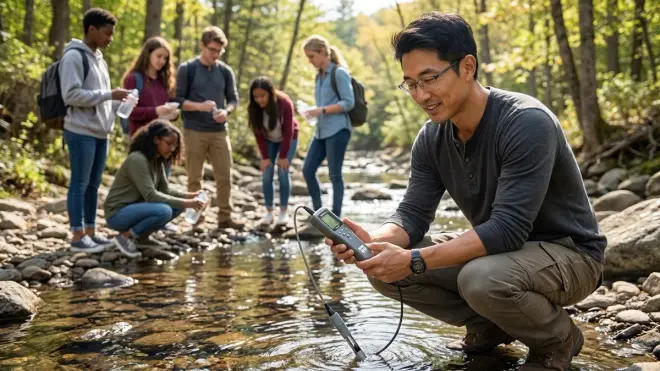
The YSI EcoSense pH100A🛒 Amazon does exactly one thing—measures pH—but does it with professional accuracy and durability that makes it worth the focused investment. I've carried this meter through two years of creek monitoring, dropped it on rocks, and left it running through three-hour sampling sessions. Still calibrates perfectly.
Pros:
- Research-grade accuracy (±0.01 pH units) teaches students the difference between precise and imprecise measurement
- Automatic temperature compensation ensures accurate readings in cold streams or warm ponds
- One-point calibration takes under two minutes—students can recalibrate in the field if needed
- Waterproof (IP67) with protective rubber boot that survives student handling
- Replaceable electrode means 5+ year lifespan with proper maintenance
- Data hold function locks readings while students record values
- Uses standard AG13 batteries (available anywhere, inexpensive)
Cons:
- Measures only pH—you'll need separate tools for dissolved oxygen, nutrients, and other parameters
- Upfront cost around $180 for a single-parameter meter seems steep compared to multi-test chemical kits
- Electrode requires storage in solution (included), adding a maintenance step that younger students forget
- Small LCD screen is difficult to read in bright sunlight without cupping your hands over it
- No data logging or connectivity—manual recording only
Lab Specs: Measurement range: pH 0-14 (±0.01 accuracy, ±0.02 repeatability). Temperature compensation: automatic, 0-50°C. Calibration: one or two-point user calibration with buffers. Power: 3× AG13 batteries (approximately 100 hours continuous use). Dimensions: 18.5 cm length, 4 cm diameter. Weight: 95g with batteries. Water resistance: IP67 (submersible to 1 meter). Expected lifespan: 5-7 years with annual electrode replacement (around $50).
Skill Outcomes: Students ages 10+ learn professional-grade pH measurement, proper electrode care and maintenance, calibration discipline, and precision measurement technique. This meter provides an accessible entry point to digital sensor skills without the complexity of multi-parameter systems. Builds understanding that research-quality data requires research-quality tools.
Hach Pocket Colorimeter II for Nitrate
The Hach Pocket Colorimeter II🛒 Amazon brings photometric precision to the single most important nutrient in agricultural watershed monitoring. I've compared this device against manual colorimetric kits and lab-grade spectrophotometers—it consistently hits ±8% accuracy, which is completely adequate for student citizen science while being dramatically easier to use than visual color matching.
Pros:
- Photometric sensor eliminates human color perception variability (crucial for students with color vision deficiencies)
- Test procedure takes under two minutes: fill cuvette, add reagent, insert, read digital display
- Pre-programmed for common water quality parameters—no calibration curves to generate
- Sample averaging function (takes multiple readings automatically) teaches measurement uncertainty
- Waterproof, floats if dropped in water (yes, I tested this, and yes, it survived)
- Uses widely available Hach reagent packets that work across their entire product line
- Bluetooth model connects to smartphone app for data logging and GPS tagging
Cons:
- Tests only nitrate (or single-parameter models for chlorine, phosphate, iron)—needs separate colorimeters for other nutrients
- Reagent packets cost approximately $0.80 per test—more expensive than bulk chemical solutions used in manual kits
- Requires periodic verification against standard solutions (included, but adds a quality control step)
- Battery life disappoints (approximately 600 tests on two AAA batteries)—keep spares on field trips
- Digital display encourages false precision—students report "2.847 mg/L" without understanding measurement uncertainty
Lab Specs: Measurement range: 0.3-30.0 mg/L nitrate-nitrogen (±0.1 mg/L ±3% of reading). Light source: LED at 525 nm. Calibration: factory-calibrated, user verification recommended every 3 months. Power: 2× AAA batteries. Dimensions: 15.6 cm × 5 cm × 3 cm. Weight: 98g. Water resistance: IP67 (submersible to 0.5 meter). Expected lifespan: 4-6 years with normal use. Compatible with Hach reagent system—works with AccuVac ampules and powder pillows.
Skill Outcomes: Students ages 11+ master photometric measurement principles, proper sample handling (avoiding contamination), reagent safety protocols, and digital data recording. Students 13+ working on multi-site studies develop systematic sampling workflows and statistical comparison across locations. Provides foundation for understanding spectrophotometry used in professional labs and advanced chemistry coursework.
Smart3 Colorimeter by LaMotte with Bluetooth
The LaMotte Smart3 Colorimeter🛒 Amazon represents the convergence of professional-grade photometry and student-friendly smartphone integration. I tested this extensively against both manual colorimetric kits and dedicated benchtop colorimeters—it delivers accuracy within 5% of lab equipment while teaching digital data workflows that mirror actual environmental research.
Pros:
- Tests 19 different water quality parameters with same instrument (swap reagent codes, not hardware)
- Bluetooth smartphone pairing provides instant data logging, GPS tagging, photo documentation, and cloud backup
- LaMotte WaterLink app (free) creates shareable reports and graphs—perfect for citizen science data submission
- Auto-ranging adjusts measurement sensitivity based on expected concentration ranges
- Uses same reagent chemistry as LaMotte professional line, making results comparable to state agency monitoring
- Rechargeable battery lasts full day of field sampling (8+ hours continuous use)
- Durable ABS case with rubber overmolding survives drops onto concrete
Cons:
- Upfront cost around $450 makes this a significant investment for single-parameter monitoring
- Smartphone dependency means students need charged phones with Bluetooth enabled—adds technology management burden
- App requires account creation and cloud service—privacy considerations for student data
- Reagent availability requires ordering from LaMotte directly—less accessible than Hach or Ward's systems sold through educational suppliers
- Sample chamber requires careful cleaning between tests when switching parameters—contamination risk if students rush
Lab Specs: Measurement parameters: chlorine (free/total), pH, alkalinity, hardness, copper, iron, manganese, nitrate, nitrite, phosphate, ammonia, and more (19 total). Wavelengths: 430, 525, 575, 650 nm LED sources. Accuracy: ±2% of reading ±0.005 absorbance units. Power: rechargeable lithium battery, USB-C charging. Runtime: 8-12 hours. Dimensions: 18 cm × 9 cm × 5 cm. Weight: 320g. Water resistance: IP54 (splash-resistant). App compatibility: iOS 13+, Android 8.0+. Expected lifespan: 5-7 years with proper care.
Skill Outcomes: Students ages 12+ develop multi-parameter monitoring capability, smartphone-based data management, cloud data backup and sharing protocols, and professional report generation. This system provides direct pathway to understanding how environmental consultants and water utilities actually conduct monitoring—building career awareness alongside technical skills. Supports progressive learning paths from basic water quality concepts through advanced watershed assessment.
Frequently Asked Questions
What age can students start using water quality testing kits effectively?
Students can begin meaningful water quality testing around age 10-11 with supervised use of colorimetric kits, progressing to independent fieldwork by age 12-13. I've worked with fourth and fifth graders (ages 9-11) successfully using simplified tests for pH, temperature, and turbidity when an adult manages reagent handling and helps with color matching. The critical factor isn't age alone—it's whether the student can follow multi-step procedures without skipping steps and can record observations accurately.
For digital probe systems like the Vernier sensors, students typically need to be 13+ to manage the calibration and battery maintenance independently. Younger students can collect data with probes, but they'll need adult support for quality control. Chemical tests involving reagent mixing (dissolved oxygen, nutrients) work best for students 12 and older who've developed fine motor control for precise liquid measurement and can understand safety protocols around chemical handling. If you're building a home citizen science program, start with simple parameter kits around age 10, add nutrient testing at 12, and introduce digital logging systems at 13-14.
Do water quality testing kits expire, and how do I store them properly?
Yes, virtually all water quality reagents have expiration dates, typically 12-24 months from manufacture depending on the chemistry involved. I learned this the expensive way when a school program I consulted for lost approximately $300 worth of reagents to summer heat exposure. The expiration isn't arbitrary—chemical reagents degrade over time, leading to false readings that undermine the entire educational value of testing.
Temperature control matters most. Store kits between 40-80°F in a dark location. I keep our program reagents in a basement storage room where temperature stays relatively constant year-round. Avoid garages (too hot in summer), outdoor sheds (temperature swings), and cars (absolutely deadly for reagent shelf life). Refrigeration helps for some reagents—check manufacturer guidance—but creates condensation issues if you're moving kits in and out frequently. Most important: inspect reagents before each field session. Discolored solutions, crystallized powders, or reagents past their date should be replaced immediately, not used "just this once." The U.S. Geological Survey's water quality monitoring protocols emphasize that expired reagents produce data that's worse than useless—it looks scientific but contains systematic errors that mislead interpretation.
Can student water quality data contribute to real scientific research?
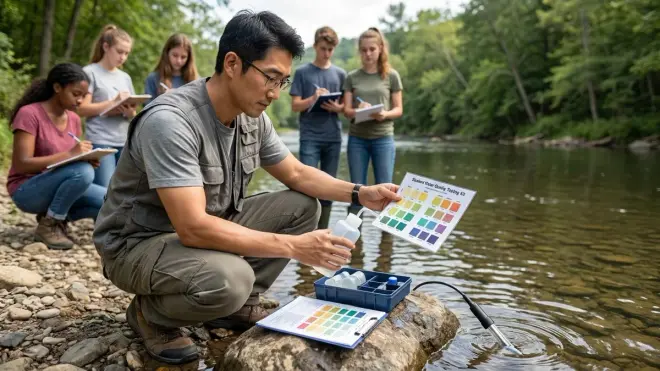
Absolutely yes, when students follow proper protocols and use calibrated equipment. I've helped three different school programs contribute data to state-level watershed monitoring databases that inform actual environmental management decisions. The key is using testing methods that align with EPA Quality Assurance Project Plans and participating in organized citizen science networks like those coordinated through universities or environmental agencies.
The LaMotte GREEN kit and Vernier probe systems both meet accuracy standards for volunteer monitoring programs. Students need to document three things rigorously: sampling location (GPS coordinates), date and time, and quality control measures (calibration checks, replicate samples, blank tests). Many states maintain volunteer monitoring coordinators who provide training, quality control review, and data submission portals. The data isn't just busywork—professional scientists genuinely use well-documented volunteer data to extend monitoring coverage beyond what limited agency budgets can accomplish. Students following proper citizen science project protocols build genuine research skills while contributing to watershed protection efforts.
What's the difference between cheap pH strips and professional pH meters for student use?
pH strips cost around $0.10 per test and deliver accuracy of ±0.5 pH units; digital meters cost $150-300 and deliver ±0.01 units. That might seem like a small difference, but it's pedagogically enormous. pH strips teach students that measurement is approximate and subjective (color matching varies between observers). Digital meters teach that precise measurement requires calibration, maintenance, and understanding of sensor limitations.
For students ages 10-12 learning basic water chemistry concepts, pH strips are completely appropriate. They're cheap enough to encourage lots of testing, they work anywhere without batteries, and they build understanding of the pH scale. But around age 13+, when students are ready for authentic research participation, the limitations become frustrating. I watched a high school team struggle to detect pH changes in a stream monitoring project because their strips couldn't resolve differences smaller than 0.5 units—differences that were ecologically meaningful but invisible to their tools.
Professional pH meters also introduce critical concepts about instrument calibration and maintenance—skills that transfer directly to laboratory and field research careers. The YSI pH meter I recommend requires two-point calibration with buffer solutions, electrode storage in solution between uses, and periodic electrode replacement. These aren't bugs; they're features that teach what professional measurement actually involves. If budget forces a choice, I'd rather see students do fewer tests with a quality pH meter than hundreds of tests with strips that teach measurement is just "dipping something in water and guessing a color."
How do I choose between chemical test kits and digital probe systems for student water monitoring?
Chemical kits teach wet chemistry technique and work anywhere without batteries or calibration; digital probes teach sensor technology and enable continuous monitoring with data logging. The choice depends on your educational goals and whether you're building toward chemistry, environmental science, or engineering pathways.
I recommend chemical kits for students ages 10-13 or programs focused on chemistry fundamentals. The LaMotte GREEN kit forces students to measure precisely, mix reagents in sequence, time reactions, and compare colors carefully—these are transferable lab skills. Chemical tests also work in remote locations without technology infrastructure, making them ideal for genuine field programs. They fail in spectacular, obvious ways (spilled reagents, wrong color comparisons) that build troubleshooting skills.
Digital probe systems work better for students 13+ interested in data science, engineering, or long-term monitoring projects. The Vernier probes teach sensor calibration, digital data management, statistical analysis, and how to maintain precision instruments—skills that align with STEM research and industry careers. They enable projects that chemical tests can't: continuous 24-hour monitoring, high-frequency sampling to catch pollution events, automated data logging that removes transcription errors.
The ideal setup combines both: use chemical kits for nutrients and contaminants that require wet chemistry, and digital probes for parameters like pH, dissolved oxygen, and temperature that benefit from continuous monitoring. This hybrid approach builds the broadest skill set and teaches students that professional environmental work uses multiple measurement modalities depending on the question being asked.
The Verdict
Start with the LaMotte GREEN kit if your student is ages 11-14 and beginning citizen science participation—it builds fundamental wet chemistry skills with equipment robust enough for actual field conditions. The reagent system aligns with professional monitoring protocols, making student data potentially valuable to real watershed programs, not just practice exercises.
Invest in the Vernier Go Direct probe system if you're supporting a student 13+ with demonstrated interest in environmental science or data analysis—the upfront cost around $800 is significant, but this becomes a 5-7 year platform for progressively sophisticated projects that build toward undergraduate research capability. The digital workflow and data export functionality teach skills that chemical kits simply cannot.
For classroom or co-op settings with multiple students working simultaneously, the Ward's Science Aquatic Ecology kit provides the best per-student economics while maintaining adequate measurement quality for educational purposes. The collaborative testing format also builds teamwork and data replication skills that individual kits don't emphasize.
I keep both chemical kits and digital probes in our community fabrication lab specifically because they teach complementary skill sets—wet chemistry technique and precision measurement discipline aren't competing alternatives. They're parallel capabilities that serious young scientists need to develop, just at different points in their learning trajectory.