
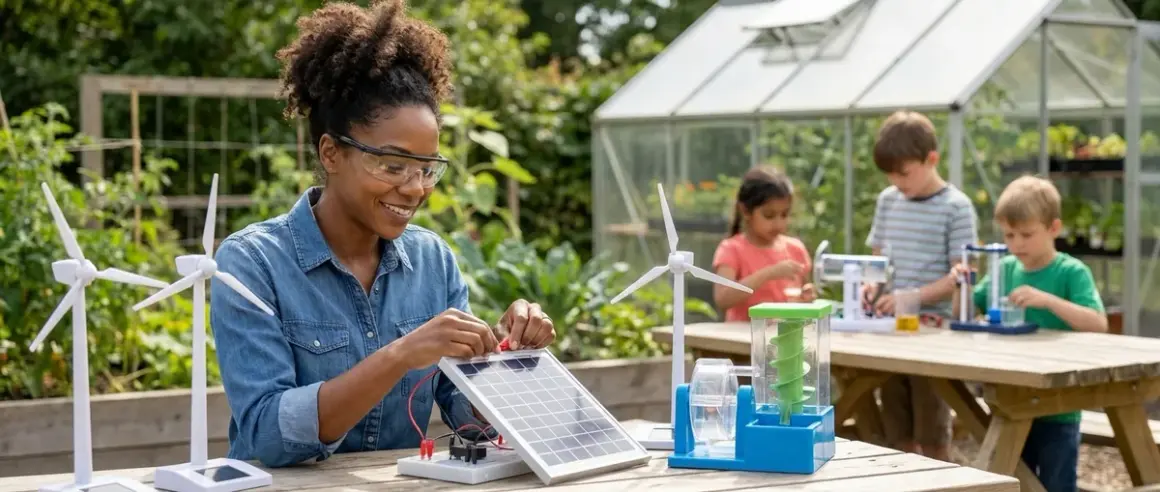

You can feel it in the headlines, in the heat waves, in the conversations your kids overhear. The future runs on renewable energy—and renewable energy science projects aren't just about winning science fairs anymore. They're about building the engineering intuition your child will need when they design microgrids, solar farms, and wind installations in the world they'll inherit. I've spent the last decade wiring solar panels and testing DIY turbines in my own home, and I've watched firsthand how hands-on energy projects transform abstract climate concepts into concrete engineering skills. This guide walks you through the kits, concepts, and learning pathways that turn curiosity into capability.
What Are Renewable Energy Science Projects?
Renewable energy science projects are structured, hands-on investigations that teach students how to capture, convert, measure, and optimize power from sustainable sources—primarily solar, wind, and hydropower. Unlike passive demonstrations, these projects require students to build functional systems, troubleshoot performance variables, and quantify efficiency outcomes. You're not just watching a solar panel light up an LED; you're measuring voltage drops under cloud cover, testing blade pitch angles on a turbine, or calculating the energy density of a battery bank charged by your own photovoltaic array.
These projects bridge the gap between theoretical physics (energy conversion, electromagnetism, thermodynamics) and real-world engineering competencies. They prepare students for industry-standard tools: multimeters, data-logging software, load testing equipment, and CAD design for optimizing blade geometry or panel mounting angles. The best kits are modular, expandable, and compatible with Arduino IDE or Python-based data collection—mirroring the workflows used by renewable energy engineers today.
The distinction matters. A toy solar car teaches cause and effect. A structured renewable energy project teaches system design, measurement protocols, and iterative optimization—the same skills your daughter will use if she's commissioning utility-scale battery storage in 2040.
How Renewable Energy Science Projects Work
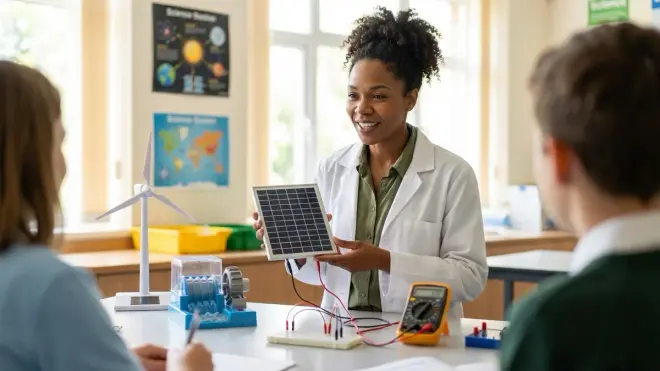
Every renewable energy project follows the same fundamental workflow, and understanding this architecture is essential before you invest in any kit. You're building a complete energy conversion system, not just assembling a gadget.
Energy capture is the first stage. Solar projects use photovoltaic cells (monocrystalline or polycrystalline silicon) to convert photons into electron flow through the photoelectric effect. Wind projects use airfoil-shaped blades to convert kinetic energy into rotational mechanical energy. Hydropower projects (less common in kits but gaining traction) use water flow to spin a turbine. Each capture mechanism has specific efficiency ceilings dictated by physics—the Betz limit for wind (59.3% theoretical maximum), Shockley-Queisser for silicon solar cells (around 33% under single-junction designs). Students learn these aren't arbitrary numbers; they're fundamental constraints that real engineers navigate daily.
Energy conversion comes next. Mechanical rotation from a wind turbine spins a generator—typically a DC motor running in reverse, transforming motion into electrical current. Solar panels output DC voltage directly, but it's variable: cloud cover, angle of incidence, and temperature all affect output. This is where students start using multimeters, learning to measure open-circuit voltage versus loaded voltage, and discovering why their panel reads 6V in spec sheets but delivers 4.8V under real-world conditions. That gap is the learning.
Energy storage and regulation separate beginner projects from intermediate ones. Basic kits light an LED directly from the source—instant gratification, minimal learning. Better kits include rechargeable batteries (NiMH or lithium polymer cells), charge controllers to prevent overcharging, and capacitors to smooth voltage spikes. Students learn why their turbine needs a rectifier to convert AC to DC, why a diode prevents backflow drain, and how to size a battery bank for overnight runtime. These are system integration skills—the same logic used in off-grid cabin installs or EV charging infrastructure.
Load testing and optimization is where real engineering begins. Students measure power output (voltage × current = watts), calculate efficiency (output power ÷ input power), and iterate on design variables. For solar: panel angle, shade mitigation, series versus parallel wiring. For wind: blade count, pitch angle, generator resistance. The eOUTILITY 100W Polycrystalline Solar Panel ships with test protocols and data worksheets, but the real skill is learning to ask why performance changed when you adjusted one variable. That's the mindset that leads to careers designing optimized renewable installations.
Data logging transforms these projects from one-off demos into true experiments. Intermediate and advanced kits integrate with Arduino or Raspberry Pi, allowing students to log voltage and current readings every second, graph performance over hours or days, and correlate output with weather data. Python libraries like matplotlib and pandas let students visualize their results—skills that transfer directly to energy monitoring systems in commercial solar farms. This is the pathway from learning to explain machine learning to kids to building predictive models for renewable energy forecasting.
Why Renewable Energy Science Projects Matter
The U.S. Bureau of Labor Statistics projects solar photovoltaic installer jobs to grow 48% between 2022 and 2032—faster than nearly any other occupation. Wind turbine technician roles are climbing at 45%. Your child won't just need coding skills; they'll need energy system literacy. They need to understand power curves, inverter efficiency, grid interconnection, and battery chemistry—concepts that renewable energy science projects introduce in tactile, memorable ways.
But the urgency is deeper than career prep. Every year I don't teach my nephew how to measure solar efficiency is a year he stays disconnected from the systems that will define his adulthood. These projects build climate competency, not just STEM skills. When students wire their own solar array and watch their phone charge from sunlight they captured, the abstract idea of "clean energy transition" becomes tangible. They internalize the constraints: energy density, intermittency, storage costs. They stop seeing renewables as magic and start seeing them as engineering problems—solvable ones.
These kits also prepare students for the maker economy and open-source hardware culture. Many advanced projects—like the OpenEnergyMonitor platform or Arduino-powered solar trackers—mirror tools used by DIY sustainability communities worldwide. Students learn to read datasheets, adapt open-source code, and troubleshoot systems with incomplete documentation. These are resilience skills. When your daughter can diagnose why her wind turbine stopped charging in a storm, she's developing the resourcefulness to maintain her own solar installation in a climate-uncertain future.
And candidly, the soft skills matter as much as the technical ones. Renewable energy projects fail often. A poorly soldered connection, a miscalculated blade angle, a battery that won't hold charge—these failures teach iteration, troubleshooting, and the humility required for real engineering work. I've watched students persevere through four turbine prototypes before achieving consistent output, and that persistence matters more than any single measurement they log.
Types of Renewable Energy Science Projects and Learning Pathways
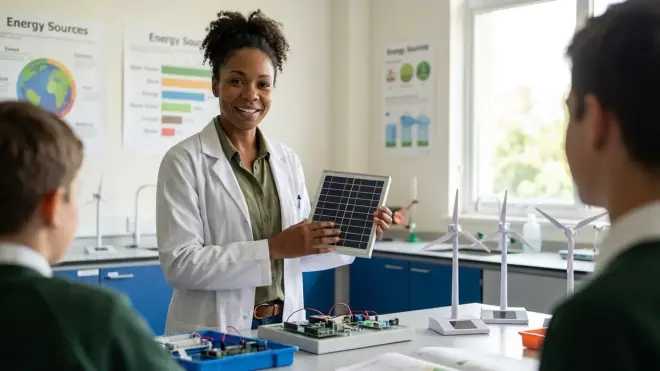
Not all renewable energy projects are created equal, and age-appropriate sequencing is critical for maintaining engagement without overwhelming foundational skills. Here's the progression that mirrors real engineering skill ladders.
Beginner Projects (Ages 8-11): Direct Conversion and Observation
Solar-powered cars, fans, and single-LED circuits dominate this tier. Students assemble pre-designed systems with minimal wiring—usually snap connectors or solder-free breadboards. The Thames & Kosmos Solar Power kit exemplifies this level: students build 15+ models (cars, planes, motorboats) powered by a single 1.5V solar panel, learning that energy capture determines speed and runtime. There's no data logging, no efficiency measurement—just cause-and-effect observation.
Simple wind turbines with hand-crank generators let students feel the resistance of generating electricity. They crank a handle, light an LED, and viscerally understand that energy conversion requires input effort. Kits like the Kidz Labs Dynamo Torch teach this without the complexity of actual wind capture.
Lab Specs at this level: No external power requirements (all energy self-generated), no software dependencies, full offline functionality. Durability is hit-or-miss—many kits use thin plastic gears prone to stripping. Expandability is minimal; these are closed systems. But they build observational fluency: students learn to identify when a panel is shaded, when a motor is overloaded, when a connection is loose. That diagnostic instinct is foundational.
Intermediate Projects (Ages 11-14): Measurement, Optimization, and System Integration
Multi-source energy kits with rechargeable storage define this tier. The Horizon Renewable Energy Science Education Set includes solar panels, a hand-crank generator, a small wind turbine, and a rechargeable NiMH battery. Students measure voltage with a built-in meter, compare output across energy sources, and calculate charge time versus discharge rate under different loads. For a deeper dive into project-specific techniques, see how to build a solar panel science project from scratch and how to create a wind turbine science project step-by-step.
DIY solar panel assembly projects let students wire individual photovoltaic cells in series and parallel, discovering firsthand how voltage and current scale. They solder tabbing wire, encapsulate cells in resin, and troubleshoot why their 6V panel only outputs 4V. This is where students encounter real-world inefficiency—and learn to accept it as a design constraint rather than a failure.
Arduino-integrated projects introduce data logging and automation. Students use voltage sensors and current sensors to feed readings into an Arduino Uno, log data to an SD card, and graph results in the Arduino IDE's Serial Plotter or export to Excel. The learning curve steepens here—students need basic C++ syntax, an understanding of analog-to-digital conversion, and patience for debugging sensor drift. But the payoff is huge: they're now using industry-standard microcontrollers, the same Arduino platform that powers thousands of open-source renewable energy projects worldwide.
Lab Specs: USB power for Arduino (5V DC, computer or wall adapter), Windows/Mac/Linux compatibility, offline IDE functionality (no cloud dependency). Expandability is excellent—students can add temperature sensors, humidity sensors, or motorized solar trackers. Durability depends on the student's soldering skill; poorly soldered connections are the primary failure point. Budget 10-15 hours for initial build and calibration, then ongoing experimentation.
Advanced Projects (Ages 14-18): Grid Simulation, Efficiency Optimization, and Hybrid Systems
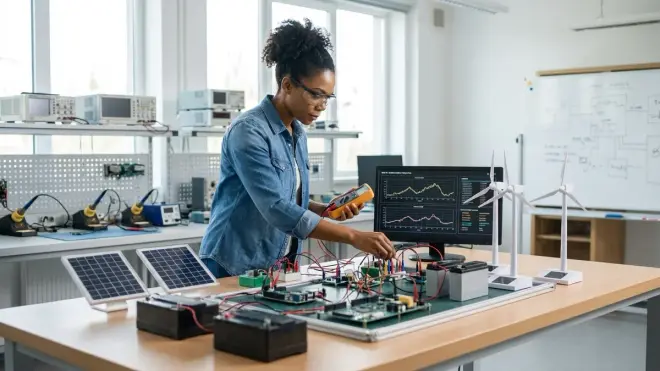
Solar tracking systems with servo motors teach closed-loop control. Students use light-dependent resistors (LDRs) to detect the sun's position, then program an Arduino to adjust panel angle via servo motors. They measure efficiency gains (typically 20-30% over fixed-tilt panels) and discover the trade-off: tracking systems consume power. This is the moment students internalize net energy analysis—a concept central to real renewable deployments.
Hybrid solar-wind-battery microgrids simulate real off-grid systems. Students wire multiple energy sources to a common charge controller, size a battery bank for 24-hour autonomy, and power a load (LED array, small fan, USB charging port). They learn about charge prioritization (solar during day, wind at night), inverter efficiency losses (DC to AC conversion), and why battery chemistry matters (lithium's energy density vs. lead-acid's cost). The Elenco Solar & Wind Renewable Energy Educational Kit includes a functional microgrid trainer board, though its wind turbine is underpowered and often disappointing in real-world conditions—students learn that manufacturer specs don't always translate to backyard performance, which is itself a valuable lesson.
Python-based data analysis projects move students beyond Arduino's limited processing power. They log data locally (Arduino + SD card or Raspberry Pi GPIO sensors), export CSV files, and analyze results in Python using pandas for data manipulation and matplotlib for visualization. They calculate capacity factors (actual output ÷ theoretical maximum), perform statistical regression on weather correlations, and present findings in science fair formats. For insights into related analytical skill-building, see how to measure solar panel efficiency in science projects.
Lab Specs: 120V AC power for battery chargers and inverters (household outlet), Python 3.x installed (Windows/Mac/Linux, fully offline), microcontroller compatibility (Arduino Uno/Mega/Nano, Raspberry Pi 3B+ or 4). Expandability is near-infinite—students can add weather stations, IoT connectivity (log data to cloud platforms), or even integrate machine learning models for output prediction. Durability is component-dependent; quality connectors (XT60 for batteries, MC4 for solar panels) matter. These projects span 30-50 hours of build and experimentation time.
For a comprehensive roadmap across age ranges, consult our renewable energy science fair projects checklist, which breaks down project complexity by grade level and competition standards.
Frequently Asked Questions {.faq-section}
What age is appropriate to start renewable energy science projects?
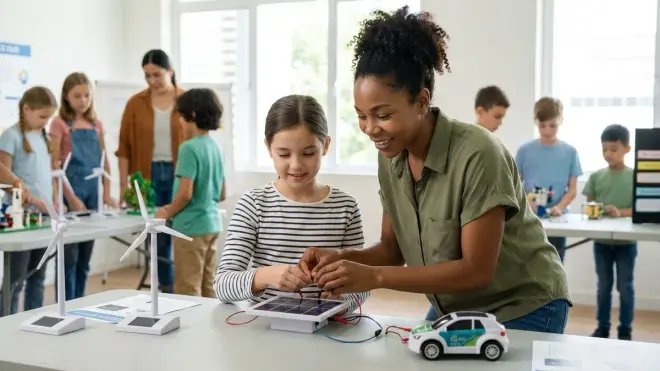
Children as young as 8 can start with direct-conversion projects like solar-powered cars or hand-crank generators that teach energy capture without requiring measurement skills or circuit theory. Around age 11, students typically have the fine motor skills and patience for soldering, multimeter use, and data logging, making this the ideal entry point for measurement-focused projects. By 14, students with foundational electronics knowledge can tackle Arduino integration, Python data analysis, and hybrid microgrid systems that mirror professional renewable energy engineering workflows. The key isn't chronological age—it's whether the student has mastered prerequisite skills like basic wiring, reading circuit diagrams, and troubleshooting with a multimeter. If your child has worked through screen-free coding progressions or built basic robots, they're ready for intermediate renewable projects regardless of age.
Do renewable energy kits require ongoing subscriptions or consumable purchases?
Most quality renewable energy kits are one-time purchases with no subscription requirements, but you will need to budget for replacement batteries, solder, and connectors as students expand or repair their systems. Solar panels and wind turbine generators have no consumables—photovoltaic cells last decades, and brushless motors rarely fail. However, rechargeable batteries degrade after 300-500 charge cycles (NiMH) or 500-1000 cycles (lithium polymer), requiring replacement every 1-3 years depending on use intensity. Advanced projects using Arduino or Raspberry Pi boards have no ongoing costs beyond SD cards for data logging (typically under $10 per card) and occasional sensor replacements if students accidentally over-voltage components. Avoid kits that lock you into proprietary software subscriptions—quality renewable energy education runs entirely on open-source tools like Arduino IDE, Python, and free data visualization platforms. The real ongoing investment is your time guiding troubleshooting, not consumable purchases.
Can renewable energy projects integrate with other STEM learning paths like coding or robotics?
Renewable energy projects integrate seamlessly with coding, robotics, and even AI learning paths, serving as real-world applications for programming and data science skills. Students who've mastered Scratch or Python basics can apply those skills to renewable projects: writing Arduino code to log solar panel voltage, using Python to analyze wind turbine performance over time, or building machine learning models that predict energy output based on weather data. Robotics students benefit even more—solar-powered autonomous rovers combine power system design with navigation algorithms, and Arduino-compatible robotics kits can mount solar panels for self-sustaining operation. If your child has worked with AI learning kits, renewable projects provide tangible datasets for supervised learning experiments: train a model to predict panel efficiency based on cloud cover and time of day. This cross-domain integration is exactly how professional engineering works—energy systems, embedded software, and data science converge in smart grid development and microgrid control systems.
How do I choose between solar and wind energy projects for my child's first kit?
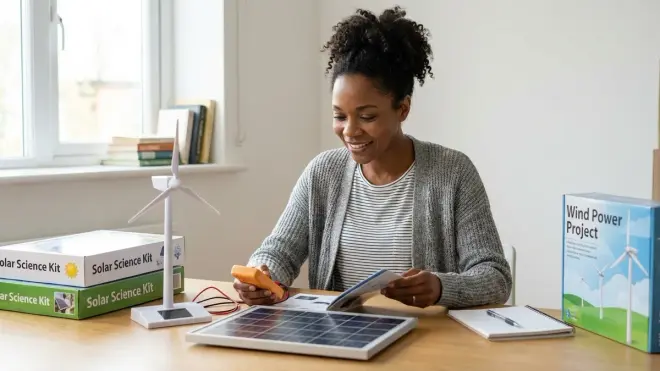
Solar projects are more forgiving for first-time learners because sunlight is predictable and panels require no mechanical tuning, while wind projects teach mechanical engineering through blade design but demand more troubleshooting patience. If your child is methodical and enjoys measurement and data analysis, solar projects deliver consistent results—you can test the same panel at 10 a.m. and 2 p.m. and see predictable variation based on sun angle. If your child thrives on mechanical tinkering and iterative design, wind projects offer richer hands-on learning: they'll adjust blade pitch, experiment with generator gearing, and discover why their three-blade turbine outperforms their two-blade prototype. Geography matters too—solar projects work anywhere with windows or outdoor space, while wind projects need consistent airflow (a fan works indoors, but real wind data requires outdoor mounting or field testing). For a detailed side-by-side analysis, see our solar vs wind energy projects comparison. Many students ultimately build both, using solar for reliable baseline power and wind for variable-condition experiments—that hybrid approach mirrors real-world renewable installations.
What tools and workspace are required to complete renewable energy science projects safely?
At minimum, you need a well-lit workspace with a grounded electrical outlet, a basic multimeter, safety glasses, and ventilation for soldering—most projects comfortably fit on a 3×4 foot desk or folding table. Beginner projects require only hand tools (screwdrivers, wire strippers) and no soldering, making them suitable for kitchen table assembly. Intermediate projects add soldering iron requirements (15-30W adjustable temperature), solder fume extraction (a small fan near an open window suffices), and a fire-resistant work surface (silicone mat or ceramic tile). Advanced projects with battery banks and inverters introduce higher-voltage DC circuits (12-24V systems), requiring insulated tools, proper fuse protection, and adult supervision to prevent short circuits that can start fires or damage components. For comprehensive workspace setup guidance, see our home STEM lab setup checklist, which covers power requirements, ventilation, and storage for ongoing projects. If you're building a dedicated learning space, consult how to organize a home STEM lab for workflow optimization. Never work with lithium batteries without a fireproof charging bag, and always use charge controllers—overcharging is the primary safety hazard in DIY renewable projects.
Summary
Renewable energy science projects don't just teach circuits and solar angles—they build the engineering literacy your child needs to navigate a climate-changed world with agency rather than anxiety. From first solar car builds to Arduino-logged microgrid systems, these projects form a progressive skill ladder that mirrors professional renewable energy engineering: energy capture, system integration, optimization, and data-driven iteration. The kits you choose matter less than the learning pathway you design—start with observation, advance to measurement, then to automation and analysis. Every voltage reading your daughter logs, every blade angle her son tests, every efficiency calculation they troubleshoot, is a step toward the kind of hands-on competency that turns abstract sustainability goals into concrete engineering solutions. This isn't about winning science fairs. It's about preparing the next generation to build the energy systems they'll need to inherit and improve. Start now, start simple, and trust that the skills compound faster than you expect.