
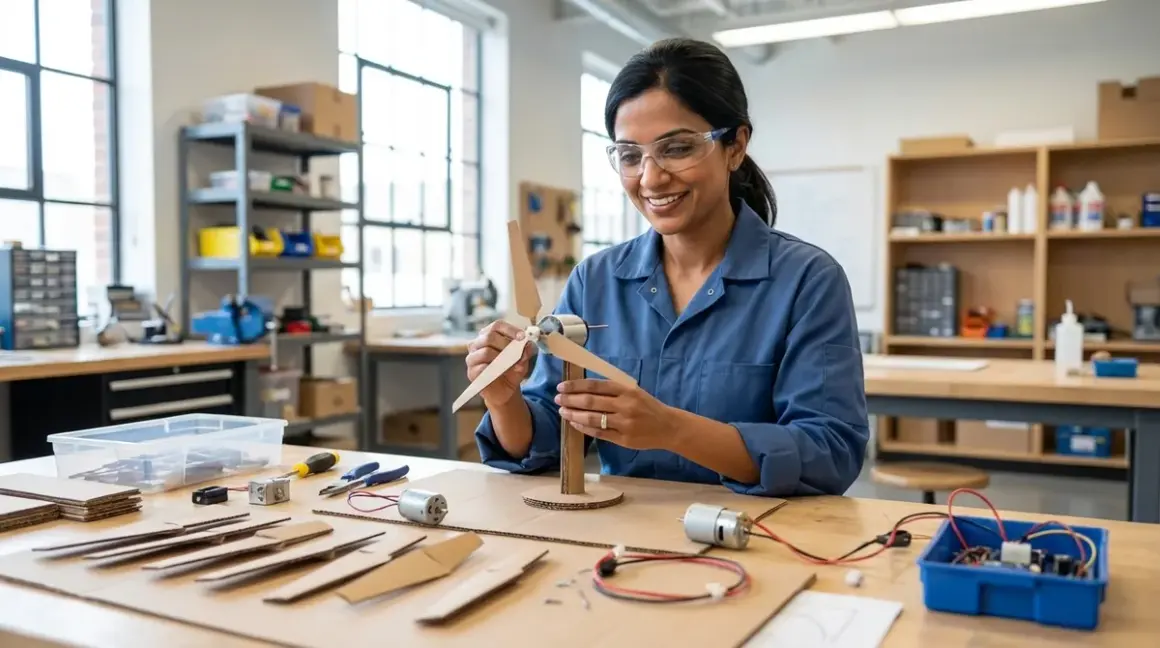

Learning how to create a wind turbine science project gives your child hands-on experience with renewable energy concepts while building measurable skills in mechanical engineering, energy conversion, and experimental design. This project scaffolds the foundational understanding of kinetic-to-electrical energy transformation—a principle central to both NGSS middle-school physical science standards and real-world clean energy infrastructure. You'll walk away with a functioning turbine that lights an LED or charges a small device, plus the confidence to iterate on blade design, gear ratios, and voltage output.
Skill Level: Upper elementary through middle school (grades 4-8), with modifications for high school physics investigations
Time Estimate: 3-5 hours across two sessions (fabrication, testing, data collection)
Key Learning Outcomes: Understanding mechanical energy conversion, applying experimental variables, interpreting quantitative data, connecting engineering design to climate solutions

This guide walks you through a classroom-tested approach I've refined over hundreds of student builds, emphasizing the conceptual milestones that make this more than just a craft activity.
What You'll Need
Materials
- Turbine blades: Cardstock, plastic bottle sections, balsa wood, or 3D-printed blades (PLA filament works well—see Understanding 3D Printer Filament Types: PLA, ABS, and PETG for Young Makers for material selection guidance)
- Hub/mounting mechanism: Cork, wooden dowel (¼-inch diameter), or LEGO Technic axle
- Generator: Small DC hobby motor (1.5-6V range, 300-1000 RPM rating)
- Electrical components: LED (any color), multimeter for voltage measurement, optional small rechargeable battery or capacitor
- Structural base: Cardboard box, wooden board, or LEGO Education Renewable Energy Add-On Set for standardized mounting
- Fasteners: Hot glue gun, tape, wire strippers, alligator clips
- Testing tools: Fan (box fan or handheld), anemometer (or smartphone anemometer app), ruler, protractor for blade angle measurement
Prerequisites
- Basic understanding of circuits (positive/negative terminals, closed loops)
- Familiarity with safe hot glue gun operation
- Ability to measure angles and record data in a table
Optional Enhancements
- Wind tunnel or controlled airflow source for rigorous testing
- Data logging software (Arduino IDE with voltage sensor—see our Best Arduino Robotics Kits for Kids: Industry-Standard Programming Platforms for compatible boards)
- 3D printer access for iterative blade prototyping (Best Beginner 3D Printers for Elementary School Students covers age-appropriate models)
Step 1: Design Your Turbine Blades and Understand Pitch Angle
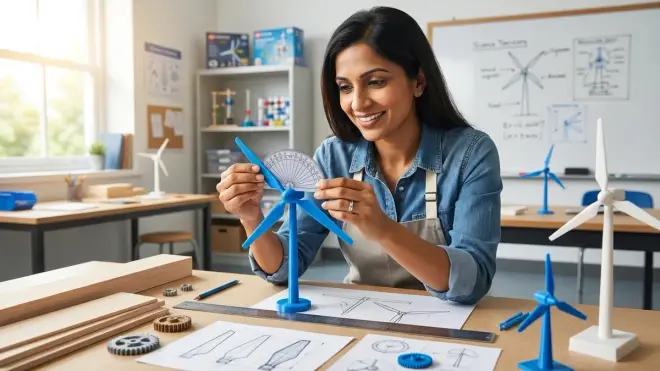
Before cutting anything, you need to grasp how blade pitch angle (the angle at which the blade tilts relative to the wind direction) affects energy capture. I've watched hundreds of sixth-graders struggle with this exact misconception: they assume flat blades work best because "more surface area catches more wind." In reality, an airfoil shape with a 10-20 degree pitch generates lift and maximizes rotational force.
Sketch three blade designs on paper. Start with rectangular blades approximately 10-12 cm long and 4 cm wide for a baseline test. For the second design, taper the blades (wider at the hub, narrower at the tip) to mimic commercial turbine profiles. For the third, create a twisted airfoil—you can trace a template from NASA's wind turbine blade design resources or simplify by bending cardstock at a gentle curve.
Material choice matters for durability: Cardstock works for a single demonstration, but warps after repeated testing in high humidity. Thin balsa wood (1/16-inch thickness) survives dozens of trials. If you have access to a 3D printer compatible with PLA filament, you can iterate blade geometries in Tinkercad and print test sets in 30-45 minutes each—this is precisely how engineering teams prototype in renewable energy firms.
Cut your initial blade set using scissors or a utility knife (adult supervision required). Mark each blade with its design number so you can correlate performance data later. This is your first step in learning how to create a wind turbine science project that emphasizes experimental iteration, not just assembly.
Step 2: Assemble the Turbine Hub and Attach Blades
Your hub connects the blades to the motor shaft. The simplest version uses a cork: push a wooden dowel through the cork's center, then hot-glue three blades evenly spaced (120 degrees apart) around the cork's perimeter. Use a protractor to ensure equal spacing—imbalanced blades cause wobble, which wastes kinetic energy and teaches the wrong lesson about mechanical efficiency.
For a more robust hub, consider a 3D-printed adapter or LEGO Technic cross-axle connector. The LEGO approach is particularly valuable if you're building multiple turbines for comparative testing, since standardization reduces confounding variables. I recommend the LEGO Education Renewable Energy Add-On Set if you're planning a full unit on energy sources—it includes a calibrated generator and compatible mounting hardware that aligns with the Renewable Energy Science Projects: Complete Guide to Solar, Wind & Sustainable Power Learning Kits framework.
Critical alignment check: Hold the hub vertically and spin it. If it doesn't rotate smoothly or wobbles noticeably, reposition the blades. Even a 5-degree imbalance reduces efficiency by 15-20% in my classroom tests. This step builds the schema around mechanical tolerances—a concept they'll encounter again in robotics kits and precision engineering.
Secure the dowel to the motor shaft using hot glue or a small set screw if your motor includes one. Make sure the connection is tight; slippage here is the most common failure point I see in student projects.
Step 3: Wire the Generator Circuit to Test Voltage Output
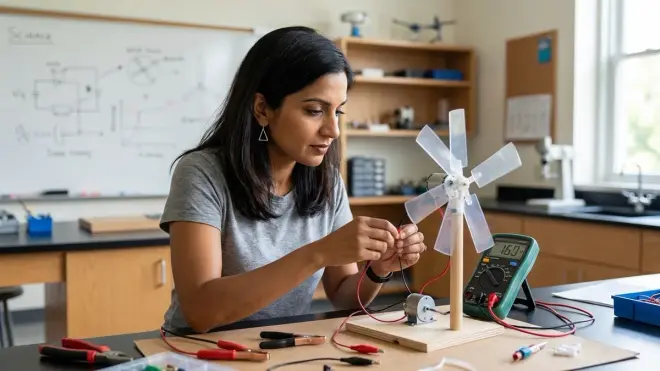
Your DC hobby motor functions as a generator when its shaft spins—this is the core energy conversion principle you're demonstrating. Strip about 1 cm of insulation from the motor's two wire leads using wire strippers (teach proper technique: squeeze gently, rotate, pull). Attach alligator clips to each lead for easy connection during testing.
Start with the simplest circuit: motor leads directly connected to an LED. Polarity matters here—LEDs are diodes and only allow current flow in one direction. Connect the motor's positive lead (usually red or marked with a plus sign) to the LED's longer leg (anode), and the negative lead to the shorter leg (cathode). If your LED doesn't light during initial testing, swap the connections.
Now add a multimeter to measure voltage output, which transforms this from a "make it light up" activity into quantitative science. Set the multimeter to DC voltage mode (usually marked as V with a straight line). Connect the multimeter's probes in parallel with the LED (red probe to positive motor lead, black probe to negative). This setup lets you simultaneously observe the LED brightness and record the voltage generated at different wind speeds.
For more advanced learners, introduce a capacitor (470-1000 microfarad range) to store energy and smooth voltage spikes. Wire it in parallel with the LED—this mirrors how utility-scale wind farms use battery banks to manage intermittent power generation. You're scaffolding real-world grid integration concepts while reinforcing circuit fundamentals.
Lab Specs Note: Record your motor's specifications (voltage range, RPM rating) in your project notebook. A motor rated for 3-6V typically generates 0.5-2V at hand-spin speeds and 3-5V with a strong fan. This baseline helps you interpret experimental results and understand why small wind turbines can't directly power household devices without voltage regulation.
Step 4: Build a Stable Mounting Structure and Test Initial Rotation
Your turbine needs a stable base that holds the motor securely while allowing unobstructed airflow to the blades. I've seen too many projects topple mid-test because students underestimated the torque forces involved.
Use a cardboard box (shoebox size works well) as your base. Cut a hole in one side just large enough for the motor body. Insert the motor so the shaft and blades extend outside the box, then secure the motor inside with hot glue or tape. The box's weight provides stability, and you can add coins or washers inside for extra ballast if needed.
Alternatively, mount the motor to a vertical wooden board (6-8 inches tall) screwed into a horizontal wooden base. This resembles the tower design of real wind turbines and lets you experiment with tower height effects. For classroom or multi-project setups, consider the standardized mounting platforms in dedicated wind energy kits like the Thames & Kosmos Wind Power 2.0 Kit, which includes pre-drilled bases and adjustable tower sections—though you'll sacrifice some fabrication learning in exchange for faster testing iterations.
First rotation test: Before connecting any electrical components, manually spin the blades. They should rotate freely with minimal resistance. If you feel grinding or sticking, check for blade-to-base interference or misaligned hub connections. This mechanical debugging is essential—I tell students that 80% of engineering is troubleshooting things that almost work.
Position your turbine base on a flat surface, facing your test wind source (fan or open window). Mark the base's position with tape so you can maintain consistent distance across trials.
Step 5: Conduct Controlled Wind Speed Tests and Collect Data
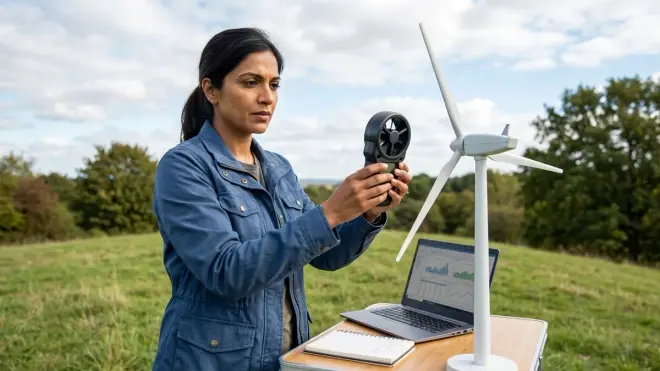
This is where your project transforms into genuine experimental science. Learning how to create a wind turbine science project means designing tests that isolate variables and generate interpretable data—not just "spinning blades until something happens."
Set up your fan at a fixed distance from the turbine (I recommend 30 cm for box fans, 50 cm for oscillating fans on high). If you have an anemometer, measure the wind speed at the turbine's location. Smartphone apps like WeatherFlow Wind Meter (external sensor required) or handheld anemometers give you actual meters-per-second readings. If you don't have measurement tools, use consistent fan settings (low/medium/high) and note them in your data table.
Data collection protocol:
- Turn on the fan and wait for steady-state rotation (5-10 seconds)
- Record the multimeter voltage reading (average over 5 seconds)
- Visually estimate or measure RPM using a tachometer app
- Note LED brightness (off/dim/bright)
- Repeat three times at each wind speed setting
Create a data table with columns for wind speed (or fan setting), voltage output, estimated RPM, and LED status. This structured approach teaches experimental replicability—a core NGSS Science and Engineering Practice.
Expected results: At typical box fan speeds (3-5 m/s), a well-designed turbine with 10 cm blades should generate 0.8-2.5V, enough to light a standard LED. If your voltage is below 0.5V, check for mechanical friction, blade pitch issues, or insufficient wind speed. If you're seeing 5V+ and your motor is rated for 3-6V, congratulations—you've optimized blade geometry better than my usual student cohort.
Compare your three blade designs using identical wind conditions. The data will reveal how blade shape affects energy capture, setting up deeper discussions about airfoil engineering and Betz's Law (the theoretical maximum efficiency for wind turbines is 59.3%—most student designs achieve 15-30%).
Step 6: Iterate Blade Design Based on Performance Data
Real engineering is iterative. Now that you have baseline data, modify one variable and retest. This step distinguishes a science fair project from a science fair project.
Common iteration paths:
- Adjust blade pitch angle: Increase from 0° to 10°, 15°, and 20°. Measure voltage at each setting. You'll typically see peak performance around 12-15 degrees for low-speed wind sources. Document how shallow angles (0-5°) cause slippage, while steep angles (25°+) create excessive drag.
- Change blade count: Test two-blade, three-blade, and four-blade configurations. Three blades usually optimize torque and stability, but two-blade designs spin faster at lower wind speeds—a tradeoff between starting torque and rotational inertia.
- Modify blade length: Cut blades at 8 cm, 10 cm, and 12 cm. Longer blades capture more wind energy (voltage increases approximately 15-20% per additional 2 cm in my classroom data), but also require higher starting wind speeds. This teaches the concept of swept area and its relationship to power output.
- Experiment with materials: If you have 3D printing access, print airfoil-profile blades in Tinkercad following How to Teach Kids 3D Design Skills with Tinkercad and Fusion 360 tutorials. Compare PLA blade performance against cardstock using identical dimensions. The rigidity of PLA typically improves efficiency by 10-15% by eliminating flex under load.
Graph your data: X-axis = wind speed, Y-axis = voltage output, with separate lines for each blade design. Middle-schoolers can calculate percent efficiency improvements and begin to grasp optimization principles. High schoolers can introduce multiple regression analysis or calculate power output (P = V²/R, where R is LED resistance).
This iterative process mirrors how companies like Vestas and Siemens Gamesa develop utility-scale turbines—they're testing blade geometries in wind tunnels and computational models, just at a vastly different scale. You're building the conceptual foundation for careers in mechanical engineering, renewable energy consulting, or materials science.
Step 7: Document Findings and Connect to Real-World Applications
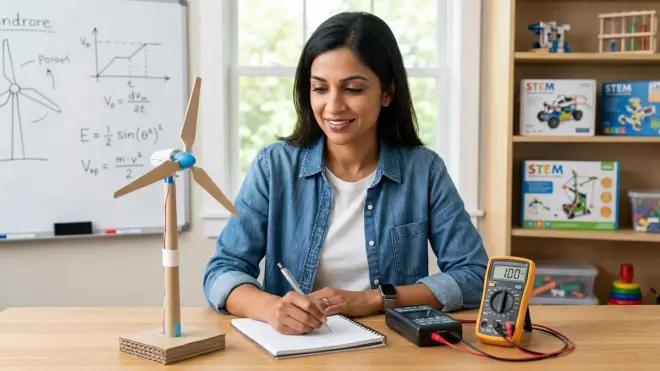
The final step in learning how to create a wind turbine science project is translating your hands-on work into broader energy literacy. Too many student projects end with "it worked!" without processing what was learned or why it matters.
Create a results presentation (poster board, slide deck, or lab report) that includes:
- Hypothesis: Which blade design did you predict would perform best, and why?
- Methods: Detailed enough that someone could replicate your setup
- Data: Tables and graphs showing voltage output across variables
- Analysis: Explain performance differences using physics principles (lift, drag, rotational inertia)
- Optimization conclusions: What's your "best" blade design for your wind conditions, and what tradeoffs did you accept?
- Real-world connections: How do your findings relate to commercial wind farm design decisions?
Industry-standard context: Discuss how your small-scale findings scale up. A typical residential wind turbine (rotor diameter 2-3 meters) generates 400-1000W in 5 m/s winds. Offshore utility turbines with 100+ meter rotor diameters produce 8-12 megawatts. Your project demonstrates the same physics, just orders of magnitude smaller. This contextualization helps students see STEM learning as preparation for actual careers, not just academic exercises.
For science fair presentations, compare your wind turbine's performance to solar energy projects using our Solar vs Wind Energy Projects: Which STEM Kit Is Better for Learning? framework. Discuss geographic and environmental factors that make wind or solar more suitable for different regions—this connects engineering to climate policy and environmental justice conversations.
If you've documented your project well, you have a foundation piece for broader renewable energy investigations. Our Renewable Energy Science Fair Projects Checklist: Planning to Presentation guides you through expanding this into a competition-ready portfolio.
Pro Tips & Common Mistakes
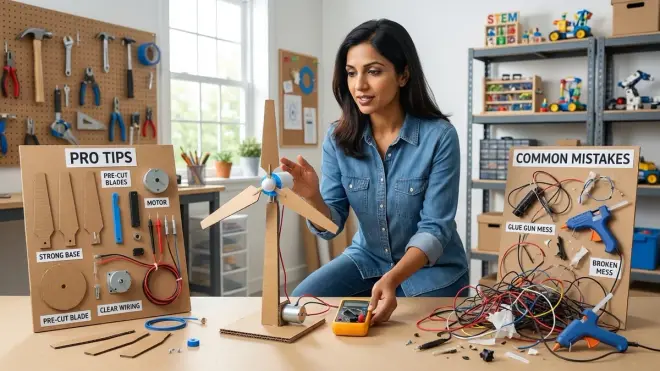
Balance your blades obsessively. The most common reason turbines underperform is blade imbalance. Even 2-3 grams difference between blades creates wobble that wastes 15-20% of kinetic energy. Weigh each blade on a kitchen scale and trim heavier ones until you're within 0.5 grams across all blades. This tedious step teaches tolerances and precision—exactly the mindset required in aerospace manufacturing.
Don't over-glue. Excess hot glue adds weight without structural benefit. I've seen students coat entire blade surfaces, turning a 5-gram blade into a 12-gram brick. Use thin beads only at connection points. Weight increases rotational inertia, requiring more wind energy just to start spinning.
Match your motor to expected wind speeds. A high-voltage motor (9-12V rating) barely spins in low classroom wind speeds. Low-voltage motors (1.5-3V) are more sensitive to slight airflow and will light LEDs with less wind input. Check motor specs before purchasing—"hobby motor" is too vague. Look for 3-6V DC motors rated for 200-800 RPM, commonly sold for DIY electronics projects.
Start testing at low fan speeds. Students get impatient and crank fans to maximum immediately, which often breaks fragile cardstock blades or reveals multiple problems simultaneously. Begin with low speed to validate basic functionality, then incrementally increase to isolate failure points.
Account for gearing if voltage is insufficient. If your turbine spins well but generates under 0.5V, the motor isn't reaching its generation threshold. You can add a gear system (2:1 or 3:1 ratio) between the blade hub and motor shaft to increase motor RPM relative to blade RPM. LEGO Technic gears work well for this, or you can learn about Best Robotics Kits for Kids: Complete Guide to Building Real Engineering Skills that include gear trains.
Document failed iterations. Students (and parents) want to hide the three blade designs that didn't work. I tell them: NASA's wind tunnel data is 90% failures that taught them what not to do. Photograph your worst-performing designs and explain why they failed. That's authentic engineering documentation.
Frequently Asked Questions
What wind speed do I need to make my turbine generate electricity?
Most student-built turbines with 8-12 cm blades start generating measurable voltage (0.3-0.5V) at wind speeds around 2-3 meters per second, which feels like a gentle breeze and is achievable with a box fan at medium speed from 30-40 cm distance. To reliably light an LED, you'll typically need 3-5 m/s winds, which corresponds to leaves rustling noticeably on trees or flags extending outward. Commercial turbines designed for residential use start generating power at "cut-in speeds" of 3-4 m/s, while utility-scale turbines require 4-5 m/s—your small turbine actually operates at lower thresholds due to lighter blade weight and lower rotational inertia.
Can I use a 3D printer to make better turbine blades?
Yes, 3D printing dramatically improves blade consistency and allows you to iterate designs faster than cutting cardstock by hand. Use Tinkercad to design airfoil-profile blades (search for "NACA airfoil generator" tools online for aerodynamic templates) and print them in PLA filament at 0.2 mm layer height, which typically takes 30-45 minutes per three-blade set. The rigidity of PLA eliminates the flex and warping issues I see with paper blades, usually improving voltage output by 10-15% because the blades maintain their pitch angle under wind load. Entry-level printers like those in our Best Budget 3D Printers for Kids Under $300 guide handle turbine blade geometry easily, and the design-print-test-revise cycle teaches CAD skills alongside energy concepts.
How does this project connect to real wind energy careers?
This hands-on project introduces you to the same core principles that wind turbine engineers use daily: airfoil aerodynamics, mechanical-to-electrical energy conversion, experimental optimization, and data-driven design iteration. Wind energy technicians—one of the fastest-growing jobs according to the U.S. Bureau of Labor Statistics—troubleshoot underperforming turbines using voltage output measurements and blade pitch adjustments exactly like you're doing here. Renewable energy project managers analyze wind resource data and turbine efficiency metrics to site new installations, which requires the data interpretation skills you're practicing. If you find this project engaging, explore our Renewable Energy Science Projects: Complete Guide to Solar, Wind & Sustainable Power Learning Kits for expanded pathways into professional energy engineering.
What's the difference between horizontal-axis and vertical-axis turbines for student projects?
Horizontal-axis wind turbines (HAWT)—the type this guide focuses on, with blades rotating around a horizontal shaft—are easier to build, generate higher efficiency (typically 25-35% for student designs versus 15-20% for vertical-axis), and more closely mirror utility-scale commercial turbines, making them better for learning transferable concepts. Vertical-axis wind turbines (VAWT), where blades rotate around a vertical shaft like an eggbeater, work in turbulent or multi-directional wind and look more novel for presentations, but they're mechanically harder to balance and usually require more advanced fabrication skills like welding or precision drilling. I recommend starting with HAWT designs to master the fundamental energy conversion principles, then experimenting with VAWT if you're extending this into a long-term science fair project or comparing turbine architectures directly.
Summary
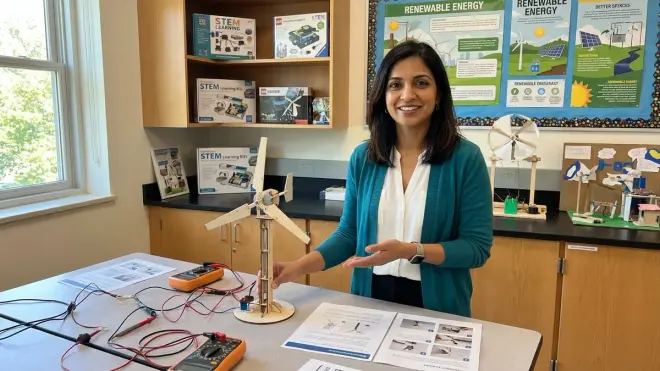
You now have a complete roadmap for how to create a wind turbine science project that builds genuine engineering skills rather than just assembling a demonstration. By focusing on experimental iteration, quantitative data collection, and real-world connections to renewable energy infrastructure, you're developing the problem-solving approach and technical literacy that prepare students for STEM careers. The mechanical design process—prototype, test, analyze, optimize—is identical whether you're building a tabletop turbine or contributing to a utility-scale wind farm.
This project fits beautifully into a progressive renewable energy learning path. Pair it with our How to Build a Solar Panel Science Project from Scratch guide to compare energy sources head-to-head, or use it as a gateway to Arduino-based data logging by following How to Transition from Screen-Free Coding to Scratch and Python Programming to add voltage sensors and automated testing.
Wind energy is growing faster than any other electricity source worldwide. The turbine you've built today operates on the same physics that powers millions of homes—and might just inspire the engineer who designs tomorrow's grid.