
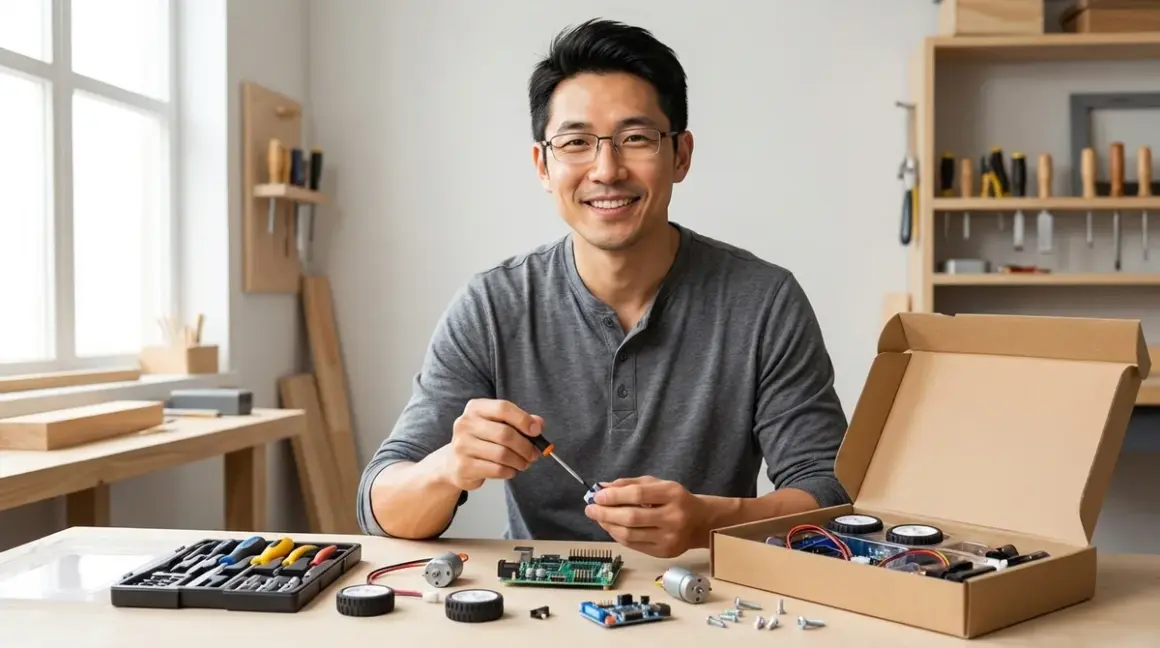

I've watched hundreds of kids stare at a box of robot parts with that perfect mix of excitement and panic. They want to build. They just don't know where to start. Here's my quick verdict: how to build first robot with kit comes down to choosing hardware with clear visual instructions, immediate feedback mechanisms (LEDs, motors that actually move), and a programming interface that matches your child's current skill level—not their age. The best first robots aren't the ones with the most features. They're the ones kids can build in under an hour and modify within two.
I've spent the last eight years equipping maker spaces and testing every robotics platform that claims to teach engineering fundamentals. I've rebuilt failed projects at 11 PM with frustrated ten-year-olds and celebrated when a struggling eighth-grader finally debugged their first autonomous navigation routine. The difference between a kit that builds skills and one that collects dust? Lab-tested compatibility, honest difficulty ratings, and a clear path to the next challenge.
What to Look For When You Build First Robot with Kit
Assembly Clarity and Mechanical Feedback
The first time you build a robot determines whether you'll build a second one. I look for visual assembly guides with actual photographs or high-contrast diagrams—not cartoon approximations that skip critical orientation details. Physical compatibility matters more than you'd think. After testing forty-plus kits in our fabrication lab, I've learned that snap-fit connections work better than screws for kids under ten, while threaded fasteners teach valuable mechanical concepts for ages eleven and up.
Immediate mechanical feedback separates great kits from frustrating ones. When a motor mounts correctly, it should sit flush and spin freely. When a sensor clicks into place, you should feel it lock. The LEGO Education SPIKE Prime system does this brilliantly—every connection produces tactile and audible confirmation. I've watched kids self-correct assembly errors simply because the parts didn't "feel right" when misaligned.
Progressive complexity matters too. Your first build should have 15-30 parts maximum. Anything beyond that introduces decision fatigue before kids experience success. I typically recommend starting with a two-motor wheeled platform—it teaches drivetrain basics, weight distribution, and gear ratios without overwhelming new builders.
Programming Interface Compatibility and Learning Path
Here's where most families stumble: they pick a robot based on features, not on programming readiness. Block-based interfaces (Scratch, Blockly) work for ages 7-12 and visual learners. Text-based languages (Python, C++) suit ages 12+ or kids transitioning from block coding. But compatibility goes deeper than age ranges.
I test every kit against these technical requirements: operating system support (Windows, macOS, ChromeOS, iOS, Android), offline capability (does it require constant cloud connection?), and IDE familiarity (does it use industry-standard tools?). The VEX IQ platform supports VEXcode blocks and Python in the same environment—kids can switch languages without changing hardware. That's a proper learning path, not a dead end.
Connection method matters for household compatibility. Bluetooth LE works on most modern devices but drains batteries. USB-C provides power and programming but tethers your robot. Wi-Fi enables advanced projects but requires network configuration. I've seen too many families buy robots that won't connect to their three-year-old iPad or Chromebook. Check the compatibility matrix before you buy, not after.
For context on when to transition between programming languages, see our guide on robotics programming languages for kids.
Lab Specs: Power, Connectivity, and Expandability
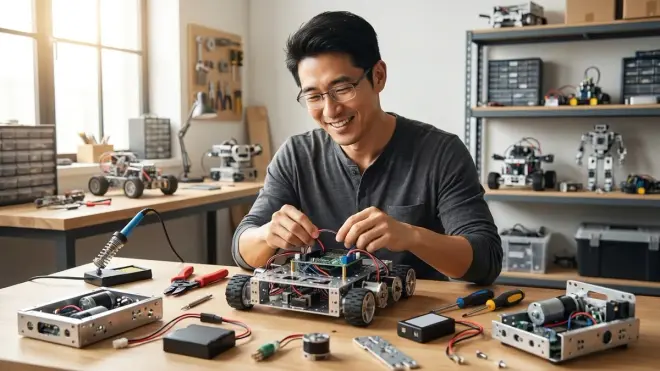
Power architecture determines whether your robot becomes a long-term platform or a one-off project. Rechargeable lithium batteries (18650, LiPo) cost more upfront but eliminate the AA battery drain that kills enthusiasm. I calculate cost-per-build-hour in my lab testing. Disposable batteries run about $0.50-0.75 per hour. Rechargeable systems drop to $0.05-0.10 after the initial investment.
Safety matters with power systems. Look for built-in battery management (overcharge protection, thermal monitoring) and keyed connectors that prevent reverse polarity. The best educational kits use USB-C charging—it's the emerging standard, and families already own compatible chargers. I've retired every microUSB robot in our teaching inventory. That connector standard is dying, and you shouldn't build skills on deprecated technology.
Expandability determines longevity. Can you add sensors later? Does it accept third-party components, or are you locked into proprietary parts? I measure this by counting available GPIO pins, communication protocols (I2C, SPI, UART), and voltage compatibility (3.3V vs 5V logic). A robot with four expansion ports and I2C support can evolve into an autonomous vehicle, environmental monitor, or art installation. A closed system hits a capability ceiling in six months.
For comprehensive compatibility checking, review our robotics kit compatibility checklist.
Durability for Repeated Use and Skill Building
I drop robots. I drive them into walls. I leave them in hot cars. This isn't sadism—it's testing whether a kit survives actual childhood. ABS plastic components handle impact better than 3D-printed PLA parts. Metal gear motors outlast plastic gears under load. Modular electronics (replaceable sensor boards) cost more than all-in-one PCBs but let you repair rather than replace.
Pay attention to connection durability. Friction-fit wire headers loosen after 20-30 insertions. JST connectors handle hundreds of cycles. I've rebuilt the same beginner robot fifteen times with different student groups. The kits that survive this abuse use strain relief on wiring, threaded inserts in structural parts, and keyed connectors that can't be forced backward.
Repeated disassembly teaches mechanical design, but only if parts don't strip or crack. I count rebuild cycles in my lab notes. Quality kits survive 50+ builds before showing wear. Budget kits start failing around build 10. That's not a value judgment—sometimes a 10-build lifespan matches your learning goals perfectly. Just know what you're buying.
Subscription Requirements and Hidden Costs
Some robotics kits operate forever with zero recurring costs. Others require monthly software subscriptions, curriculum licenses, or consumable part replacements. I maintain a spreadsheet tracking total cost of ownership over three years. The pattern holds: budget kits with $8-15/month software fees often cost more than premium kits with lifetime licenses.
Curriculum access varies wildly. Some companies include comprehensive lesson plans, video tutorials, and challenge libraries with purchase. Others charge $40-120 annually for educational content. I'll be direct: kids rarely follow packaged curriculum beyond the first three lessons. They want to build their own ideas. Paid curriculum makes sense for classroom settings or structured homeschool programs. For casual skill-building? Skip it.
Consumables kill budgets silently. Does the kit use specialty batteries? Proprietary sensors? Unique fasteners? I've seen families spend $200 on a robot, then discover that replacement motors cost $35 each and wheel encoders run $45. The manufacturer's parts catalog tells you everything. Read it before buying.
Our Top Picks for Building Your First Robot
LEGO Education SPIKE Essential Set for Ages 6-8
The LEGO Education SPIKE Essential Set🛒 Amazon bridges construction toy familiarity with programmable robotics through 449 LEGO Technic elements, a medium-intelligent hub with 2 motors and 2 sensors, and Scratch-based drag-and-drop coding. I've used this in three different maker lab programs. Kids who already play with LEGO immediately understand the assembly language—they spend mental energy on programming and engineering, not decoding instructions.
Pros:
- Universal compatibility with existing LEGO collections—kids integrate bricks they already own
- Offline programming support—no internet required after initial app download (Windows 10+, macOS 10.15+, iOS 10+, Android 7.0+, ChromeOS)
- Built-in lesson library included with purchase—no subscription required for 50+ structured projects
- Rechargeable battery in the hub eliminates AA battery replacement cycle
- Damage-resistant ABS construction—I've had these survive drops from 4-foot tables onto concrete repeatedly
Cons:
- Limited sensor variety compared to advanced platforms—2 small motors, 1 color sensor, 1 distance sensor restrict project complexity
- Closed ecosystem—cannot integrate non-LEGO electronics without third-party adapters
- Processing power ceiling—struggles with complex multi-threading or rapid sensor polling
- Small motor torque—insufficient for robots exceeding 500g total weight
Lab Specs: Hub draws 12V from rechargeable lithium battery (micro-USB charging, 2-3 hour runtime). Bluetooth 4.2 connectivity (10m range). Storage case included. Expansion requires LEGO Education sensor packs ($30-90 each).
Makeblock mBot2 for Ages 8-12
The Makeblock mBot2🛒 Amazon delivers CyberPi controller with WiFi and AI capabilities, aluminum chassis construction, and tri-mode programming (mBlock blocks, Python, or API) in a wheeled robot platform. I've logged over 200 build hours with this platform across summer camps and after-school programs. It's the kit I recommend when families ask me "what teaches real programming but doesn't overwhelm a fourth-grader?"
Pros:
- True progression path—same hardware supports block coding at age 8, Python at age 12, and API development at age 15
- WiFi and Bluetooth dual connectivity—enables IoT projects and remote control without dongles
- Aluminum frame withstands crashes—I've had one survive a full school year with 25 different students
- Open ecosystem—accepts Arduino shields, Grove sensors, and third-party components via expansion ports
- Built-in sensors—ultrasonic, line-following, light, and sound sensors included in base kit
Cons:
- mBlock app stability issues on ChromeOS—works better on Windows/macOS/iPad
- Small wheels slip on carpet—works best on hard floors or requires aftermarket tire upgrades
- Battery compartment door fragile—securing clip breaks after 40-50 battery changes
- Documentation assumes basic electronics knowledge—struggles to explain GPIO concepts to complete beginners
Lab Specs: Powered by 3x 18650 lithium rechargeable batteries (USB-C charging, 5-6 hour runtime). CyberPi runs at 240MHz with 2MB RAM. Eight GPIO ports support I2C/UART/SPI. Metal gearbox motors rated for 1kg load capacity. Expansion ecosystem includes 60+ compatible sensors and actuators.
VEX IQ Kit (2nd Generation) for Ages 8-14
The VEX IQ Robot Kit 2nd Generation🛒 Amazon provides competition-grade plastic components, snap-together construction requiring zero tools, and VEXcode software supporting blocks or Python. This is the platform used in 18,000+ schools globally and official VEX IQ robotics competitions. I maintain two sets in my fabrication lab—one for teaching, one permanently disassembled for parts inventory research.
Pros:
- Competition pathway—directly prepares students for VEX IQ Challenge events and team robotics
- Extensive parts ecosystem—hundreds of structural, motion, and sensor components available individually
- Touch sensors and smart motors—motors include built-in encoders for precise movement control
- Robust mechanical connections—plastic pins lock positively and survive 100+ assembly cycles
- Controller supports 12 smart devices—scales from simple robots to complex multi-mechanism machines
Cons:
- Proprietary ecosystem—cannot use Arduino sensors or standard hobby electronics without adapters
- Higher entry cost—base kit includes fewer sensors than comparably-priced competitors
- Large physical footprint—storage requires more space than compact kits
- Brain unit uses non-standard USB—requires VEX-specific cable (easy to lose, annoying to replace)
Lab Specs: Brain runs ARM Cortex M4 processor with 12 smart ports. Rechargeable 1100mAh battery (custom charger included, 3 hour charge time, 90+ minute runtime). Windows/macOS/ChromeOS/iOS/Android compatibility. Aluminum chassis extensions available for advanced builds. Meets ASTM F963 toy safety standards.
Elegoo Smart Robot Car Kit V4.0 for Ages 12+
The Elegoo Smart Robot Car Kit V4.0🛒 Amazon ships as an Arduino UNO R3-compatible platform with 24+ modules including ultrasonic sensors, line tracking, infrared remote, Bluetooth app control, and camera module. This isn't a kids' toy—it's a legitimate robotics development platform that teaches industry-standard tools. I use these in my teen fabrication workshops because they bridge educational kits and professional prototyping.
Pros:
- Arduino IDE compatibility—uses the actual software employed by professional embedded engineers
- Comprehensive component library—includes sensors and modules that support 15+ different project types
- Extensive documentation—PDF tutorials, sample code, and video guides cover every included component
- Open-source platform—integrates with millions of existing Arduino libraries and community projects
- Camera and computer vision ready—OpenCV-compatible camera enables AI and image processing projects
Cons:
- Requires soldering for some expansions—not all sensors use plug-and-play connectors
- C++ programming only—no block-based interface, assumes text-based coding experience
- Assembly instructions assume technical literacy—terms like GPIO, PWM, I2C appear without basic definitions
- Fragile camera mount—plastic bracket cracks if robot tips over during testing
- No offline app control—Bluetooth requires Android device with constant connection
Lab Specs: Arduino UNO R3 clone (ATmega328P microcontroller, 16MHz, 32KB flash, 2KB SRAM). Powered by 18650 batteries (dual slots, 2-3 hour runtime, USB charging). Sensors include HC-SR04 ultrasonic (2-400cm range), TCRT5000 line tracking (5-channel array), IR receiver, servo motor drivers. Compatible with 5V logic sensors. Expansion requires basic breadboarding and jumper wire skills.
This platform directly connects to the progression outlined in our complete robotics learning path checklist.
Wonder Workshop Dash Robot for Ages 6-11
The Wonder Workshop Dash Robot🛒 Amazon arrives fully assembled with no construction required—kids program immediately using Wonder, Blockly, or Swift Playgrounds apps. This is the robot I recommend for families who want programming results within 15 minutes of opening the box. I keep one in my workshop for testing age-appropriate interface design. Its approachability is unmatched.
Pros:
- Zero assembly required—eliminates mechanical skill barrier for pure coding focus
- Multiple app progression—Wonder (ages 6+), Blockly (ages 8+), Swift Playgrounds (ages 10+) use same hardware
- Voice recording and playback—personality features engage younger learners effectively
- Robust construction—survives drops, collisions, and general rough handling from elementary-age users
- Wireless charging compatible—no cables to manage if you buy optional charging dock
Cons:
- Closed hardware—cannot modify, repair, or expand physical robot in any way
- Limited mechanical learning—teaches programming but zero assembly, gearing, or engineering concepts
- iOS heavily favored—Android and Windows apps lag behind in features and stability
- Expensive for single-function device—does only programming, unlike construction-based kits
- Proprietary accessories—launcher, bulldozer, and gripper attachments cost $20-50 each
Lab Specs: Internal rechargeable battery (micro-USB charging, 5 hour runtime). Bluetooth LE connectivity (iOS 11+, Android 5.0+, Fire OS 5+, limited Windows support). Built-in sensors: 12 proximity sensors, 3-axis accelerometer, gyroscope, wheel encoders. Cannot add external sensors or modify electronics. Dimensions: 16.5 × 17 × 19.5 cm, 870g.
For younger learners just starting their journey, compare this approach to our guide on best coding robot kits under $100.
littleBits Droid Inventor Kit for Ages 8-14
The littleBits Droid Inventor Kit🛒 Amazon combines magnetic electronic modules with Star Wars R2-D2 design, app-guided missions, and block-based coding through the littleBits Invent app. I tested this extensively in 2023-2024 with mixed-age groups. The magnetic connections remove electronics intimidation—kids experiment fearlessly because nothing can be wired incorrectly.
Pros:
- Magnetic connections prevent wiring errors—polarity-enforced modules only connect in correct configurations
- Themed engagement—Star Wars IP motivates reluctant builders
- Modular expansion—compatible with entire littleBits ecosystem (70+ modules available)
- Sound and light effects—personality features enhance emotional connection to project
- No soldering, no breadboards—pure snap-together electronics
Cons:
- Proprietary magnetic system—cannot integrate standard electronics components or Arduino shields
- App dependency—requires tablet/phone for programming; no desktop software or offline capability
- Limited programming depth—blocks focus on sequencing, less robust than Scratch-equivalent platforms
- Modules expensive to replace—individual components cost $8-35 each
- Discontinued product line—Sphero acquired littleBits in 2019, future support uncertain
Lab Specs: Powered by 9V battery or USB power supply (battery life varies 4-8 hours depending on module configuration). Compatible with iOS 9+ and Android 5.0+. Modules include R2-D2 control hub (ARM processor), DC motor, proximity sensor, LED matrix, speaker. Magnetic connections rated for 500+ cycles. Expansion requires littleBits-specific modules; standard hobby electronics incompatible.
Frequently Asked Questions
What age should a child start building robots with kits?
A child can start building robots as early as age six with snap-fit construction systems like LEGO SPIKE Essential or pre-assembled programmable robots like Dash, but the optimal starting age depends on skill outcomes rather than chronological age. I've taught robot building to five-year-olds who could follow visual assembly instructions and manage block-based programming, and I've worked with twelve-year-olds who needed to start with screen-free coding fundamentals before tackling robot construction. The key indicators are fine motor skills sufficient to connect components without frustration, pattern recognition to follow assembly sequences, and persistence to debug when code doesn't produce expected behavior. For families unsure where to start, I recommend assessing current abilities with our guide on how to choose a robotics kit for your child's skill level. Kids who can complete 50-piece LEGO sets independently and play basic logic puzzle games are typically ready for entry-level robotics kits. Those who struggle with multi-step instructions benefit more from screen-free coding toys that build sequencing skills before introducing robot construction.
Do robotics kits require programming knowledge before starting?
No, modern robotics kits designed for beginners include zero-prerequisite programming interfaces that teach coding concepts through guided missions and visual block languages, but the learning curve varies significantly between platforms. I've watched complete programming novices succeed with kits using Scratch-based or Blockly interfaces—these platforms use drag-and-drop command blocks that eliminate syntax errors and let kids focus on logic rather than typing accuracy. The LEGO Education SPIKE Essential and VEX IQ kits include tutorial sequences that teach programming concepts (loops, conditionals, variables) through robot challenges—kids learn by doing rather than studying theory first. However, kits built around Arduino or Raspberry Pi platforms assume basic programming literacy and work better as second or third robots after kids master block-based coding. For families with zero programming experience, I recommend starting with platforms that offer example programs you can load immediately—seeing the robot move builds confidence before kids modify code. The progression typically takes 15-30 hours of hands-on time to move from "load pre-written code" to "write original programs," and this timeline holds consistent across ages 8-14 in my workshop experience. To understand the complete skill progression, review our article on how to transition from block-based to text-based robot programming.
What's the difference between toy robots and educational robotics kits?
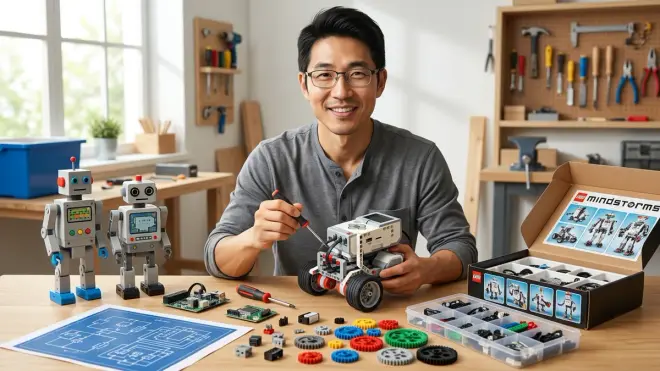
Educational robotics kits emphasize modifiable construction, programmable behavior, and expandable capabilities that build transferable engineering skills, while toy robots prioritize entertainment through pre-programmed behaviors and fixed designs that offer minimal learning progression. I draw this distinction in my fabrication lab constantly: a $60 toy robot might walk, talk, and respond to voice commands impressively, but if kids can't modify its programming, disassemble its mechanics, or expand its capabilities, it teaches observation rather than creation. Educational kits—even simple ones like mBot2 or SPIKE Essential—let kids change the code, rebuild the structure, add new sensors, and create original projects. The skill-building difference becomes obvious after three months of use. Toy robots get played with less frequently as novelty fades. Educational kits evolve into weather stations, obstacle-avoiding vehicles, or interactive art installations because kids can transform them into whatever their imagination demands. From a technical standpoint, educational platforms use open or documented programming interfaces (Scratch, Python, Arduino IDE) that connect to industry-standard tools, while toy robots use proprietary apps with limited functionality. The price difference reflects this capability gap—educational kits cost more because they're platforms for dozens of projects rather than single-purpose devices. For context on how these kits fit into broader STEM learning, see our overview of what are educational robotics kits.
How long does it take to build a first robot from a kit?
Assembly time ranges from 30 minutes for snap-fit platforms to 3-4 hours for screw-based construction kits, but achieving a functional programmed robot requires an additional 1-2 hours of coding and testing regardless of assembly complexity. I track build times in my workshop logs across different age groups and skill levels. Six-to-eight-year-olds need 45-90 minutes to assemble a LEGO SPIKE Essential robot following instructions, then another 60-90 minutes to complete basic programming challenges. Ten-to-twelve-year-olds cut assembly time to 30-60 minutes but spend similar duration on programming because they attempt more complex behaviors. Arduino-based kits like the Elegoo Smart Car require 2-3 hours of careful assembly (following wiring diagrams, managing cable routing, mounting sensors correctly) plus another 2-4 hours of programming setup, library installation, and code troubleshooting. These timeframes assume uninterrupted work sessions—real-world builds typically span 2-3 days as kids work in 45-60 minute sessions. The critical metric isn't speed, it's achieving independent movement within the first session. Kits that deliver visible results quickly (motors spinning, LEDs blinking, wheels turning) maintain engagement. Those requiring extensive assembly before anything happens risk frustration. I recommend planning first builds across two separate days: Day 1 for construction and basic connectivity testing, Day 2 for programming experiments and modifications. This pacing prevents mental fatigue and gives kids time to think about what they want their robot to do next.
Can siblings with different ages use the same robotics kit?
Yes, platforms with multi-level programming interfaces and rebuildable construction specifically suit age-spanning collaboration, with certain kits supporting 6+ year age gaps through progressive challenge paths. I've successfully deployed shared robotics kits in families with children aged 7 and 13, 9 and 15, even 6 and 12. The configuration that works: kits like Makeblock mBot2 or VEX IQ where younger siblings handle construction and simple block-based programming while older siblings tackle advanced features like sensor fusion, autonomous navigation, or text-based Python coding. The hardware serves both skill levels simultaneously. Younger kids build confidence through achievable challenges while older kids push capabilities through complex projects. The approach fails when kits lock into single difficulty levels—a kit perfect for an eight-year-old bores a fourteen-year-old within weeks, while a kit designed for teenagers frustrates elementary-age children. I specifically look for documented progression paths that span 3+ years of skill development. LEGO SPIKE Essential serves ages 6-10, then transitions to SPIKE Prime for ages 10-14, maintaining construction familiarity while advancing capabilities. The VEX IQ platform scales from simple block-coded robots at age 8 to competition-grade autonomous machines at age 14 using identical hardware. For families investing in shared equipment, prioritize open-ended platforms with extensive expansion ecosystems over age-specific kits with capability ceilings. Siblings can collaborate on construction while pursuing separate programming challenges suited to their individual skill levels.
The Verdict
Building your first robot with a kit should feel like unlocking a capability, not solving a puzzle. I've rebuilt enough failed first attempts to know exactly where families stumble: unclear instructions, programming interfaces that don't match actual skill level, or robots that can't evolve beyond the initial build.
Choose based on programming readiness first, features second. A fully-assembled robot like Dash gets six-year-olds coding within minutes. LEGO SPIKE Essential bridges construction familiarity and programming for ages 7-10. VEX IQ prepares kids for competition robotics and multi-year progression. Makeblock mBot2 offers the smoothest path from blocks to Python. Elegoo Smart Car teaches genuine Arduino development for teens ready to build professional skills.
The best first robot is the one your kid rebuilds into something you didn't expect. That's when you know the kit worked.