
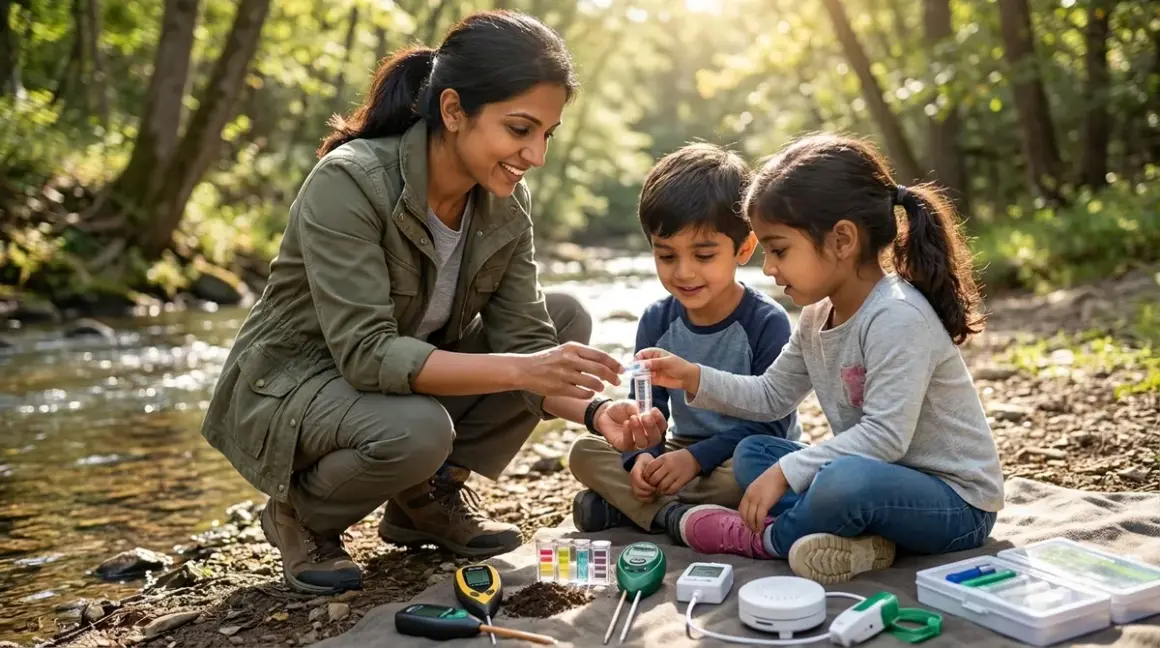

Picture this: your fifth-grader comes home from school announcing they need to "collect data for a science fair project about pollution." You're thinking construction-paper posters and baking-soda volcanoes. But what if instead, they could deploy environmental monitoring kits for kids that collect actual air quality data, contribute to real research databases used by scientists, and build the same data literacy skills that environmental engineers use in the field? That's the transformation I've watched happen in my classroom dozens of times—and it starts with choosing the right monitoring equipment. Quick verdict: The best environmental monitoring kits for kids balance accessible entry points with genuine scientific rigor, offer compatibility with both block-based and text-based programming, and connect young researchers to authentic citizen science networks where their data matters.
What to Look For in Environmental Monitoring Kits for Kids
Platform Compatibility and Programming Pathways
The most effective environmental monitoring kits for kids bridge the gap between visual programming and industry-standard tools. Look for systems that support multiple programming environments—typically starting with block-based interfaces (Scratch, MakeCode) and progressing to Python or Arduino IDE. This scaffolds beautifully: your eight-year-old can begin with drag-and-drop sensor blocks, while your thirteen-year-old uses the same hardware to write Python scripts for data analysis.
OS requirements matter more than you'd expect. Many kits claim "works with any device" but require specific browser versions, Bluetooth LE support, or desktop software that won't run on older Chromebooks or tablets. Verify whether the kit requires constant cloud connectivity or can log data offline—critical for field deployment where Wi-Fi isn't available. I've watched too many promising investigations stall because a kit needed real-time cloud sync during a park deployment.
Check whether the platform uses open-source libraries or proprietary software. Open-source systems (like Arduino-compatible boards) mean your child can transition directly to tools used in university research labs and environmental consulting firms. Proprietary ecosystems often hit capability ceilings right when students are ready for more sophisticated analysis, forcing you to start over with entirely new hardware.
Sensor Accuracy, Calibration Requirements, and Data Validity
Here's where many "educational" kits disappoint: they measure something, but the data isn't accurate enough to teach proper scientific methodology. Professional-grade environmental sensors require regular calibration—a valuable learning opportunity if the kit supports it, a deal-breaker if it doesn't.
Look for kits that specify sensor resolution and accuracy ranges. A temperature sensor accurate to ±2°C teaches fundamentally different lessons than one accurate to ±0.3°C. The first might show daily trends; the second can detect microclimate variations that actually matter for ecological studies. For air quality sensors, check whether they measure particulate matter (PM2.5, PM10), volatile organic compounds (VOCs), or just proxy indicators like humidity.
Calibration workflows separate serious citizen science tools from toys. The best kits include calibration protocols using reference standards (even if that's "place in a sealed bag with a humidity packet" for humidity sensors). This teaches essential sensor calibration skills and helps students understand measurement uncertainty—a concept that bridges directly to NGSS standards on data reliability and experimental design.
Consider whether the kit connects to established citizen science databases like EPA's Air Sensor Toolbox or community networks. When your child's data contributes to actual research—when they can see their readings on regional air quality maps alongside professional monitoring stations—the learning shifts from abstract to deeply meaningful.
Expandability, Modularity, and Progressive Complexity
The most valuable environmental monitoring kits for kids function as platform investments, not one-off projects. Look for systems with standardized expansion ports (I²C, Grove connectors, Qwiic interfaces) that accept additional sensors without requiring soldering or advanced electronics skills.
A strong learning pathway might start with a basic temperature and humidity kit at age 10, add soil moisture and pH sensors for a gardening project at 12, then integrate GPS and SD card logging for watershed mapping at 14. This progressive complexity builds data collection and analysis capabilities that compound over time, rather than starting fresh with disconnected tools.
Modularity also means failure resilience. When (not if) your child drops a sensor in a creek or accidentally reverse-polarizes a connection, can you replace just that component? Or does the entire kit become e-waste? The best designs use interchangeable sensor modules with clear troubleshooting documentation—teaching debugging skills alongside environmental science.
Check whether the ecosystem supports third-party sensor integration. Can you add a professional-grade CO₂ sensor from a lab supplier once your child masters the basics? Systems that work with industry-standard protocols (like I²C or 1-Wire) future-proof your investment and prepare students for actual field research equipment.
Power Management, Deployment Duration, and Field Readiness
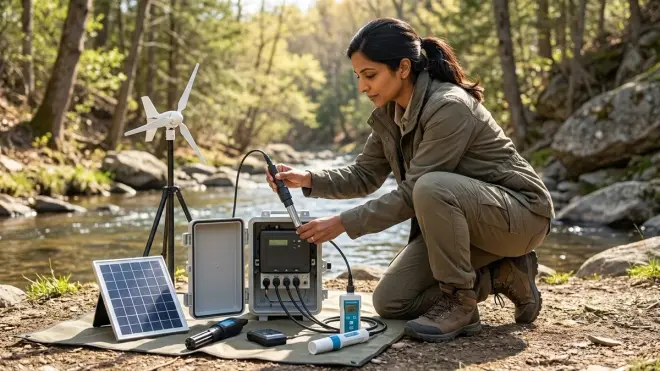
Classroom demonstrations and backyard monitoring have vastly different power requirements. If your goal includes multi-day field deployments—tracking stream temperature across a weekend, or logging air quality during a local event—you need realistic battery life specifications and weather resistance.
Many kits advertise "portable" designs but realistically run for 4-6 hours on a USB battery pack—fine for a school day, inadequate for overnight monitoring. Look for systems that support low-power sleep modes, log data locally (not just stream it), and can run for 24+ hours on rechargeable battery packs. Solar charging integration is a bonus that ties directly to renewable energy concepts.
Weatherproofing requirements vary by deployment scenario. An enclosed case with IP54 rating handles light rain and dust; serious outdoor monitoring needs IP67 (submersible) protection for sensors. Some kits cleverly separate the sensor heads (which can be weatherproofed) from the main electronics (which stay dry)—a design that mirrors professional weather stations and teaches practical engineering constraints.
Consider data logging capacity and retrieval methods. Does the kit require you to connect a laptop in the field to download data, or does it log to a microSD card you can swap out? Can it transmit data via cellular, LoRa, or Wi-Fi for remote monitoring? These aren't just conveniences—they're fundamental decisions about study design that students need to understand before deploying equipment.
Documentation, Community Support, and Curriculum Integration
The best environmental monitoring kits for kids include structured learning pathways, not just technical manuals. Look for guides that scaffold investigation design: how to formulate testable questions, design data collection protocols, analyze patterns, and communicate findings. This pedagogical structure matters enormously for home learners who don't have classroom support.
Strong online communities transform isolated tinkering into collaborative science. Check whether the kit connects to active forums, Discord servers, or classroom networks where students can share methodologies, troubleshoot problems, and compare datasets across different geographic regions. I've watched students far more motivated by seeing their air quality data compared with a peer group across three states than by any grades I could assign.
Integration with existing curriculum frameworks reduces your planning burden. Kits aligned with NGSS standards (particularly MS-ESS3, MS-LS2, HS-ESS3) include investigation templates, assessment rubrics, and connections to broader environmental science concepts. Some explicitly prepare students for science fair formats or Research Science Institute (RSI) applications—valuable context for high schoolers building research portfolios.
Look for transparent upgrade paths in the documentation. Does the manufacturer clearly articulate how this kit connects to more advanced tools? The best companies show explicit progression: "Start with this all-in-one kit at age 10-12, migrate to modular sensors with Arduino at 13-15, then transition to Raspberry Pi with professional sensor libraries for high school research projects." That roadmap is pedagogical gold.
Our Top Picks
micro:bit Smart Citizen Kit
The micro:bit Smart Citizen Kit🛒 Amazon combines the widely-adopted micro:bit platform with environmental sensors specifically calibrated for community air quality monitoring. This kit scaffolds beautifully from block-based programming in MakeCode to JavaScript and Python, using the same hardware throughout—exactly what you want for progressive skill development.
Pros:
- Dual programming interfaces: MakeCode blocks for ages 8-11, Python for ages 12+ using the same hardware
- Pre-calibrated BME688 sensor measures temperature, humidity, pressure, and air quality (VOC) with documented accuracy ranges
- Built-in LED matrix and radio enable students to build wireless sensor networks comparing data across multiple locations
- Offline data logging to onboard storage, plus optional cloud sync through Smart Citizen platform that maps student data alongside professional monitoring stations
- Extensive curriculum resources aligned with NGSS standards MS-ESS3-3 (human impacts on environment) and MS-PS4-C (information technology)
- Low power consumption: 20+ hours continuous logging on 3×AAA batteries, or indefinite operation with micro USB power
- Robust community: thousands of schools worldwide using identical hardware, making troubleshooting and project sharing straightforward
Cons:
- Limited expandability: micro:bit edge connector supports additional sensors, but requires adapters that younger students find fiddly
- Display size constraints: 5×5 LED matrix shows limited data visualization—students need separate devices for detailed graphs
- BME688 VOC readings are relative, not absolute: teaches important lessons about sensor limitations, but can't directly compare to EPA air quality standards without calibration reference
Arduino Environmental Science Bundle
The Arduino Environmental Science Bundle🛒 Amazon represents the gold standard pathway toward industry-standard tools. Built around the Arduino Uno R3, this kit includes DHT22 temperature/humidity sensors, GP2Y1010AU0F dust sensors for particulate matter, and MQ-135 air quality sensors, all with open-source libraries that professional researchers actually use.
Pros:
- Industry-standard platform: Arduino IDE and C++ programming are precisely what environmental engineering firms use for custom sensor deployments
- True modularity: standard pin headers mean students can add any Arduino-compatible sensor (thousands available) without manufacturer lock-in
- Superior sensor documentation: detailed datasheets teach how to read specifications, understand calibration curves, and calculate measurement uncertainty
- SD card logging shield included: students design their own CSV file structures and data collection intervals—crucial database literacy
- No cloud dependency: entirely offline operation teaches data sovereignty and works in field locations without connectivity
- Long-term viability: Arduino skills transfer directly to college engineering labs, research internships, and maker communities
- Cost-effective expandability: replacement sensors typically cost $3-15, making experimentation and failure less stressful
Cons:
- Steeper initial learning curve: requires understanding of circuit assembly, polarity, and basic electronics—not ideal before age 11-12
- Text-based programming only: no block-based option, making this inappropriate for students who haven't yet mastered transition from block to text coding
- Weatherproofing requires DIY solutions: kit provides sensors and electronics, but students must design their own protective enclosures—a valuable engineering challenge but time-intensive
Vernier Go Direct Air Quality Sensor
The Vernier Go Direct Air Quality Sensor🛒 Amazon brings professional-grade accuracy to student investigations. Vernier is the lab equipment company that middle and high school science departments actually use, making this a direct introduction to tools your child will encounter in formal STEM education.
Pros:
- Research-grade calibration: measures particulate matter (PM2.5), temperature, humidity, and barometric pressure with accuracy comparable to EPA reference monitors
- Dual connectivity: Bluetooth wireless for field deployment (100m range) or USB for continuous monitoring with real-time graphing
- Cross-platform compatibility: works with Chromebooks, iPads, Windows, Mac via Graphical Analysis app (free)
- Integrated rechargeable battery: 14+ hours continuous operation with USB-C charging
- Professional data export: generates CSV files compatible with Excel, Google Sheets, and statistical software like R
- Curriculum integration: Vernier provides investigation manuals explicitly aligned with AP Environmental Science and NGSS standards
- Sensor lifespan and support: designed for 5+ years of classroom use with responsive technical support and repair options
Cons:
- Proprietary ecosystem: while data exports are standard formats, sensor calibration and configuration require Vernier's software
- Limited programming access: designed for data collection rather than learning to code sensor interactions—students use Vernier's apps, not write their own
- Higher price point: professional calibration and build quality come at premium pricing versus DIY kits (typically around $200-250)
- No expandability: a purpose-built instrument rather than a platform for adding additional sensor types
Raspberry Pi Environmental Monitoring HAT
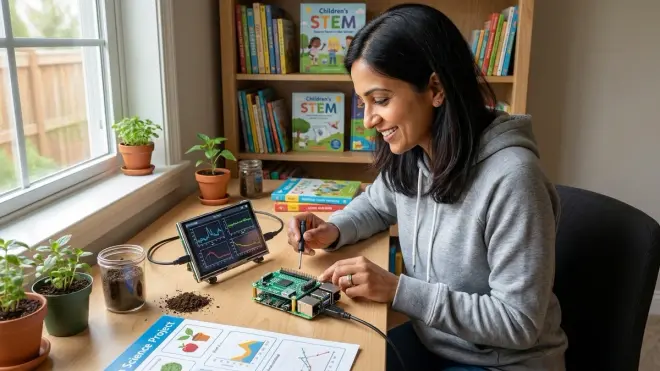
The Raspberry Pi Environmental Monitoring HAT🛒 Amazon transforms a Raspberry Pi into a weather station and air quality monitor with sensors that detect temperature, humidity, pressure, light, particulate matter, and oxidizing/reducing gases. This represents the progression point for students who've mastered Arduino or micro:bit and are ready for Linux-based data science workflows.
Pros:
- Full Linux environment: students learn command-line operation, Python scripting, cron jobs, and database management—skills that define modern data science
- Superior processing power: on-device data visualization with matplotlib, statistical analysis with pandas, even basic machine learning with scikit-learn
- Network capabilities: built-in Wi-Fi and Ethernet enable remote monitoring, automated data uploads, and web-based dashboards students build themselves
- Camera integration: add Pi Camera module for time-lapse documentation of environmental conditions alongside sensor data
- Professional workflow preparation: this setup mirrors actual IoT environmental monitoring systems deployed by municipalities and research institutions
- Multiple programming languages: Python (most common), Node.js, Java, even R for statistical analysis—all supported natively
- Long-term logging: microSD card storage handles months of high-frequency sensor data without external downloads
Cons:
- Requires existing Raspberry Pi: HAT (Hardware Attached on Top) is an add-on board, necessitating separate purchase of Raspberry Pi 4 or Pi 5 (around $50-80)
- Linux learning curve: students need comfort with terminal commands and file systems before this becomes accessible
- Power requirements: Raspberry Pi demands stable 5V/3A power supply—can't run on simple battery packs like simpler kits, limiting true portable deployment
- No pre-built software: maximum flexibility means students must write all data collection and analysis code themselves (excellent for learning, time-intensive for quick projects)
Kestrel DROP D3 Environmental Data Logger
The Kestrel DROP D3 Environmental Data Logger🛒 Amazon offers a different approach: professional monitoring equipment specifically designed for student access. Kestrel manufactures the handheld weather meters that wildland firefighters, military units, and research meteorologists depend on—this is their educational entry point.
Pros:
- No programming required: sealed, weatherproof unit logs data autonomously for 30+ days on coin cell battery
- True field deployment: IP67 waterproof rating means students can leave this in streams, hang it from trees, or deploy during storms without equipment anxiety
- Bluetooth data retrieval: free Kestrel LiNK app (iOS/Android) downloads data wirelessly through sealed case
- Professional accuracy: NIST-traceable calibration on temperature (±0.5°C), humidity (±2% RH), and pressure sensors
- Multiple deployment modes: magnetic mount, carabiner clip, or direct stake mounting for diverse installation scenarios
- Long-term data sets: 10,000+ data point storage enables semester-long investigations
- Zero maintenance: sealed design prevents sensor contamination and moisture damage that plague open sensor boards
Cons:
- Limited sensors: measures only temperature, humidity, and pressure—no air quality, light, or soil sensors
- No programming learning: excellent for pure environmental science investigations, but teaches zero coding or electronics skills
- Closed system: no expandability, no sensor swapping, no customization beyond logging intervals
- Data analysis happens elsewhere: students must export CSV files to other software for graphing and statistical analysis—good workflow practice, but adds steps
SparkFun Environmental Combo Board
The SparkFun Environmental Combo Board🛒 Amazon packs CCS811 air quality, BME280 environmental, and VEML6075 UV sensors onto a single Qwiic-compatible board. SparkFun's distinctive red PCBs are ubiquitous in makerspaces and university engineering labs, making this a genuine introduction to tools your child will encounter in advanced STEM spaces.
Pros:
- Qwiic connector system: tool-free sensor connections using standardized I²C cables—no soldering, no breadboards, no wire confusion
- Triple sensor integration: measures VOCs, CO2 equivalent, temperature, humidity, pressure, and UV index from one compact board
- Arduino and Python libraries: well-documented open-source code for both platforms, with example sketches for common data collection scenarios
- Excellent learning documentation: SparkFun's tutorials explain not just how to use sensors, but why certain configurations matter and what the readings actually mean
- Expandable ecosystem: Qwiic cables daisy-chain dozens of SparkFun and third-party sensors without electronic complexity
- Small form factor: 1"×1" board fits in compact weatherproof enclosures students can design and 3D print
- Active troubleshooting community: SparkFun forums and GitHub issues provide responsive support when things go wrong
Cons:
- Requires separate microcontroller: this is a sensor board only, needs Arduino, ESP32, or Raspberry Pi to operate (adds $15-40 to total cost)
- CCS811 requires burn-in period: air quality sensor needs 48-hour continuous operation before stable readings—important methodology lesson, but delays immediate use
- No weatherproof housing included: students must design protective cases (great for engineering practice, obstacle for immediate deployment)
- I²C address conflicts possible: when daisy-chaining multiple sensors, some share addresses requiring manual configuration—advanced troubleshooting that frustrates younger students
Frequently Asked Questions
What age should kids start using environmental monitoring kits?
Most children develop the patience and data literacy needed for meaningful environmental monitoring around age 9-10, when they can sustain multi-day investigations and understand that data collection requires consistency. However, the specific kit matters enormously. A micro:bit-based system with block programming works well from age 8-9 because the visual interface makes sensor readings immediately concrete. Arduino-based systems generally require age 11-12 minimum, when students can handle text-based coding and circuit assembly without constant adult intervention.
The critical factor isn't just age, but prior skill development. If your child has worked through screen-free coding experiences and understands basic programming logic, they'll engage with sensor kits 1-2 years earlier than peers coming in cold. Similarly, students who've completed basic robotics projects already understand the sensor-processor-output loop that environmental monitoring requires. Focus less on arbitrary age gates and more on whether your child can articulate what they want to measure and why—that question-formulation skill predicts success better than birth year.
Do environmental monitoring kits require subscriptions or ongoing costs?
Most hardware-based environmental monitoring kits require no subscriptions, but cloud platforms and some smartphone-connected systems do charge for data storage, advanced visualization, or access to community networks after initial trial periods. The Arduino Environmental Science Bundle, SparkFun boards, and basic micro:bit systems operate entirely offline with zero recurring costs—you own the hardware and all data stays local unless you explicitly upload it.
Vernier's Go Direct sensors use free software with no subscription tiers. Kestrel's LiNK app is free permanently. However, some citizen science platforms like Smart Citizen charge around $3-5 monthly for cloud storage beyond basic tiers, and advanced features like automated alerts or API access to historical data may sit behind paywalls.
The hidden recurring cost is often sensor calibration and replacement. Air quality sensors (especially electrochemical gas sensors) degrade over 12-24 months and need replacement—typically $15-40 depending on sensor type. Particulate matter sensors can accumulate dust that affects accuracy, requiring replacement or professional cleaning. Budget around $20-50 annually for sensor maintenance if you're conducting serious, ongoing monitoring. This isn't a subscription, but it's worth factoring into total cost of ownership. The valuable teaching moment: professional environmental monitoring stations face these same maintenance requirements, so learning to track sensor health and schedule replacements builds authentic research skills.
Can kids contribute real data to citizen science projects with these kits?
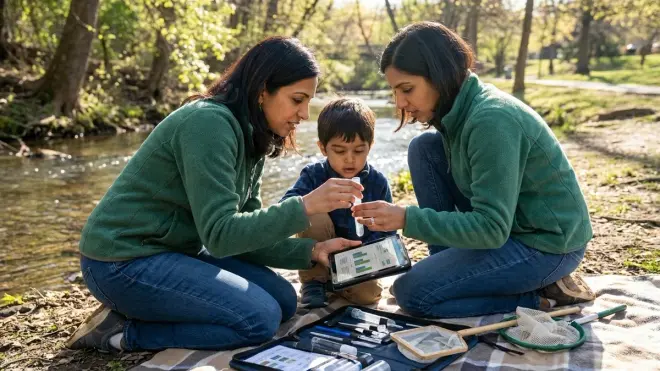
Absolutely yes, and this is where environmental monitoring transforms from isolated learning exercise into genuine scientific participation. Citizen science networks like PurpleAir, Globe Observer, and regional watershed monitoring programs actively seek student-contributed data—provided it meets quality standards.
The key qualifier is sensor calibration and documentation. Research networks need to know what equipment collected the data, calibration status, and deployment conditions. Kits with NIST-traceable calibration (like Vernier sensors) or those that can be co-located with reference monitors for validation (like PurpleAir-compatible PM sensors) produce data scientists can actually use. Uncalibrated educational sensors teach valuable methodology but won't contribute to professional databases.
I've guided students through successful data submissions to local water quality consortiums and air quality networks. The process teaches research rigor: maintaining calibration logs, documenting sensor placement with GPS coordinates, noting environmental conditions that might affect readings, and understanding data quality flags. When students see their weather station data appear on NOAA's Community Collaborative Rain, Hail and Snow Network or their air quality readings integrated into regional maps, the learning motivation jumps dramatically. Start by identifying which citizen science projects operate in your region, then choose monitoring equipment that matches their data collection protocols—that backward design ensures your child's work contributes meaningfully.
How do environmental monitoring kits connect to STEM career preparation?
Environmental monitoring kits build a remarkable skill stack that transfers directly to professional STEM pathways: environmental engineering, atmospheric science, ecology, public health, climate research, and increasingly, data science and IoT development. The technical competencies—sensor calibration, data logging, statistical analysis, spatial mapping—are precisely what environmental consultants, field researchers, and sustainability analysts do daily.
More specifically, students who progress through environmental monitoring develop three career-critical capabilities. First, they learn to design data collection protocols that balance scientific validity with practical constraints—a skill that defines field research across disciplines. Second, they build data pipeline literacy: understanding how raw sensor voltages become calibrated measurements, get logged to databases, undergo quality control, and generate visualizations that communicate findings to non-technical audiences. Third, they develop systems thinking about coupled human-environmental systems—recognizing that pollution isn't just a chemistry problem but involves transportation patterns, industrial processes, policy decisions, and community impacts.
The platform progression matters for career preparation. Students who start with micro:bit or Arduino, then transition to Raspberry Pi and Python data analysis, emerge with the exact technical stack that entry-level environmental tech positions require. When my students apply for summer research internships or university lab positions, the ones who can demonstrate "deployed wireless sensor network to monitor urban heat island effect, collected 6 weeks of temperature data across 12 locations, analyzed spatial patterns with Python and GIS mapping" stand out dramatically. That's not hypothetical resume building—it's the actual job description for environmental monitoring technicians and junior researchers. For students interested in climate science, ecology, or environmental policy, these kits provide earlier, more authentic exposure to career tools than almost any other educational technology.
What's the learning progression from basic to advanced environmental monitoring?
A well-designed progression typically spans 4-5 years and builds through increasing layers of complexity: sensor diversity, programming sophistication, study design independence, and statistical analysis depth. Here's the pathway I've seen work reliably for middle-school through high school students.
Foundation stage (ages 9-11, 6-12 months): Single-parameter monitoring with pre-built kits. Students deploy a temperature logger or simple weather station, collect data for 1-2 weeks, create basic graphs, and identify daily patterns. Learning focus: consistent data collection, understanding what sensors measure, creating time-series visualizations. Block-based programming or turnkey systems work best here. This builds the discipline and curiosity that sustains longer investigations.
Expansion stage (ages 11-13, 12-18 months): Multi-parameter monitoring with modular systems. Students combine temperature, humidity, and air quality sensors, design studies comparing two locations (schoolyard vs parking lot, bedroom vs kitchen), and begin asking "why" questions about patterns. Programming progresses to customizing data collection intervals, adding conditional logging, and exporting data for spreadsheet analysis. Introduction to calibration concepts and measurement uncertainty.
Integration stage (ages 13-15, 12-24 months): Network deployments with text-based programming. Students deploy multiple sensor nodes, learn wireless data collection, begin using Arduino or Python to process data, and connect measurements to explanatory variables (traffic patterns affecting air quality, tree cover influencing temperature). Statistical analysis grows to include correlation, regression, and hypothesis testing. Students begin contributing to citizen science databases and comparing their data against professional monitoring stations.
Specialization stage (ages 15+, ongoing): Student-designed investigations addressing self-selected questions. They specify sensors needed, design custom data collection systems, conduct multi-month studies, and present findings to authentic audiences (science fairs, city council meetings, research symposiums). Programming includes database management, automated visualization, and potentially machine learning for pattern recognition. Some students begin collaborating with university researchers or environmental organizations on community monitoring projects.
The key to successful progression is layering skills rather than replacing tools. The micro:bit they started with at 10 becomes a wireless sensor node in their 13-year-old mesh network. The Arduino they learned at 12 controls the pump in their 15-year-old water sampling robot. Each new capability builds on prior foundations rather than abandoning them—exactly how professional research skills develop, and exactly what makes these investments in environmental monitoring kits worthwhile over the long term.
The Verdict
Environmental monitoring kits represent one of the rare educational technology categories where the learning investment compounds across years rather than hitting dead ends. Your child won't outgrow these tools—they'll deepen their sophistication with them, much like a young musician doesn't abandon their instrument but learns increasingly complex pieces.
For families just beginning this journey, the micro:bit Smart Citizen Kit or SparkFun Environmental Combo Board offer accessible entry points with clear upgrade paths. For students ready for industry-standard tools, Arduino Environmental Science Bundle builds the exact skillset that university labs and environmental careers require. And for pure field science without programming overhead, Kestrel DROP D3 delivers professional data quality that can contribute immediately to citizen science networks.
The real victory isn't any single kit—it's watching your child transition from "I'm measuring temperature" to "I'm investigating how urban tree canopy affects afternoon microclimate patterns" to "I'm analyzing whether our school's air quality improvements correlate with attendance data." That progression from data collection to scientific investigation to community impact is what environmental monitoring kits make possible, and it's learning that lasts far beyond any classroom assignment.