
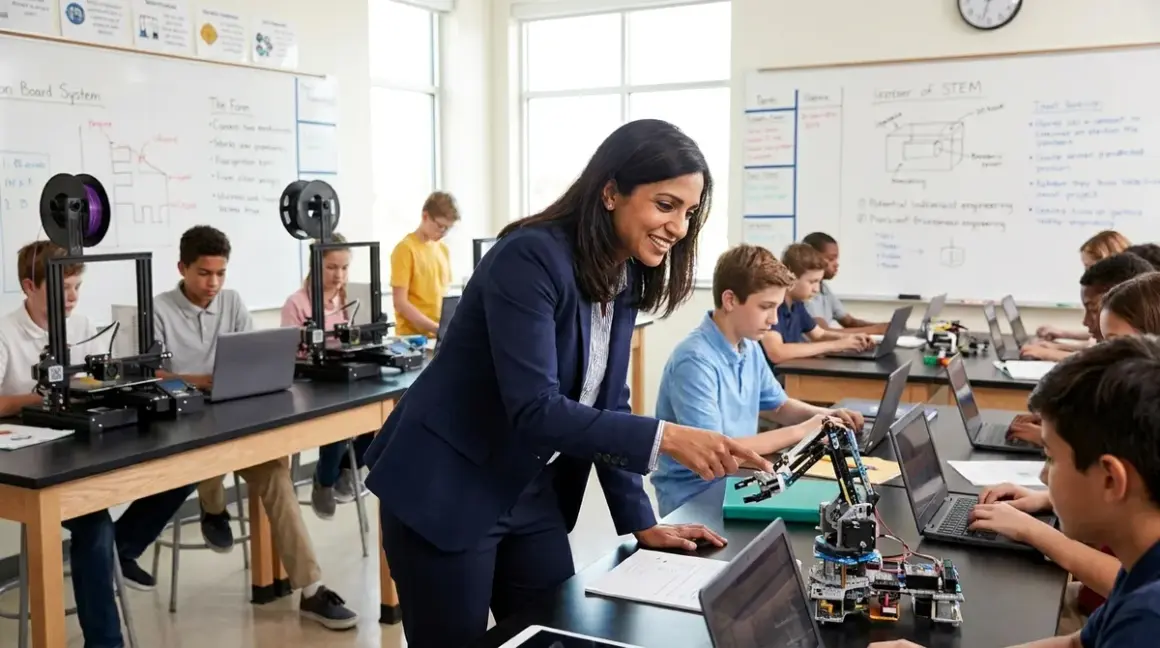

When your middle-schooler comes home with a textbook chapter on renewable energy, they might memorize definitions and pass the test. But if they instead design, build, and troubleshoot an actual solar-powered water pump that fails three times before it works—debugging voltage drops, calculating panel angles, and documenting their iterations—they're experiencing what is project-based STEM learning for middle school. This approach transforms abstract concepts into concrete, hands-on challenges that mirror how engineers, scientists, and programmers actually work in their careers.
What Is Project-Based STEM Learning?
Project-based STEM learning (PBL) is an instructional method where students acquire disciplinary knowledge and technical skills by investigating complex, real-world problems over an extended period—typically two to six weeks. Rather than studying isolated topics in sequence, learners tackle an authentic challenge that requires them to integrate concepts from science, technology, engineering, and mathematics simultaneously.
The defining characteristics that separate genuine project-based learning from simple hands-on activities:
- Driving question or problem: Students pursue a specific, open-ended challenge ("How can we reduce our school's energy consumption by 20%?" rather than "Build a circuit following these instructions")
- Sustained inquiry: Multiple research phases, prototyping cycles, and iterative improvements—not a single afternoon activity
- Student agency: Learners make meaningful decisions about their approach, materials, and problem-solving strategies within defined parameters
- Authentic connection: Projects reflect scenarios professionals encounter, using industry-standard tools and methods when age-appropriate
- Public product: Final deliverables go beyond teacher-only assessment—presentations to community members, functional prototypes, published data sets, or documented processes that others can replicate
I've watched hundreds of sixth-graders struggle with the exact misconception that "doing a lab" equals project-based learning. The difference is profound: a lab typically confirms a known outcome using prescribed steps, while authentic PBL requires students to define their own methodology, anticipate failure points, and revise based on data they collect themselves.
For middle school specifically, effective PBL scaffolds the transition from teacher-directed elementary activities to the independent research and technical documentation students will need for high school AP courses and eventual STEM careers. It builds schema around the engineering design process—not as a poster on the wall, but as a lived experience of constraint-driven problem-solving.
How Project-Based STEM Learning Works
The mechanics of what is project-based STEM learning for middle school follow a recursive cycle that mirrors professional STEM workflows, adapted to developmentally appropriate cognitive loads and time frames.
Phase 1: Entry Event and Question Formulation
Projects launch with a provocative hook—a video showing local water contamination data, a challenge from a community partner, or a demonstrated phenomenon that contradicts students' intuitive understanding. This entry event generates questions, which the class then refines into an investigable driving question.
In my classroom, I introduced a unit on environmental sensors by showing real-time air quality data from our school's neighborhood that spiked during rush hour. Students wanted to know why, where the pollution traveled, and whether indoor air was different. We shaped those curiosities into: "Can we design a network of sensors to map pollution patterns around our campus and recommend ventilation improvements?" That question embedded data collection, spatial analysis, device programming, and persuasive communication—all within a problem they could see out the window.
Phase 2: Building Foundational Knowledge
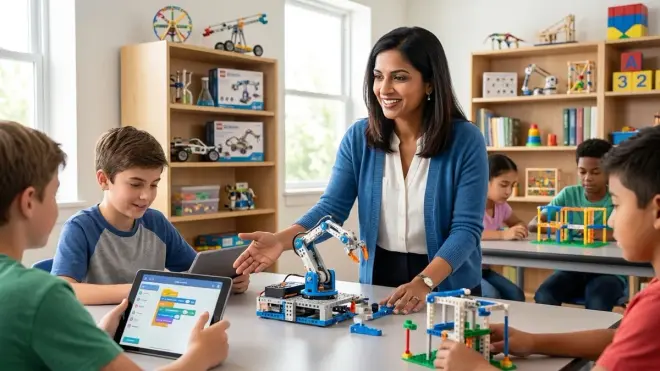
Before students can design solutions, they need baseline competencies. This phase interleaves direct instruction, research, and mini-challenges that target specific skill gaps. If the project requires Arduino programming, you'll teach loops, conditionals, and sensor input through focused exercises before students tackle the full system.
This isn't a return to traditional "learn then do" sequencing. Instead, students learn just-in-time: they discover what they need to know when they hit a genuine obstacle. A team trying to collect environmental data with sensor kits realizes they don't understand calibration—that's when you introduce the concept, because the need is concrete and immediate.
Phase 3: Iterative Design and Prototyping
The core of PBL happens here. Students generate multiple potential solutions, evaluate trade-offs, build prototypes, test against success criteria, collect performance data, and revise. This phase is cyclical by design—expect two to four iterations minimum.
For physical builds, this is where you see students working with platforms like LEGO Mindstorms or VEX robotics kits for mechanical assemblies, Arduino or Raspberry Pi boards for sensing and control logic, and CAD software like Tinkercad or Fusion 360 for custom 3D-printed mounting brackets or enclosures. For data science projects, students might use Google Sheets, Python with pandas libraries, or visual platforms like Scratch or Blockly to analyze datasets they've collected.
Lab Specs matter intensely during this phase. A wind turbine project fails if students can't measure actual voltage output—you need multimeters with 0.01V precision. An autonomous robot project stalls if the kit's sensors can't be expanded—you need platforms with I²C or GPIO headers. Before launching any project, inventory the tools required for legitimate testing: power supplies with adjustable voltage, breadboards and jumper wires for circuit prototyping, calibrated sensors with documented accuracy ranges, and computers that can run the specific IDE (Arduino IDE, Scratch 3.0, Thonny for MicroPython, or whatever the project demands) without cloud dependency for when internet fails mid-class.
Phase 4: Presentation and Reflection
Students create a public-facing deliverable: a presentation to the school board, a tutorial video for next year's class, a written proposal with supporting data, or a functional prototype with documentation. The audience must extend beyond the teacher—this forces clearer communication and authentic accountability.
Crucially, reflection is structured, not optional. Students answer: What worked? What failed and why? What would you change if you started over? Which STEM skills did you develop? How does your solution compare to professional approaches in this field? This metacognitive work is where conceptual understanding solidifies and transfers to future contexts.
Why Project-Based STEM Learning Matters
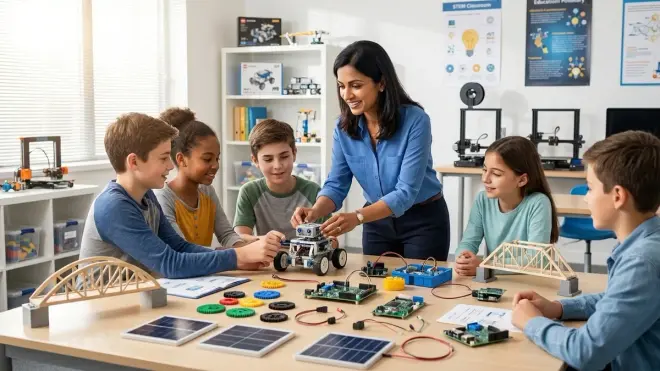
Middle school occupies a critical developmental window—students are transitioning from concrete operational thinking to formal operational reasoning, and they're forming career aspirations that statistics show significantly influence their eventual fields. What is project-based STEM learning for middle school, if not the bridge between "science is fun" and "I can actually do this work professionally"?
Traditional didactic instruction teaches students to recognize and apply concepts when explicitly told which ones to use. PBL builds the transfer skills that separate novices from practitioners: recognizing which type of problem you're facing, selecting appropriate tools without prompting, troubleshooting when your first approach fails, and synthesizing knowledge across disciplines.
Research published by the National Academy of Sciences documents that students in PBL environments demonstrate statistically significant gains in long-term retention, ability to apply concepts to novel situations, and engagement compared to traditional instruction—particularly for students who struggle with passive learning formats.
From a practical standpoint, project-based learning develops specific capabilities that prepare students for industry-standard workflows:
- Version control and documentation: Professional engineers maintain detailed build logs, parametric changes, and test results. Students practicing this at age 12 with engineering notebooks or digital lab journals are learning habits they'll use in university research labs or industry R&D roles.
- Constraint-based design: Real engineering happens within budgets, material limitations, and client specifications. When students must design a solution using only components from a limited kit or meet a specific performance target, they're building the same prioritization skills mechanical engineers use with CAD simulations or software developers use with computational complexity requirements.
- Collaborative technical workflows: Professional STEM work is intensely collaborative. Students who've negotiated task division, merged code from multiple team members, or coordinated testing schedules are practicing soft skills that often determine career success more than raw technical knowledge.
For home learning environments, designing a progressive STEM learning path around project cycles allows you to target specific skill gaps your child faces, whether that's debugging logical errors in code, designing controlled experiments, or translating complex data into clear visualizations. Each completed project becomes a portfolio piece demonstrating concrete capabilities—far more meaningful than test scores when applying to competitive high school STEM programs or explaining their interests to mentors.
Types and Variations of Project-Based STEM Learning
While the core PBL structure remains consistent, middle school implementations vary based on disciplinary emphasis, duration, and degree of student autonomy.
Engineering Design Projects
Students create functional physical systems: robots that solve a specific task, renewable energy installations, or mechanical devices that meet performance specifications. These projects emphasize applied physics, CAD modeling, materials science, and iterative prototyping.
Example platforms include LEGO robotics kits with SPIKE Prime or Mindstorms for electromechanical systems (programming via Scratch-based visual coding or Python, expandable with third-party sensors, requires computer with USB connectivity and 4GB+ RAM), Arduino-based robotics kits for embedded systems programming (text-based C++ coding, breadboard circuit prototyping, steeper learning curve but directly translates to professional electronics work), or 3D printer setups paired with design software for custom part fabrication.
The LEGO Education SPIKE Prime Set serves as a strong middle school entry point—it includes 528 Technic elements, a programmable Hub with 6 I/O ports, three motors with rotation sensors, a color sensor, distance sensor, and force sensor. Programming happens via drag-and-drop Scratch blocks or Python text code in the same environment, allowing smooth transitions as students advance. Requires a computer, tablet, or Chromebook running the SPIKE App (offline mode available after initial download), and connects via Bluetooth. The platform expands with additional sensor packs and third-party components. Rechargeable battery lasts 4-5 hours of active use. Durable ABS construction withstands repeated disassembly—I've used the same sets for four years of middle school classes with minimal part replacement needed.
Scientific Investigation Projects
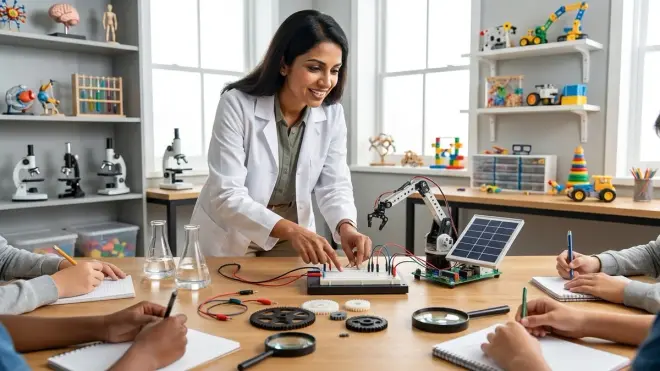
Students design and conduct original research: citizen science data collection, controlled experiments testing hypotheses, or field studies documenting local ecosystems. These projects emphasize experimental design, statistical analysis, data visualization, and scientific communication.
Citizen science kits for environmental monitoring provide authentic contexts. Platforms like the SparkFun Environmental Combo Breakout (requires Arduino board, measures air quality, humidity, temperature, pressure, and CO₂ via I²C interface, needs basic soldering skills to attach headers, outputs raw data that students must calibrate and interpret) or simpler closed systems like water quality testing kits allow students to contribute to real databases while building lab technique skills.
Computational Thinking Projects
Students create software applications, data visualizations, or algorithmic solutions: machine learning models trained on datasets, game designs that teach specific concepts, or automated data processing pipelines. These projects emphasize algorithmic logic, data structures, debugging strategies, and user interface design.
For middle schoolers transitioning from visual to text-based coding, Python-based platforms like Teachable Machine by Google provide accessible entry points to real machine learning workflows. The platform runs entirely in a web browser, requires no installation, and generates TensorFlow models that students can export and integrate into Scratch projects or Python scripts. No ongoing subscription, though internet access is required during training. Students can train image, audio, or pose classification models using their own collected data in 20-30 minutes, then test accuracy and identify bias in their training sets—direct experience with supervised learning concepts that professionals use.
Interdisciplinary Integrated Projects
The most ambitious PBL implementations blend multiple disciplines into complex challenges: designing a sustainable school garden system (biology, chemistry, engineering, economics), creating a community awareness campaign about local environmental issues (ecology, data science, media production), or proposing architectural modifications to improve building energy efficiency (physics, computer modeling, persuasive writing).
These projects more closely mirror professional STEM work, where biologists collaborate with statisticians, mechanical engineers coordinate with software developers, and technical experts must communicate findings to non-specialist stakeholders. The trade-off is increased complexity in project management—students need stronger self-regulation skills, and teachers need robust scaffolding structures to prevent overwhelming cognitive load.
Frequently Asked Questions
How long should a project-based STEM learning unit last for middle school students?
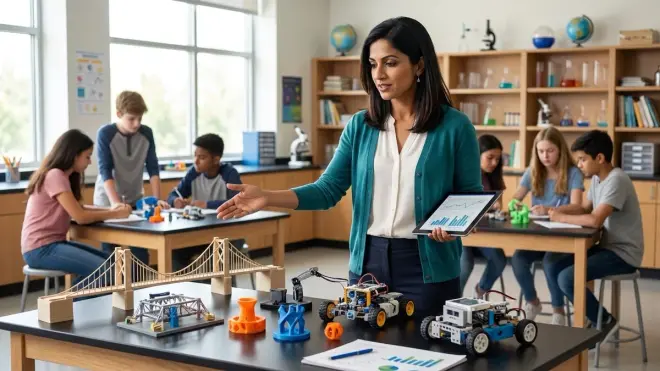
A well-designed middle school PBL unit typically runs three to six weeks, meeting three to five times weekly in dedicated STEM class periods or structured home learning sessions. Shorter durations (one to two weeks) work for focused mini-projects building specific technical skills—like learning Arduino programming through a single-sensor data logger—but don't provide sufficient time for the iterative cycles that distinguish genuine PBL from extended lab activities. Units longer than six weeks risk losing momentum and cognitive coherence unless carefully structured into distinct phases with intermediate deliverables. The ideal duration balances depth of investigation with maintaining student engagement, allowing time for at least two full prototype-test-revise cycles before final presentation.
What technical skills should students have before starting project-based STEM learning?
Students don't need extensive prerequisites, but they benefit from foundational computational thinking and basic lab safety awareness before tackling open-ended projects. For engineering projects involving electronics, students should understand simple circuits, series versus parallel connections, and how to use a multimeter—these are teachable in a 2-3 day mini-unit using circuit starter kits. For projects requiring programming, students should have exposure to loops, conditionals, and variables through visual coding platforms like Scratch before attempting text-based languages, though robotics platforms that support both block and text coding allow smoother transitions mid-project. Most importantly, students need scientific notebook habits—documenting observations, recording data systematically, and maintaining build logs—which are behavioral skills you establish through explicit instruction and consistent expectations from day one.
Can project-based STEM learning work in a home environment without specialized equipment?
Yes, but you need to strategically select projects that match your available resources and establish a dedicated workspace with consistent access to necessary tools. Start by assessing your home STEM lab setup requirements—available table space, power outlet access, storage for ongoing projects that can't be disassembled between sessions, and internet connectivity if using cloud-dependent platforms. Choose initial projects that use consumable-free, reusable kits with low infrastructure demands: LEGO robotics platforms require only a computer and USB cable, renewable energy kits with solar panels and wind turbines need basic multimeters and sunlight or a fan, and many citizen science projects require only notebooks and outdoor access for observational ecology. As your child's skills progress, invest incrementally in expandable platforms rather than one-time consumable kits, prioritizing tools that will serve multiple future projects—a quality multimeter, soldering station, or entry-level 3D printer are one-time purchases that unlock dozens of advanced projects.
How do I assess student learning in project-based STEM work?
Effective PBL assessment uses multiple evaluation points across the project cycle, not just the final product. Begin with a rubric shared at project launch that weights process components (research documentation, prototype iterations with explicit improvements, team collaboration logs, troubleshooting records) as heavily as final deliverables. Use formalized checkpoint presentations where students explain current progress, obstacles encountered, and planned next steps—this reveals conceptual understanding better than finished products ever will. Assess technical skills through discrete capability milestones: Can the student write a functional Arduino loop to read sensor data every 500ms? Can they identify which variable in their code controls motor speed? Can they explain why their first turbine blade design generated insufficient torque? These concrete skill demonstrations are more meaningful than holistic project grades. Finally, require written technical reflections addressing specific prompts: What was your hypothesis about why the first design failed? What data led you to change your approach? How does your solution compare to commercial versions professionals use? The quality of metacognitive analysis in these reflections directly correlates with genuine learning rather than lucky guessing or over-reliance on teammates.
What are the most common mistakes families make when implementing project-based STEM learning at home?
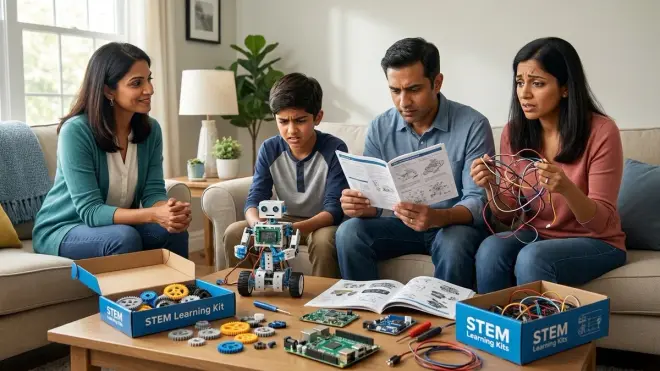
The biggest pitfall is selecting projects that look impressive but lack authentic technical challenge or iterative cycles—essentially fancy craft activities disguised as STEM. A baking soda volcano isn't project-based learning; designing a system to measure and compare the reaction rates of various acids with different bases under controlled temperature conditions, then optimizing the reaction for maximum gas production, becomes PBL. Families also frequently underestimate time requirements, attempting to compress a four-week investigation into a weekend, which eliminates the crucial failure-and-revision cycles where the deepest learning happens. Another common mistake is over-scaffolding—providing step-by-step instructions that eliminate student decision-making and problem-solving opportunities. If your child is simply following a build manual, they're not doing project-based learning, they're doing assembly. Finally, many families invest heavily in consumable subscription boxes that don't support progressive skill building or expandability. A one-time purchase robotics kit with programming capabilities that your child can expand with additional sensors and customize through increasingly complex code provides exponentially more long-term value than monthly boxes with pre-packaged, single-use activities that must be discarded after completion.
Summary
Project-based STEM learning transforms how middle schoolers engage with science, technology, engineering, and mathematics—shifting from passive knowledge reception to active problem-solving that mirrors professional workflows. Through sustained investigations of authentic challenges, students develop not just disciplinary content knowledge but the transfer skills, technical documentation practices, and collaborative capabilities that will serve them through advanced coursework and into STEM careers.
Implementing what is project-based STEM learning for middle school requires thoughtful infrastructure—selecting platforms with appropriate technical complexity, establishing workspace with necessary power and connectivity requirements, and building progressive learning paths that scaffold from guided projects to student-directed investigations. The investment pays dividends: students who tackle genuine engineering design cycles, collect and analyze real scientific data, or build functional computational systems develop a fundamentally different relationship with STEM disciplines. They stop seeing themselves as consumers of scientific knowledge and start identifying as capable practitioners who can investigate questions, build solutions, and contribute meaningfully to technical conversations.
Whether you're working within a classroom, building a home STEM lab, or supplementing traditional instruction, the core principle remains constant: give students complex problems, provide appropriate tools and time, then step back and let them struggle productively. That struggle—the debugging, the failed prototypes, the revised hypotheses—is where authentic STEM capability develops. You're not preparing them for tests; you're preparing them for work that doesn't yet exist, using tools that haven't been invented, solving problems we haven't identified. That requires practice navigating ambiguity, and project-based learning is how you provide it.