

If you're helping your child navigate the world of AI and machine learning, you've likely encountered the terms supervised vs unsupervised learning for kids—and you may be wondering how to explain these foundational concepts without drowning in technical jargon. These two approaches form the backbone of how machines learn from data, and understanding the difference helps your child grasp not just what AI does, but how it actually thinks. This distinction becomes especially important as your learner moves from visual block-based coding into text-based languages where they'll implement these algorithms themselves. Let me walk you through this in a way that connects classroom rigor with kitchen-table clarity.
What Is Supervised vs Unsupervised Learning for Kids?
Supervised learning is the process where a machine learns from labeled examples—think of it as learning with an answer key. You show the algorithm input data (like pictures of cats and dogs) along with the correct labels ("cat," "dog"), and it learns to recognize patterns so it can correctly label new images it's never seen before. The "supervision" comes from those pre-labeled training examples guiding the learning process.
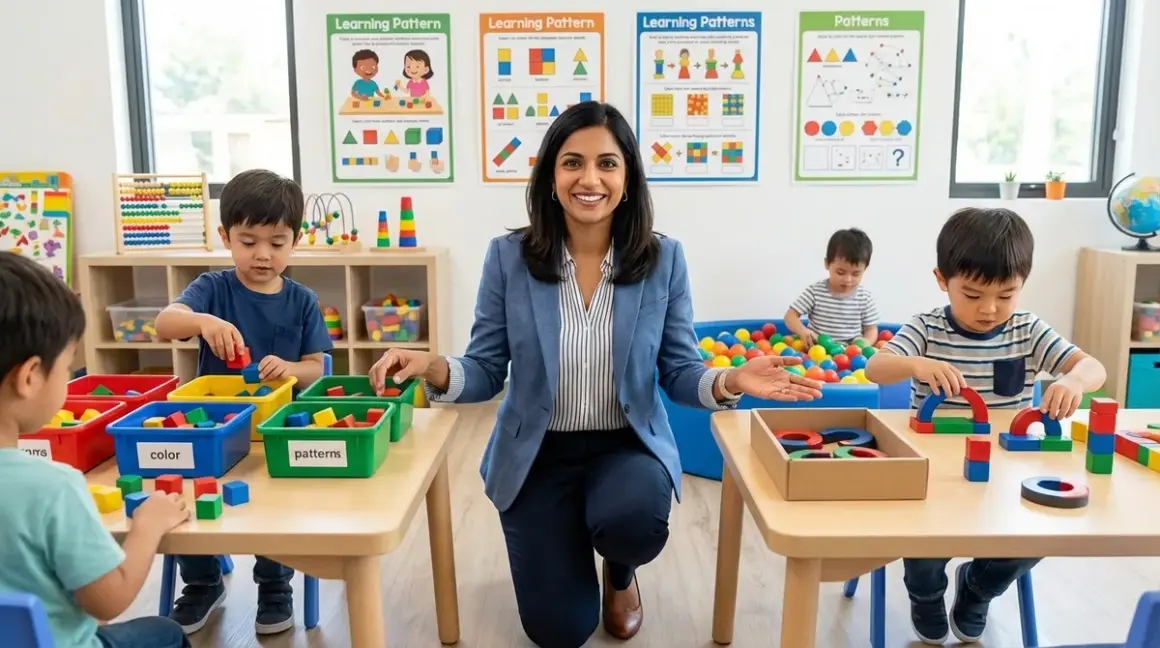
Unsupervised learning, by contrast, works without labels. The algorithm receives raw data and must find patterns, groupings, or structures on its own. Imagine dumping a box of mixed LEGO bricks on the table and asking your child to sort them into piles that make sense—by color, size, or shape—without telling them which sorting method to use. The machine identifies hidden relationships in data without being told what's "right."
This distinction matters because different real-world problems require different approaches. Supervised learning excels when you have clear categories and labeled training data (spam detection, medical diagnosis, handwriting recognition). Unsupervised learning shines when you're exploring data to discover unknown patterns (customer segmentation, anomaly detection, recommendation systems).
Both approaches appear in age-appropriate AI learning platforms, though supervised learning typically comes first in progressive STEM learning paths because the concept of "learning from examples" is more intuitive for young learners.
How Supervised Learning Works
Let's build schema around supervised learning by breaking down its mechanism step by step. I've watched hundreds of sixth-graders struggle with this exact misconception—they think the machine "memorizes" examples like flashcards. But supervised learning is about pattern recognition, not rote memorization.
The Training Phase
The algorithm receives a training dataset composed of input-output pairs. For instance, if you're teaching a model to identify handwritten digits:
- Input: A 28x28 pixel grid showing a handwritten "3"
- Output: The label "3"
The algorithm examines thousands of these pairs, adjusting its internal parameters (weights) to minimize the difference between its predictions and the actual labels. This process involves:
- Making a prediction based on current parameter values
- Calculating error by comparing the prediction to the true label
- Adjusting parameters to reduce that error
- Repeating across thousands of examples until accuracy plateaus
This iterative refinement is called training, and it's why machine learning requires substantial computational power and time. The Raspberry Pi 5 Starter Kit provides enough processing capability for simple supervised learning models using Scratch ML extensions or beginner Python libraries, though more complex models will need cloud-based platforms.
The Testing Phase
Once trained, you evaluate the model's performance using a test dataset—data it has never encountered during training. This distinction is crucial. If you only tested the model on training data, you'd measure memorization, not genuine learning. The test set reveals whether the model has learned generalizable patterns or just overfit to the training examples.
This scaffolds the scientific method beautifully: hypothesis (model structure), experimentation (training), and validation (testing) mirror the inquiry process your child practices in well-designed science investigations.
Real-World Implementation for Kids
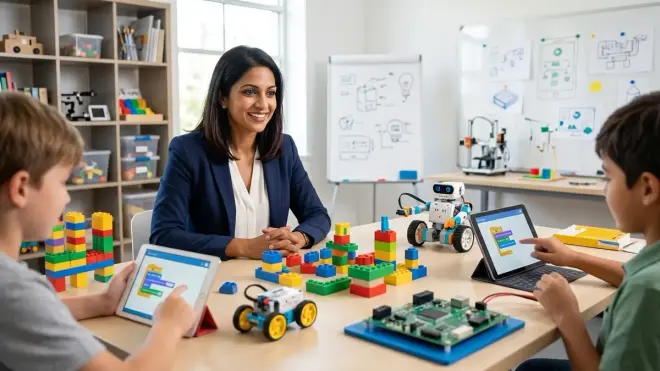
Platforms like Scratch's ML extension and Google's Teachable Machine make supervised learning accessible to elementary and middle school learners. Your child can train an image classifier to distinguish between hand gestures, facial expressions, or household objects in under ten minutes—using their webcam as the data source and visual blocks instead of code.
The AIY Vision Kit v1.1 takes this further, allowing kids to train on-device models that run without internet connectivity—a critical consideration for screen-time management and data privacy. It operates on Raspberry Pi hardware (not included) and uses TensorFlow Lite, the same framework deployed in professional applications.
For text-based learners ready for Python, the scikit-learn library provides supervised learning algorithms with surprisingly simple syntax. A functional decision tree classifier can be implemented in about fifteen lines of code—appropriate for ages 12+ who've completed foundational Python skill milestones.
How Unsupervised Learning Works
Unsupervised learning operates without the safety net of labeled examples, which makes it conceptually trickier for young learners but incredibly powerful for real-world exploration.
Clustering Algorithms
Clustering groups data points based on similarity. The k-means algorithm, one of the most common clustering methods, works like this:
- Choose the number of groups (k) you want to find
- Place k "center points" randomly in your data space
- Assign each data point to its nearest center
- Move each center to the average position of its assigned points
- Repeat steps 3-4 until centers stop moving
I use a physical activity to teach this: Give students sticky notes with different numbers written on them, spread across the classroom floor. Ask them to form three groups where notes within each group have similar values. They'll naturally gravitate toward low, medium, and high number zones—that's clustering.
For kids, clustering appears in activities like:
- Sorting images by visual similarity without being told categories
- Grouping songs by musical characteristics (tempo, mood, genre) based on audio features
- Organizing survey responses to discover customer segments
The littleBits Rule Your Room Kit includes sensor-based data collection that can feed into simple clustering activities, though it requires integration with Python scripts for actual unsupervised learning—it's not out-of-box ML.
Dimensionality Reduction
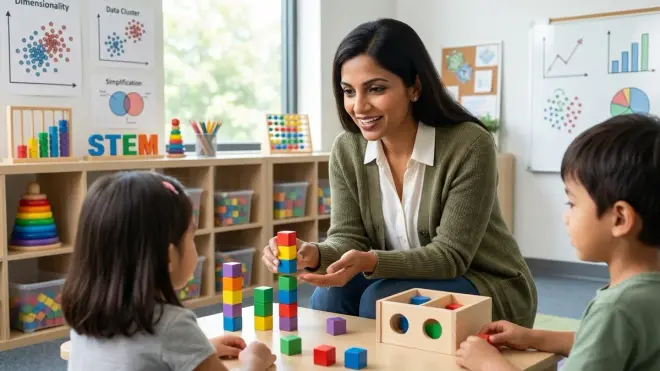
This technique simplifies complex data by finding the most important features. Imagine describing a person's face: instead of storing millions of pixel values, dimensionality reduction identifies that "eye distance," "nose length," and "face width" capture most of the variation between faces.
For middle schoolers exploring AI concepts, this parallels summarizing a book chapter—you extract the key points while preserving the essential meaning. Practically, it makes large datasets manageable and visualizable, preparing students for the data-heavy reality of machine learning careers.
Pattern Discovery and Anomaly Detection
Unsupervised algorithms can identify unusual data points that don't fit established patterns—a critical capability in cybersecurity, quality control, and fraud detection. Your child's credit card company uses this when it flags suspicious purchases that deviate from your typical spending behavior.
This concept translates beautifully into science fair projects: collect environmental data (temperature, humidity, air quality) over several weeks, then use unsupervised learning to detect anomalous readings that might indicate measurement errors or genuine environmental events.
Why Understanding Supervised vs Unsupervised Learning for Kids Matters
The distinction between supervised vs unsupervised learning for kids isn't academic trivia—it's a conceptual framework that shapes how your learner approaches computational problem-solving throughout their STEM education.
Preparing for Industry-Standard Workflows
Professional data scientists spend significant time deciding which approach fits their problem. Does available data include labels? If not, can labels be acquired, or should unsupervised methods be deployed? Your middle schooler working through this decision-making process develops the same analytical framework used in research labs and tech companies.
Machine learning career paths increasingly require understanding these fundamentals by undergraduate internship applications. Students who've implemented both supervised and unsupervised models—even in Scratch or Python—demonstrate practical AI literacy that stands out on high school résumés and college applications.
Connecting to Next Generation Science Standards
The NGSS emphasizes using computational thinking to model complex systems and analyzing data to identify patterns. Both supervised and unsupervised learning directly address these standards, particularly in middle school life science (analyzing genetic data), earth science (climate pattern recognition), and physical science (classifying particle collision events).
When your child builds a supervised classifier to identify plant species from leaf images, they're hitting crosscutting concepts around patterns, cause and effect, and systems modeling. When they use clustering to group similar weather patterns, they're practicing data analysis skills that transfer across STEM disciplines.
Scaffolding From Concrete to Abstract
Supervised learning typically comes first in learning progressions because the feedback loop is intuitive: "I taught it using examples, now it can recognize new examples." This builds confidence before introducing unsupervised learning's ambiguity, where "correct" answers are less clear-cut.
This progression mirrors cognitive development. Younger learners (ages 8-10) grasp supervised learning through tools like Scratch ML extensions, while unsupervised concepts typically land better around ages 11-13 when abstract reasoning strengthens.
Types & Variations You'll Encounter
The supervised vs unsupervised learning for kids framework actually encompasses several sub-types, each with distinct characteristics and applications.
Supervised Learning Variations
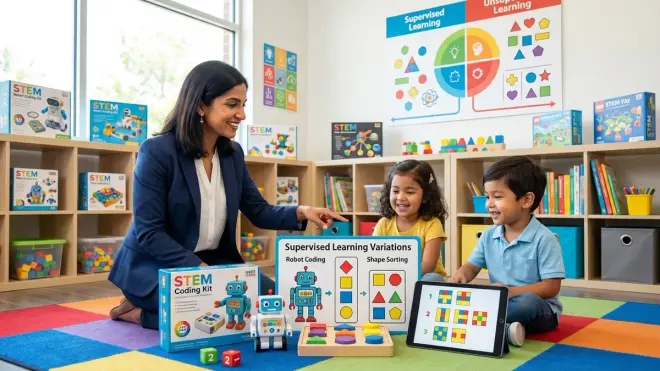
Classification assigns data to discrete categories (spam/not spam, cat/dog/bird). This is the most common type in educational kits because results are easy to validate.
Regression predicts continuous numerical values (house prices, temperature forecasts, crop yields). It appears less frequently in kids' AI kits but becomes important in science fair projects involving measurement and prediction.
Time series prediction forecasts future values based on historical sequences—relevant for weather modeling, stock simulation (educational contexts), and sensor data analysis.
Unsupervised Learning Variations
Clustering groups similar items together—we covered k-means, but hierarchical clustering and DBSCAN offer different approaches with varying complexity levels.
Association rule learning discovers relationships between variables (customers who buy X often buy Y). This appears in recommendation system projects appropriate for ages 12+.
Generative models learn to create new data similar to training examples. Recent generative AI tools (image creation, text generation) use unsupervised and semi-supervised techniques, though understanding these requires solid foundational knowledge first.
Semi-Supervised and Reinforcement Learning
Semi-supervised learning bridges both worlds, using a small labeled dataset plus a large unlabeled one—practical for real-world scenarios where labeling is expensive or time-consuming.
Reinforcement learning is technically a separate category where agents learn through trial, error, and rewards. It's conceptually distinct from supervised/unsupervised approaches, though many educational resources group them together. If your child is interested in game-playing AI or robotics navigation, that's reinforcement learning territory. For deeper exploration, see our guide on teaching kids AI and machine learning.
Lab Specs for At-Home AI Learning
Setting up for supervised vs unsupervised learning for kids requires consideration of technical requirements that vary dramatically by platform and skill level.
Hardware Requirements
Entry level (ages 8-10, block-based coding):
- Computer: Any laptop/desktop manufactured within the last 5 years; Chromebooks work with Scratch ML extensions
- RAM: 4GB minimum, 8GB recommended
- Webcam: Built-in or USB (for image/video training data)
- No GPU required
- Power: Standard laptop battery or outlet
- Connectivity: Internet required for most block-based platforms (Teachable Machine, Scratch ML); models typically run in browser
Intermediate level (ages 11-13, transitioning to Python):
- Computer: Windows 10/11, macOS 10.14+, or Ubuntu 20.04+
- RAM: 8GB minimum
- Processor: Intel i5/AMD Ryzen 5 or better
- Storage: 20GB free space for Python libraries and datasets
- Connectivity: Internet for library installation and cloud training; offline execution possible after setup
- Optional: Raspberry Pi 5 Starter Kit for dedicated ML projects (requires separate keyboard, mouse, monitor)
Advanced level (ages 14+, complex models):
- Same as intermediate, but 16GB RAM recommended
- GPU: Optional but accelerates training significantly; NVIDIA cards with CUDA support preferred
- Cloud alternatives: Google Colab (free tier), Kaggle notebooks (free)—eliminates hardware requirements for computation-intensive projects
Software Ecosystem
Block-based platforms:
- Scratch 3.0 with ML extensions (browser-based, free, no account required)
- Google Teachable Machine (browser-based, free, Google account recommended)
- MIT App Inventor with image recognition components (browser-based, free)
- No installation, no version conflicts, works across operating systems
Python-based tools:
- Python 3.8-3.12 (avoid 3.13 until library compatibility improves)
- Libraries: scikit-learn (supervised/unsupervised), pandas (data handling), matplotlib (visualization)
- Development environments: Thonny (beginner-friendly), VS Code (professional), Jupyter notebooks (exploratory)
- Installation requires 2-3 hours for first-time setup; package management learning curve exists
For detailed progression guidance, consult our screen-free to text-based programming transition guide, which applies equally well to AI learning paths.
Expandability and Progressive Learning
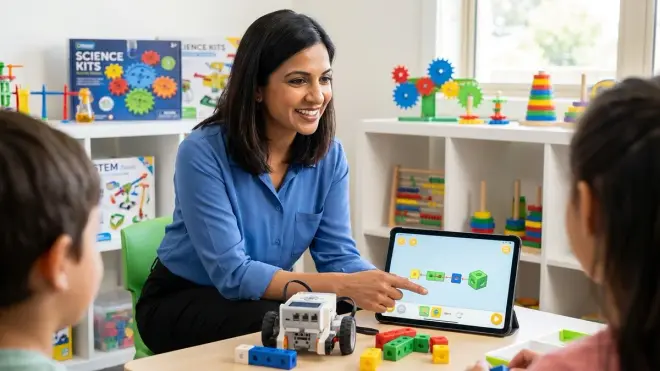
Look for platforms that support skill ladder progression:
- Visual model training (Teachable Machine) → ages 8-10
- Block-based ML coding (Scratch extensions) → ages 9-11
- Python with high-level libraries (scikit-learn) → ages 12-14
- Deep learning frameworks (TensorFlow, PyTorch) → ages 15+
Avoid isolated toys that don't connect to industry-standard tools. The value proposition lies in building transferable skills, not one-off activities. The NVIDIA Jetson Nano Developer Kit represents the high end of this progression—it's essentially a dedicated AI computer that runs full Linux, Python, and professional frameworks, appropriate for serious high school learners aiming toward computer science programs.
Frequently Asked Questions
What age is appropriate to start teaching supervised vs unsupervised learning for kids?
Children as young as 8 can grasp supervised learning concepts through visual, example-based platforms like Google Teachable Machine, where they train image classifiers by showing examples and immediately testing results. The concrete cause-and-effect relationship (I show cat pictures, it learns cats) aligns with their developmental stage. Unsupervised learning typically makes more sense around ages 11-12 when abstract thinking strengthens and kids can understand "finding patterns without knowing what you're looking for." That said, you can introduce clustering through physical sorting activities with younger children—the formal AI terminology can wait until they're implementing it computationally. The key milestone is whether your child can articulate why they chose their groupings and what patterns they noticed.
Do kids need to learn supervised learning before unsupervised learning?
While not strictly required, supervised learning provides a more intuitive entry point because the feedback mechanism is explicit—the algorithm knows when it's wrong and adjusts accordingly. This creates a clear mental model of how machines learn from mistakes. Unsupervised learning's ambiguity (no right answers, multiple valid groupings) can be frustrating without that foundation. In practice, most AI learning kits and curricula introduce supervised classification first, then branch into unsupervised methods once the broader concept of "learning from data" has solidified. The exception is physical sorting activities with young children, where clustering is tangible and doesn't require understanding the underlying algorithms. For computational implementations, stick with the supervised-first progression unless your child specifically gravitates toward open-ended exploration over goal-directed tasks.
What's the best platform for teaching both supervised and unsupervised learning concepts?
Python with scikit-learn offers the most comprehensive and scalable option for kids aged 12+, providing access to both supervised algorithms (decision trees, logistic regression, support vector machines) and unsupervised methods (k-means clustering, hierarchical clustering, PCA) through consistent, learner-appropriate syntax. The library is genuinely industry-standard—used in university courses and professional contexts—so skills transfer directly. For younger learners (ages 8-11), Scratch ML extensions handle supervised learning beautifully but have limited unsupervised capabilities; you'll need to supplement with Python or physical activities for clustering concepts. Google's Teachable Machine excels at image/audio classification but doesn't address unsupervised learning at all. If you're building a progressive STEM learning path, plan for a platform transition around age 11-12, moving from block-based supervised learning to Python-based implementations of both paradigms.
Can kids implement supervised and unsupervised learning without expensive AI kits?
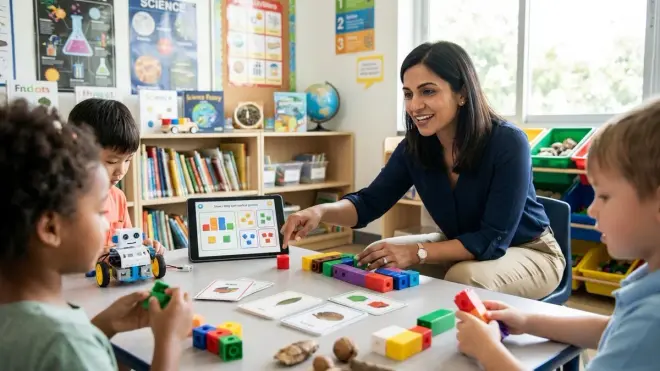
Absolutely—the most accessible and powerful tools are free software platforms that run on standard computers you likely already own. Google Teachable Machine, Scratch ML extensions, and Python with scikit-learn cost nothing beyond your existing hardware. You don't need specialized robotics kits, though products like the AIY Vision Kit v1.1 (around $90) or dedicated AI platforms add tangible, device-based learning experiences that some kids find more engaging than screen-only coding. The real investment is time, not money. Downloading Python libraries, working through tutorials, debugging code, and collecting training data require patience and parental involvement, especially during the first few projects. Cloud platforms like Google Colab eliminate even hardware requirements for more advanced deep learning experimentation. Save your budget for robotics kits or 3D printers that have genuine hardware requirements—AI learning is largely a software journey.
How do supervised and unsupervised learning connect to other STEM skills like robotics or 3D printing?
Machine learning integrates with robotics through computer vision (supervised learning for object recognition) and sensor data analysis (unsupervised anomaly detection in robot behavior). A robot navigating obstacles might use supervised learning to identify objects from camera feeds, then apply those classifications to navigation decisions. The Arduino programming skills your child develops for motor control and sensor interfacing combine with Python ML libraries to create intelligent robotic behaviors—that integration typically happens around ages 13-15 after foundational competency in both domains. For 3D printing, machine learning appears in quality control (detecting failed prints from camera images), generative design (algorithms that create optimized structures), and parametric modeling (learning what design parameters produce desired results). These applications are advanced, but the conceptual groundwork laid through supervised vs unsupervised learning projects makes them accessible to high school students pursuing engineering pathways.
Building Long-Term ML Competency
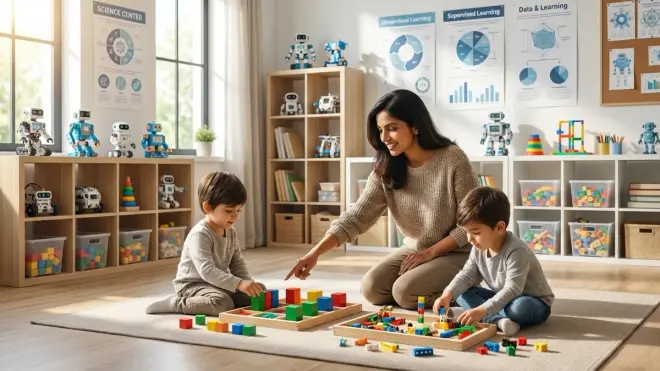
The supervised vs unsupervised learning distinction provides your child with a mental framework that organizes not just their current AI projects, but their entire computational problem-solving approach as they progress through middle school, high school, and potentially into undergraduate STEM coursework.
When you frame these concepts as skill-building investments rather than isolated activities, you're setting up a learning trajectory that mirrors professional data science workflows. Your eleven-year-old training a Scratch ML model to recognize hand gestures is practicing the same problem decomposition, data collection, model evaluation, and iteration process that a machine learning engineer applies to medical image analysis or natural language processing.
The technical depth increases—from visual blocks to Python to TensorFlow—but the conceptual foundation remains constant. That's why understanding supervised vs unsupervised learning for kids matters: it's not about the specific algorithm they implement today, but about building the analytical architecture they'll use for the next decade of computational learning.
Start with concrete, quick-feedback supervised learning projects that build confidence. Introduce unsupervised clustering when your child shows readiness for ambiguity and open-ended exploration. Connect both to their other interests—sports statistics, music analysis, environmental data, creative projects. The most effective AI learning happens when algorithms become tools for answering questions your child genuinely cares about, not abstract exercises in a vacuum.
And remember: you don't need to be an AI expert yourself. Your role is creating the infrastructure—providing hardware access, allocating time, connecting them with resources—while they build the expertise. These skills compound rapidly with practice, and six months from now you may find yourself asking them to explain the latest model they've trained.