


If you're wondering which AI concepts for children to learn will genuinely prepare them for a future we can barely imagine, you're not alone. As artificial intelligence weaves itself into nearly every industry—from healthcare diagnostics to climate modeling—the question isn't whether your child needs AI literacy, but what foundational understanding they'll need to navigate (and shape) that world. This checklist breaks down essential AI concepts for children to learn across developmental stages, from preschool pattern recognition through middle school algorithm design. You'll find concrete skill milestones, not vague promises, plus guidance on which concepts connect to hands-on AI learning kits and screen-free alternatives that build computational thinking before screen exposure.
Foundational Concepts: Pattern Recognition and Data Literacy (Ages 4-7)
These early AI concepts for children to learn establish the cognitive scaffolding for everything that follows. Pattern recognition isn't just a precursor to machine learning—it's how your child begins to understand that intelligence, whether human or artificial, relies on noticing, organizing, and applying information.

Sorting by observable attributes: Your child learns to categorize objects by color, shape, size, or texture—the exact skill computers use in classification algorithms. This tactile practice (using physical blocks, shells, or LEGOs) builds neural pathways that screen-based sorting games simply can't replicate in early childhood.
Predicting patterns in sequences: When your child identifies what comes next in a repeating pattern (red, blue, red, blue, ___), they're engaging in rudimentary prediction modeling. This mirrors how AI systems analyze sequences to forecast outcomes, from weather patterns to music recommendations.
Understanding that data represents real things: Before your child can grasp how AI "learns," they need to connect abstract symbols (numbers, pictures, words) to concrete objects and experiences. Transitioning from counting physical apples to tallying marks on paper introduces data abstraction—a cornerstone of computational thinking.
Recognizing that collections of information answer questions: Your kindergartener who surveys classmates' favorite colors and creates a bar chart? They're building data literacy. This early understanding that gathered information reveals insights prepares them for supervised learning concepts later.
Identifying when patterns break or don't fit: Teaching your child to spot anomalies ("This one doesn't belong") introduces outlier detection—the foundation for quality control algorithms and anomaly detection systems used in cybersecurity and medical diagnostics.
Making predictions based on past observations: When your child says "It usually rains after gray clouds," they're applying experiential data to forecast future events. This intuitive reasoning parallels how machine learning models use historical data to make predictions.
Many screen-free coding kits incorporate pattern-based logic challenges that build these skills without requiring digital literacy first. Does every four-year-old need explicit AI education? No—but they do need rich pattern-recognition experiences that create flexible, analytical thinking.
Input-Output Logic and Cause-Effect Relationships (Ages 6-9)
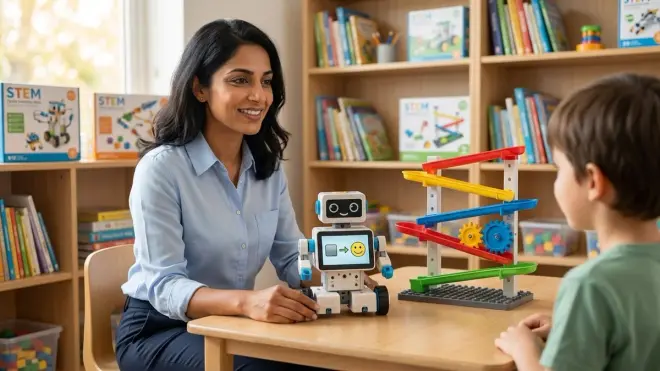
This developmental stage bridges concrete operational thinking with abstract computational concepts. Your child moves from "this happened" to "this happened because"—the causal reasoning at the heart of algorithm design.
Understanding that actions produce predictable results: When your child programs a coding robot to turn left after a specific command sequence, they're internalizing input-output relationships. This concrete experience with commands and responses demystifies how AI systems process instructions.
Recognizing that instructions must be precise and sequential: The frustration of a robot not following poorly-ordered commands? That's computational precision in action. Your child learns that computers (and AI systems) require unambiguous, logically ordered instructions—they can't infer intent the way humans do.
Identifying when the same input produces different outputs: This introduces probabilistic thinking. When your child rolls dice repeatedly and gets different results from identical actions, they're building intuition for randomness and probability—concepts essential for understanding how AI handles uncertainty.
Connecting sensors to decision-making: When a robot avoids obstacles using ultrasonic sensors, your child witnesses how AI gathers environmental data (input) and adjusts behavior (output). This tangible cause-effect loop mirrors industrial automation and autonomous vehicle systems.
Understanding that complex results come from combined simple steps: Decomposition—breaking big problems into smaller, manageable pieces—appears throughout robotics kits for kids. Your child discovers that impressive behaviors emerge from sequences of simple, logical steps.
Recognizing feedback loops: When your child adjusts their strategy based on results ("That didn't work, so I'll try this"), they're engaging in iterative refinement—the same process AI systems use during training. This metacognitive awareness transfers directly to debugging and optimization.
At this stage, the transition from screen-free coding to text-based programming typically begins. Your nine-year-old doesn't need to write Python yet, but they should understand that code translates human intentions into machine-executable instructions.
Algorithm Design and Decision Trees (Ages 8-11)
Now your child tackles the conceptual architecture behind AI: how systems make decisions, what "rules" mean in computational contexts, and why different approaches solve different problems. These AI concepts for children to learn transform them from users to designers.
Designing step-by-step procedures to solve problems: Algorithm creation starts with everyday challenges—writing a recipe, giving someone directions. When your child can articulate a clear, sequential process for completing a task, they're thinking algorithmically. Applying this skill to Scratch or Python programming makes the concept concrete.
Using conditional logic (if-this-then-that): Decision trees underpin countless AI applications, from chatbots to medical diagnosis tools. When your child programs "if the sensor detects an obstacle, then turn right," they're building the same logical structures used in expert systems and decision-making algorithms.
Understanding that computers follow instructions without understanding meaning: This crucial insight—that AI lacks human comprehension—prevents both unrealistic expectations and unwarranted fear. Your child learns that "smart" systems aren't conscious; they're executing sophisticated pattern-matching based on training data.
Comparing different solutions to the same problem: When your child discovers multiple ways to program the same robot behavior, they're engaging in algorithmic thinking. Some solutions are faster, some use fewer steps, some are easier to modify—this comparative analysis mirrors software engineering practices.
Recognizing that rules can conflict and priorities matter: What happens when a robot's obstacle-avoidance rule conflicts with its follow-the-line rule? Your child learns about prioritization, exception handling, and the complexity of real-world decision-making—all central to ethical AI design.
Understanding loops and efficiency: Why repeat code when you can write it once and loop it? This efficiency concept appears everywhere from Arduino robotics programming to professional software development. Your child builds computational fluency alongside resourcefulness.
Around age ten, many children benefit from explicit machine learning instruction that connects their algorithmic understanding to how AI systems improve through training rather than explicit programming.
Machine Learning Fundamentals and Training Concepts (Ages 10-14)
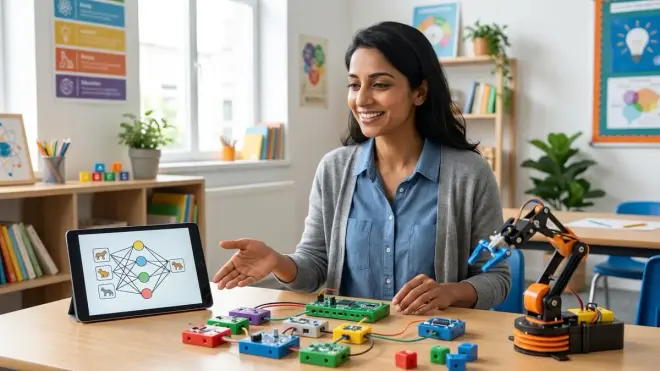
This is where AI concepts for children to learn shift from rule-based systems to learning systems—the distinction between traditional programming and modern AI. Your middle schooler can now grasp abstraction, probability, and the difference between correlation and causation.
Understanding that AI learns from examples, not just rules: This conceptual leap—from if-then logic to pattern recognition from data—defines modern AI. When your child sees a simple machine learning model classify images after training on hundreds of examples, the "aha" moment is palpable.
Recognizing that training data shapes AI behavior: If you train an image classifier using only photos of golden retrievers, it won't recognize dachshunds as dogs. This insight introduces bias, representation, and data quality—concepts with profound ethical implications in facial recognition, hiring algorithms, and criminal justice applications.
Distinguishing supervised from unsupervised learning: Does the AI learn from labeled examples (supervised), or does it find patterns on its own (unsupervised)? Understanding this distinction helps your child grasp why different AI approaches suit different problems. For accessible explanations, see supervised vs unsupervised learning for kids.
Understanding neural networks as layered pattern detectors: Your teen doesn't need the calculus behind backpropagation, but they should understand that neural networks process information through interconnected layers, each detecting increasingly complex features—edges, then shapes, then objects.
Recognizing overfitting and generalization: When your child builds a model that performs brilliantly on training data but fails on new examples, they've encountered overfitting. This experience teaches the balance between memorization and genuine learning—a challenge in both human and artificial intelligence.
Understanding that AI predictions include uncertainty: AI systems assign confidence scores, not absolute truths. Your teen should know that "85% likely to be a cat" means the system could be wrong—a critical literacy skill as AI-generated content becomes ubiquitous.
Connecting AI capabilities to real-world applications: How do recommendation algorithms work? What enables voice assistants? Why do some medical AI systems outperform human diagnosticians while others fail spectacularly? Contextualizing AI within actual STEM career pathways makes the learning personally relevant.
Teaching kids AI and machine learning effectively at this stage requires balancing technical accuracy with age-appropriate abstraction. Your thirteen-year-old doesn't need to implement gradient descent, but they should understand that training involves iteratively adjusting parameters to minimize errors.
Ethical Considerations and AI Limitations (Ages 10-14)
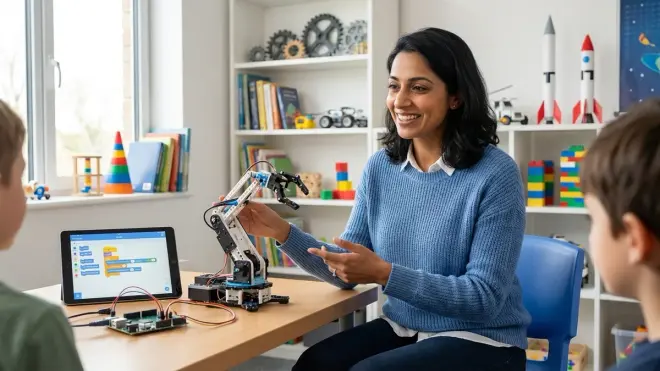
Perhaps the most important AI concepts for children to learn aren't technical—they're ethical and critical. As AI systems make increasingly consequential decisions, your child needs the literacy to question, evaluate, and advocate responsibly.
Recognizing that AI reflects human biases in training data: When facial recognition performs poorly on darker skin tones or hiring algorithms favor male candidates, the problem isn't the math—it's biased training data reflecting historical discrimination. Your child should understand that AI amplifies existing inequalities unless deliberately designed otherwise.
Understanding privacy implications of data collection: Every interaction with AI systems generates data. Your teen should know what data they're providing, how it might be used, and why data privacy matters—both personally and societally.
Questioning AI decision-making in high-stakes contexts: Should AI determine loan approvals? Criminal sentencing? College admissions? Your child doesn't need definitive answers, but they need the critical thinking skills to ask these questions and evaluate trade-offs.
Recognizing current AI limitations: Despite media hype, AI can't actually "understand" language, "feel" emotions, or transfer learning across domains the way humans do. Demystifying these limitations prevents both technophobia and uncritical acceptance.
Understanding environmental costs of AI training: Large language models and image generators require enormous computational resources with significant energy consumption. Your child should connect AI development to broader sustainability concerns.
These discussions don't require separate lessons—integrate them naturally when your child encounters AI systems. Why did YouTube recommend that video? What would happen if the training data only included one type of person? Who benefits from this AI application, and who might be harmed?
Final Check Before You Go
Early Childhood (Ages 4-7):
✓ Sorts objects by attributes and identifies patterns
✓ Makes predictions based on observed sequences
✓ Understands that information answers questions
✓ Spots items that don't fit patterns
Elementary (Ages 6-9):
✓ Grasps input-output relationships through hands-on coding
✓ Writes precise, sequential instructions
✓ Recognizes feedback loops and iterative improvement
✓ Connects sensors to decision-making in robotics
Middle Grades (Ages 8-11):
✓ Designs algorithms for everyday problems
✓ Uses conditional logic (if-then statements)
✓ Compares different solutions to same challenges
✓ Understands efficiency and loops
Middle School (Ages 10-14):
✓ Distinguishes learning systems from rule-based programs
✓ Understands how training data shapes AI behavior
✓ Recognizes neural networks as layered pattern processors
✓ Questions AI decisions and identifies bias
✓ Knows current AI limitations and ethical concerns
Frequently Asked Questions
Should I teach AI concepts before my child learns to code?
Yes—foundational AI concepts like pattern recognition, prediction, and cause-effect logic develop beautifully through screen-free, tactile activities long before formal coding instruction begins. Children as young as four can engage with the cognitive building blocks of AI through sorting games, pattern sequences, and hands-on classification activities, then progress to screen-free coding kits that build algorithmic thinking without requiring digital literacy. Text-based programming and explicit machine learning instruction can wait until ages 10-12, after your child has internalized computational thinking through concrete manipulation and play.
Which programming language is best for teaching AI concepts to kids?
Scratch provides the gentlest entry point for ages 7-10, offering visual block-based programming that makes input-output logic and conditional statements immediately accessible without syntax frustration. Python becomes the preferred language for ages 10 and up when children tackle actual machine learning projects, since it's the industry standard for AI development with accessible libraries like TensorFlow and scikit-learn. For detailed comparison of when each language serves learning goals best, see Python vs Scratch for teaching AI. The key isn't the language itself—it's matching cognitive readiness to abstraction level.
How do I teach AI ethics to children without overwhelming them?
Start with relatable scenarios rather than abstract principles: "This app recommends videos—how does it decide what you'd like?" or "If a robot learned about dogs by only seeing golden retrievers, what would happen when it met a Chihuahua?" Use your child's own experiences with algorithms (game recommendations, search results, social media feeds) as springboards for questions about bias, privacy, and fairness. The goal isn't comprehensive ethical frameworks—it's nurturing the habit of questioning how AI systems work, who benefits from them, and what problems they might create. These conversations happen naturally during AI project work when your child's own models make interesting mistakes or unexpected predictions.
Final Thoughts
The AI concepts for children to learn aren't about keeping pace with technology—they're about cultivating the cognitive flexibility, critical thinking, and ethical awareness your child needs to shape technology rather than merely consume it. Pattern recognition at age five becomes algorithm design at age nine, which becomes ethical questioning at thirteen. Each stage builds on the last, creating not just technical literacy but genuine computational fluency. You don't need to be an AI expert yourself; you just need to provide rich experiences with cause-effect relationships, hands-on problem-solving, and space for your child to notice patterns, test predictions, and ask why systems work the way they do. That curiosity, paired with progressive skill-building tools, creates the foundation for whatever AI-integrated future we're heading toward—and the wisdom to question whether we should build something just because we can.