
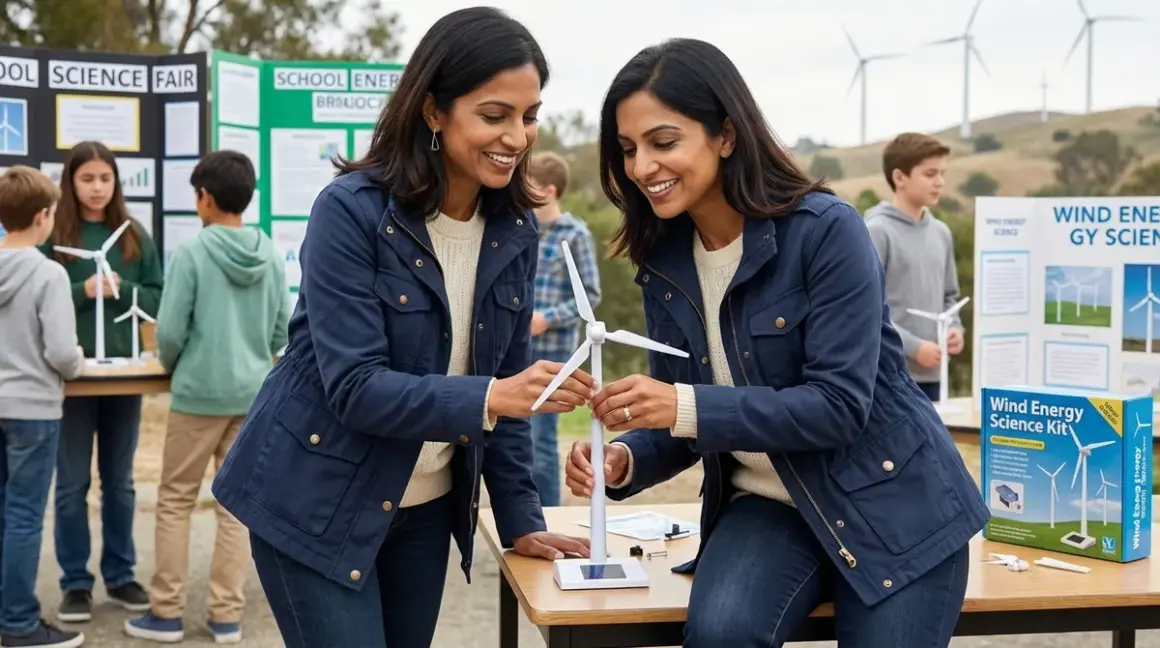

You're standing in front of a science fair display board, and your child's third attempt at explaining "how the wind turbine turns" is met with the same polite nod from the judge—but you can see they're not grasping the energy conversion concept. I've watched this scenario unfold dozens of times, and the issue is rarely effort; it's that the kit didn't scaffold the underlying physics clearly enough to build genuine understanding. The best wind energy science project kits transform abstract concepts like kinetic energy conversion and electrical generation into hands-on learning experiences that prepare students for actual renewable energy engineering principles, not just spinning blades for visual effect.
If you're looking for the bottom line: the KidWind Basic Wind Experiment Kit offers the most comprehensive progression from mechanical concepts to electrical generation with industry-standard multimeter integration, while the Thames & Kosmos Wind Power 2.0 provides the strongest bridge to real-world turbine engineering for middle and high school students ready for advanced blade design variables.
What to Look For in Wind Energy Science Project Kits
When you're evaluating wind energy science project kits, you need to think beyond the "cool factor" of spinning blades. The most effective kits scaffold learning in a specific sequence: mechanical energy capture, rotational dynamics, energy conversion, and finally electrical generation with measurable output. Here's what separates genuine learning tools from decorative science fair props.
Progressive Skill Development from Observation to Engineering
The strongest kits don't start with "build this turbine and plug in the LED." They guide students through discrete concept stages. Look for kits that begin with blade design experimentation—changing pitch angles, surface area, and material weight—so students develop schema around the relationship between wind force and rotational speed before introducing electrical components.
This aligns perfectly with NGSS standards MS-PS3-3 (energy transfer) and MS-ETS1-4 (iterative design optimization). You want a kit that explicitly supports variable testing: at least 3-4 different blade configurations, adjustable mounting angles, and ideally interchangeable generator components so students can isolate each variable. Kits that lock you into a single "correct" build teach assembly skills, not engineering thinking.
The progression should culminate in measurable electrical output. This means the kit must include or explicitly require a multimeter (many don't, which is a significant gap). Students need to see voltage and amperage readings change based on their design modifications. Without quantitative data, you're asking them to make subjective observations about "which one seems faster," which doesn't build the analytical foundation they'll need for actual STEM work.
Technical Compatibility and Data Integration
Here's where many kits falter: they treat wind energy as an isolated phenomenon rather than a system you can model and analyze. The best wind energy science project kits integrate with data logging tools and software platforms your child will encounter in actual lab settings.
Look for compatibility with Arduino IDE or MicroPython environments if you're working with a student in grades 7-12 who has basic coding exposure. Several advanced kits now include sensor integration (anemometer inputs, voltage sensors, RPM measurement) that connect to Arduino boards, letting students graph performance data over time and test multiple iterations systematically. This isn't essential for elementary students, but by middle school, it's the difference between a science fair project and a genuine engineering investigation.
For younger learners (grades 4-6), you want kits that work with visual data tools like simple spreadsheet templates or dedicated apps that don't require programming knowledge but still teach graphing and data interpretation skills. Some manufacturers provide cloud-based platforms—check whether these require ongoing subscriptions or if the core functionality works offline. (I consistently recommend offline-capable tools for classroom and home use; cloud dependencies create access barriers and privacy concerns.)
Also verify OS compatibility if software is involved. Many educational platforms still release iOS-only apps, which creates frustration if your family uses Windows or Android devices exclusively. Cross-platform compatibility or no-software-required operation gives you the most flexibility.
Lab Specs: Durability, Power Requirements, and Expandability
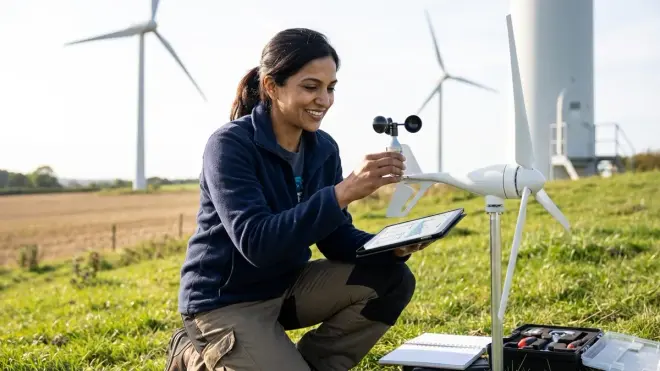
A wind energy kit that survives exactly one build before the generator shaft bends or the blade mounts crack isn't a learning investment—it's a frustration purchase. You need to evaluate these tools with the same criteria we use for actual lab equipment.
Durability for repeated builds: Look for metal generator housings and reinforced plastic blade mounts, not thin injection-molded parts that snap under normal assembly pressure. The best kits support 10-15 build cycles with different configurations. Check whether replacement parts are available separately; companies that sell replacement blades, shafts, and generators as individual components are signaling they've designed for longevity.
Power and connectivity: Most wind turbines in educational kits generate 1-6 volts DC under typical indoor fan conditions. Verify what the kit expects as a power source for testing—some include small DC motors (which double as generators), while others assume you'll provide a variable-speed fan. Battery-dependent accessories (like included storage capacitors or LED demonstration loads) should use standard cell sizes (AA, AAA, 9V), not proprietary button cells that create ongoing costs.
For expandability, the strongest kits use modular mounting systems that integrate with other renewable energy experiments. Several manufacturers now design with standardized mounting plates so the same turbine can connect to different generator types, hybrid solar-wind systems, or energy storage components. If your student shows deep interest in renewable energy, this modularity means the kit becomes part of a progressive learning path rather than a one-off project.
Real-World Engineering Connections
This matters more than most parents realize: does the kit teach principles that transfer to actual wind energy engineering, or just craft-project approximations?
Strong kits explicitly address blade aerodynamics using real terminology—lift and drag coefficients, angle of attack, tip-speed ratio. You don't need calculus-level explanations for middle schoolers, but the instructional materials should use the same conceptual framework that professional turbine engineers use, just scaffolded appropriately. Look for kits that reference real turbine designs (horizontal-axis vs vertical-axis configurations, Savonius vs Darrieus vertical models) so students understand they're exploring actual engineering trade-offs, not arbitrary craft choices.
The best instructional materials include scale comparisons to commercial wind farms. When a student tests a 20cm diameter blade and calculates power output, the guide should help them understand how those principles scale to the 60-meter rotors they see on highway wind farms. This contextual framing transforms the project from "I made electricity with a fan" to "I'm modeling the same energy physics that utility companies optimize for grid-scale generation."
Some advanced kits now include grid-tie concepts—energy storage, DC-to-AC conversion basics, and load matching. These are sophisticated topics, appropriate for high school students, but they're exactly what prepares learners for industry-standard renewable energy system design. If your student is genuinely interested in energy engineering as a career path, these advanced features are worth the investment.
Our Top Picks
KidWind Basic Wind Experiment Kit
The KidWind Basic Wind Experiment Kit🛒 Amazon remains the gold standard for middle school wind energy science project kits because it prioritizes systematic experimentation over flashy finished products. This kit includes four different blade designs (curved, flat, twisted, and split), a hub system that lets you test 2, 3, 4, or 6-blade configurations, and a small DC motor/generator with mounting hardware.
Pros:
- Supports genuine variable isolation with interchangeable components for blade shape, quantity, pitch angle, and hub height—students can test one factor at a time following proper experimental design protocols
- Requires multimeter integration (not included) for voltage/current measurement, teaching proper use of standard lab equipment that appears in every high school and college physics lab
- Scales from elementary to high school with downloadable curriculum guides aligned to NGSS standards for grades 4-12, each providing age-appropriate investigation protocols
- Expandable with modular mounting system compatible with KidWind's advanced wind turbine kits, solar panels, and energy storage modules for multi-variable renewable energy investigations
- Exceptional durability with metal generator housing and thick ABS plastic blade mounts that survive 15+ build cycles in classroom settings
Cons:
- No multimeter included despite being essential for meaningful data collection—adds $15-25 to the real setup cost and creates a barrier for families without existing lab tools
- Blade attachment system uses small set screws that students under age 10 find frustrating to tighten precisely; younger learners need adult assistance to ensure secure mounting
- Documentation assumes some physics vocabulary (torque, angular velocity) without defining terms, which can create confusion for students without prior physical science coursework
This kit works best for students in grades 5-10 who are ready to move beyond "does it spin?" to quantitative questions like "how does doubling the blade surface area affect power output at constant wind speed?" You'll need to provide your own wind source (box fan works well), multimeter, and data recording system. The kit pairs beautifully with the structured experimental protocols in our renewable energy science fair projects guide if your student needs help designing controlled tests.
Thames & Kosmos Wind Power 2.0
The Thames & Kosmos Wind Power 2.0 Science Kit🛒 Amazon delivers the most sophisticated blade engineering experience available in consumer kits, making it ideal for high school students ready for advanced physics applications. This kit includes nine different rotor blade sets (three each of three designs), a professional-quality nacelle with adjustable gear ratios, and a power LED plus storage capacitor for energy accumulation experiments.
Pros:
- Introduces real turbine engineering concepts including horizontal-axis vs vertical-axis configurations, gear ratio optimization for different wind speeds, and the relationship between blade count and efficiency at various rotational speeds
- Full-color 32-page manual explicitly connects projects to commercial wind farm engineering, discussing offshore vs onshore design constraints, grid-scale energy storage challenges, and capacity factor calculations
- Includes LED and capacitor for energy storage demonstrations, letting students explore the intermittency challenges that make wind power complex for grid operators
- High build quality with reinforced gear assemblies designed for 20+ experimental cycles; Thames & Kosmos sells replacement gearboxes and blade sets individually for long-term use
- No subscriptions or software dependencies—entirely offline operation with optional free downloadable worksheets for extended investigations
Cons:
- Higher initial cost (typically around $50-60) reflects the sophisticated mechanical components but may exceed budget for families exploring wind energy casually rather than as a sustained interest area
- Complex assembly requires 45-60 minutes for initial build, which can frustrate elementary-age students expecting quick results; best suited for grades 8-12 with patience for mechanical problem-solving
- Generator output relatively low (around 400mW peak in typical indoor conditions) means you won't power dramatic loads; students expecting to charge phones will be disappointed by the modest LED illumination
This kit shines when paired with formal investigation protocols. It's the best choice for science fair projects that ask research questions like "How does blade count affect efficiency at different wind speeds?" or "What gear ratio produces maximum power output from variable wind sources?" The mechanical sophistication supports hypothesis testing that middle school kits can't address, preparing students for the engineering analysis they'll encounter in AP Physics or undergraduate renewable energy coursework.
Engino Discovering STEM: Wind Energy Kit
The Engino Discovering STEM Wind Energy🛒 Amazon takes a building-block approach that works exceptionally well for students in grades 4-7 who need concrete, manipulable models before abstracting to energy concepts. This kit uses Engino's snap-together construction system to build multiple wind turbine configurations, a water wheel for kinetic energy comparison, and a crane powered by the turbine's electrical output.
Pros:
- Multiple build configurations (five different wind-powered machines) illustrate energy transfer concepts through varied applications—students see the generator powering different mechanical loads, building schema around work and energy
- Excellent for kinesthetic learners who struggle with purely observational experiments; the snap-together construction creates strong engagement while teaching mechanical advantage concepts alongside energy generation
- Includes printed instruction booklet plus free AR app (iOS/Android) that overlays explanatory animations onto physical builds, bridging hands-on and digital learning without screen-dependent operation
- Motor/generator included with sufficient output to power the included crane and LED, giving students immediate feedback that their turbine design is generating usable energy
- Compatible with other Engino STEM kits for students who want to expand into solar power, hydraulics, or simple machines—the construction system is genuinely interoperable
Cons:
- Limited blade experimentation compared to dedicated wind kits; the focus on varied builds means less depth in optimizing turbine design specifically—you'll build more things but test fewer variables
- AR app adds educational value but creates tablet dependency for the full experience; families committed to screen-free learning lose about 30% of the instructional content
- Smaller generator output (under 2V typical) limits quantitative measurement opportunities unless you're using a sensitive multimeter; younger students may not see dramatic differences between design iterations
This kit occupies a useful middle ground between "simple craft project" and "rigorous experiment platform." It's ideal for students who need to build understanding about energy transfer through multiple physical models before they're ready for the focused hypothesis testing that kits like KidWind support. If your child is in grades 4-6 and hasn't done substantial hands-on physics work yet, this scaffolds the concepts beautifully before advancing to more specialized investigation tools.
Horizon Renewable Energy Science Education Set
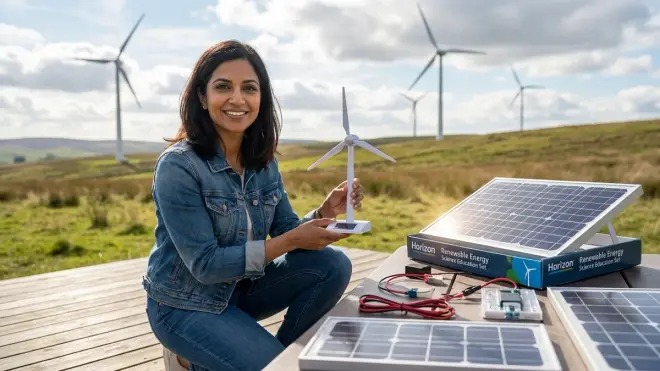
The Horizon Renewable Energy Science Education Set🛒 Amazon offers the strongest integration pathway from isolated wind experiments to comprehensive energy systems thinking, making it valuable for students in grades 7-11 who want to understand how wind fits into broader renewable infrastructure. This set includes a wind turbine with adjustable blade pitch, a small solar panel, a hydrogen fuel cell system, and rechargeable battery storage—all with consistent electrical connectors for hybrid experimentation.
Pros:
- System integration focus teaches grid-scale concepts that isolated kits miss—students explore load matching, energy storage, and hybrid generation strategies that mirror real utility-scale challenges
- Hydrogen fuel cell component introduces electrolysis and fuel cells using simple reversible PEM cells; students see chemical energy storage as an alternative to batteries, building understanding of multiple storage technologies
- Curriculum guide explicitly addresses capacity factor and intermittency, the two factors that make renewable energy complex for grid operators—concepts essential for serious energy engineering discussions
- All components use standardized 2mm banana plug connectors allowing flexible system configuration and easy multimeter integration for voltage/current measurement at multiple points
- Durable components designed for 50+ experimental cycles in classroom settings; Horizon sells replacement parts and offers educational webinars for teachers implementing renewable energy curricula
Cons:
- Significantly higher price point (typically around $200) reflects the multi-component system but exceeds most families' budget for a single learning investment unless renewable energy is a sustained, serious interest area
- Complexity requires substantial adult facilitation for students under grade 7; the system integration benefits are lost if learners don't understand each component individually first—best as an advanced follow-up to simpler wind or solar kits
- Hydrogen fuel cell generates only small amounts of hydrogen (safety appropriate, but limiting for extended demonstrations); students need realistic expectations about storage capacity and charge/discharge cycle times
This isn't a first wind energy kit—it's a capstone system for students who've already explored basic wind and solar principles and are ready for integrated renewable energy system design. The value proposition shifts from "learn about wind turbines" to "understand how renewable energy engineers design reliable power systems from intermittent sources." If your student is considering renewable energy engineering as a career path, this kit introduces industry-standard integration challenges that university programs expect entering students to understand. It pairs particularly well with our comprehensive guide to renewable energy projects for students ready to tackle multivariable investigations.
4M Green Science Windmill Generator
The 4M Green Science Windmill Generator🛒 Amazon serves a specific niche: introductory wind energy concepts for elementary students (grades 3-5) who aren't ready for variable experimentation but need concrete experience with energy conversion before advancing to quantitative investigations. This simple kit includes plastic windmill blades, a small DC motor/generator, LED, and mounting hardware for a single fixed configuration.
Pros:
- Simple 20-minute assembly appropriate for elementary students with minimal adult assistance; clear visual instructions reduce reading barriers for younger learners still developing technical documentation skills
- Immediate success with LED illumination builds confidence and engagement before introducing the frustration of optimization experiments—students see that wind can generate electricity without needing to understand efficiency calculations
- Very low cost (typically around $15-18) makes it accessible for classroom sets or families exploring whether wind energy captures their child's interest before investing in advanced kits
- No batteries or additional power required—completely mechanical-to-electrical demonstration that reinforces energy conversion without confounding variables from battery storage
- Can be modified for advanced students willing to hack the design; the simple construction allows creative blade replacements, mounting modifications, and generator upgrades for learners who want to tinker
Cons:
- Single fixed configuration offers no variable testing opportunity—you build it once, see the LED light, and that's the complete learning experience unless students independently design modifications
- Fragile construction with thin plastic components that crack during aggressive assembly; expect 3-5 build cycles maximum before components fail—not suitable for repeated classroom use
- No instructional depth beyond basic assembly—the included pamphlet doesn't explain lift, drag, energy conversion, or any underlying physics; parents need to supplement with additional instruction if conceptual understanding is the goal
This kit works best as an introduction for younger students or as a supplementary demonstration alongside more robust primary kits. If you're teaching a mixed-age group and need a simple hands-on activity for elementary students while older siblings work with KidWind or Thames & Kosmos kits, this provides appropriate engagement without overwhelming younger learners. It's also useful for explaining renewable energy concepts to kids who need concrete experience before they're ready for abstract efficiency discussions. Just recognize its limitations: this builds awareness, not engineering skills.
Eisco Labs Wind Turbine Generator Model
The Eisco Labs Wind Turbine Generator and Motor🛒 Amazon targets the specific needs of formal lab environments and serious home STEM setups where durability and measurement precision matter more than varied configurations. This is a professional-quality generator mounted on a sturdy base with banana plug outputs designed explicitly for multimeter connection and long-term repeated use.
Pros:
- Lab-grade durability with metal housing, reinforced blade mounts, and sealed bearings designed for 100+ experimental cycles without performance degradation—this is equipment that lasts through multiple siblings or classroom years
- Professional electrical connections using standard 4mm banana plugs that match the inputs on educational multimeters and oscilloscopes; teaches proper lab equipment integration from the start
- Precision engineering with low friction losses produces consistent, repeatable measurements across trials—essential for students conducting formal hypothesis testing where experimental error needs to be minimized
- Includes technical specifications sheet with generator constants, internal resistance, and efficiency curves that high school physics students can use for theoretical calculations and prediction modeling
- Standalone generator focus means all budget goes into the measurement component rather than fancy blade sets; students can design and test their own blade configurations from cardstock, balsa, or 3D-printed materials
Cons:
- No blades or instructional materials included—this is a component, not a complete kit; families need to source their own blade materials and develop experimental protocols independently (or follow our step-by-step wind turbine project guide)
- Higher cost for a single component (typically around $40-50) may seem excessive compared to complete kits at similar prices, though the cost-per-experimental-cycle is actually lower given the exceptional durability
- Requires existing lab infrastructure including multimeter, mounting system, wind source, and data recording tools—not appropriate for families without established STEM learning spaces
This is the right choice when you're building a complete home STEM lab and want equipment that will serve through high school and potentially early college coursework. It's particularly valuable for students who've outgrown kit-provided blades and want to conduct original blade design research—the precision and durability support genuine engineering iteration rather than one-off demonstrations. Pair this with cardstock, protractors, and rulers for blade design, a household fan for consistent wind source, and a multimeter for measurement, and you have everything needed for AP Physics-level investigation of wind energy principles. The professional-quality generator also prepares students for the measurement precision they'll encounter in university lab settings, making it a strong choice for students considering engineering or physics majors.
Frequently Asked Questions
What age group are wind energy science project kits appropriate for?
Wind energy science project kits span a wide age range, but appropriate complexity varies significantly. Elementary students (grades 3-5) benefit most from simple cause-and-effect demonstrations like single-configuration turbines that light an LED, building basic schema around energy conversion without overwhelming them with optimization variables. These learners need to understand that wind can produce electricity before they're ready to ask how to make it more efficient.
Middle school students (grades 6-8) are ready for variable experimentation where they test different blade designs, mounting angles, or generator configurations while holding other factors constant. This is when students develop formal operational thinking and can handle "what happens if I change X while keeping Y and Z the same?" investigations. Look for kits like KidWind that explicitly support controlled experiments aligned with middle school NGSS engineering standards.
High school students (grades 9-12) should work with kits that introduce engineering mathematics—calculating tip-speed ratios, using power equations (P = I × V), graphing efficiency curves, and comparing experimental data to theoretical predictions. The Thames & Kosmos and Horizon kits provide this sophistication. At this level, wind energy projects prepare students for university physics and engineering coursework, not just science fair displays. The measurement precision and mathematical modeling separate high school investigations from middle school explorations.
Do I need a multimeter for wind energy experiments, or can the kit measure power on its own?
You absolutely need a multimeter for meaningful wind energy experiments, and it frustrates me that many manufacturers don't include them while marketing kits as "complete." Yes, your child can see an LED illuminate and observe that "it's working," but that provides zero quantitative data for comparison. Without voltage and current measurements, students can't determine whether adding a third blade increased power by 15% or 2%—they're just guessing based on LED brightness, which isn't a reliable indicator.
A basic digital multimeter costs around $15-25 and is essential infrastructure for any home STEM lab. Look for models with DC voltage range (0-20V), DC current measurement (0-2A), and preferably data logging capability if you're working with older students who want to graph performance over time. The multimeter teaches proper measurement technique, significant figures, and data recording practices that every lab science requires. Including measurement precision in your home STEM lab setup pays dividends across multiple projects, not just wind energy.
Some advanced kits (like Horizon's) include voltage displays or integrate with Arduino-based data logging, which can supplement but not replace hands-on multimeter experience. By high school, students need to be comfortable connecting test leads, selecting appropriate scales, and interpreting digital readouts—these are baseline laboratory skills for any STEM field. Budget for a multimeter alongside your wind energy kit, not as an optional enhancement.
Can wind energy kits be used indoors, or do you need outdoor wind for experiments?
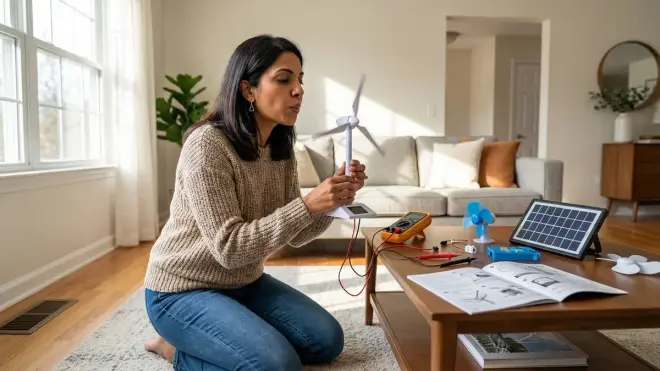
Most educational wind energy science project kits work perfectly well with indoor box fans as controlled wind sources—in fact, I prefer indoor testing for student investigations because it eliminates the confounding variable of changing wind speed. When you're trying to test how blade pitch affects power output, you need consistent wind speed across all trials, which natural outdoor wind simply doesn't provide. A box fan set on medium speed gives you repeatable conditions for proper experimental design.
That said, outdoor testing is valuable for advanced students exploring real-world engineering challenges. Natural wind is turbulent, variable, and directional—exactly the conditions that commercial turbine engineers must accommodate. Students can investigate questions like "how does power output vary over a 30-minute period?" or "does turbine orientation relative to wind direction affect performance?" These questions require outdoor conditions but represent more sophisticated learning objectives appropriate for high school students.
For indoor work, you'll want a fan that provides wind speeds of roughly 8-15 mph at the turbine location. Most box fans deliver this at medium to high settings when positioned about 2-3 feet from the turbine. An optional but valuable addition is a handheld anemometer (around $15-20) to measure actual wind speed so students can include that variable in their data tables. This lets them create power curves showing output versus wind speed, mirroring the performance specifications that utility companies use for commercial turbine evaluation. Our step-by-step guide to creating wind turbine projects includes detailed protocols for both indoor controlled testing and outdoor real-world validation.
How do wind energy kits compare to solar energy kits for teaching renewable energy concepts?
Wind and solar kits teach overlapping but distinct concepts, and ideally students experience both as part of a comprehensive renewable energy learning path. Wind energy kits emphasize mechanical-to-electrical energy conversion—students see rotational motion transform into current flow, building understanding of generators and electromagnetic induction. They explore aerodynamics, gear ratios, and how blade design affects mechanical efficiency before electricity enters the picture. This makes wind kits particularly strong for teaching physics principles around force, motion, and energy transfer.
Solar energy kits focus on photovoltaic conversion—light energy directly producing electrical current without mechanical intermediaries. Students investigate angle of incidence, shading effects, and series versus parallel circuit configurations. Solar projects teach different physics concepts around electromagnetic radiation, semiconductor behavior, and circuit design. The experimentation variables differ: solar students optimize panel angle and positioning, while wind students optimize blade design and mechanical coupling.
For comprehensive learning, students should work with both at different points in their development. I typically recommend starting with solar in grades 4-6 because the variables are simpler (no moving parts to align or balance) and the light source (lamp or sun) provides more consistent conditions than wind. Progress to wind in grades 6-8 when students can handle the mechanical complexity and multiple interacting variables. By high school, students benefit from hybrid systems like the Horizon kit that explicitly compare the two technologies and address grid integration challenges. Solar energy kits and wind kits aren't competitors—they're complementary components of renewable energy literacy.
Can students use wind energy kits for science fair projects at a competitive level?
Yes, but success depends on asking genuine research questions rather than just demonstrating that wind produces electricity. I've judged dozens of renewable energy projects at regional science fairs, and the difference between participation-level and award-winning projects is clear: winning projects investigate specific variables with controlled experiments and quantitative analysis, while participation projects just build and demonstrate.
A strong science fair project using a wind energy kit might ask: "How does blade surface area affect power efficiency at different wind speeds?" or "What is the optimal number of blades for maximum power output in low-speed wind conditions?" Notice these questions require systematic variable testing with measured, graphed results. Students test 4-5 different blade configurations, measure voltage and current for each at 3-4 different wind speeds, calculate power output, and create graphs showing the relationships. Following proper science fair project protocols with hypothesis, controlled variables, repeated trials, and error analysis transforms a kit from a demonstration into a competitive investigation.
The kit itself matters less than the research design. I've seen award-winning projects using $20 kits because the student asked sophisticated questions and conducted rigorous testing. I've also seen expensive kits produce weak projects because the student just built what the instructions showed and wrote up the assembly process. Advanced kits like KidWind and Thames & Kosmos support competitive projects better because they include the variable components and measurement precision for proper hypothesis testing, but ultimately, the investigation quality depends on the research question and experimental rigor, not the kit price tag. Your child will need guidance developing that research question, designing controlled experiments, and analyzing results statistically—skills worth developing regardless of which kit you choose.
The Verdict
Wind energy science project kits serve their purpose best when matched precisely to your student's current skill level and your learning objectives. If you're introducing energy conversion concepts to elementary students, simple demonstration kits like 4M Green Science provide appropriate engagement. For middle schoolers ready for genuine experimental design, the KidWind Basic Kit remains unmatched in supporting systematic variable testing with proper controls and quantitative measurement.
High school students investigating wind energy seriously—whether for competitive science fairs, AP Physics coursework, or genuine career exploration—need the engineering sophistication of Thames & Kosmos Wind Power 2.0 or the system integration approach of Horizon's comprehensive renewable energy set. These aren't casual purchases, but they're legitimate learning investments that prepare students for university-level renewable energy engineering.
The common thread across all successful wind energy learning experiences: students need to measure, compare, and iterate their designs with real data, not just observe spinning blades. Budget for a multimeter, create consistent testing conditions, and guide your student toward specific research questions rather than open-ended "let's see what happens" building. That's when wind energy kits transform from craft projects into genuine engineering education that builds skills transferable to the actual renewable energy sector. Your investment in these learning tools compounds when paired with structured investigation protocols, turning curiosity about spinning blades into quantitative understanding of how engineers optimize energy capture from variable natural resources.