
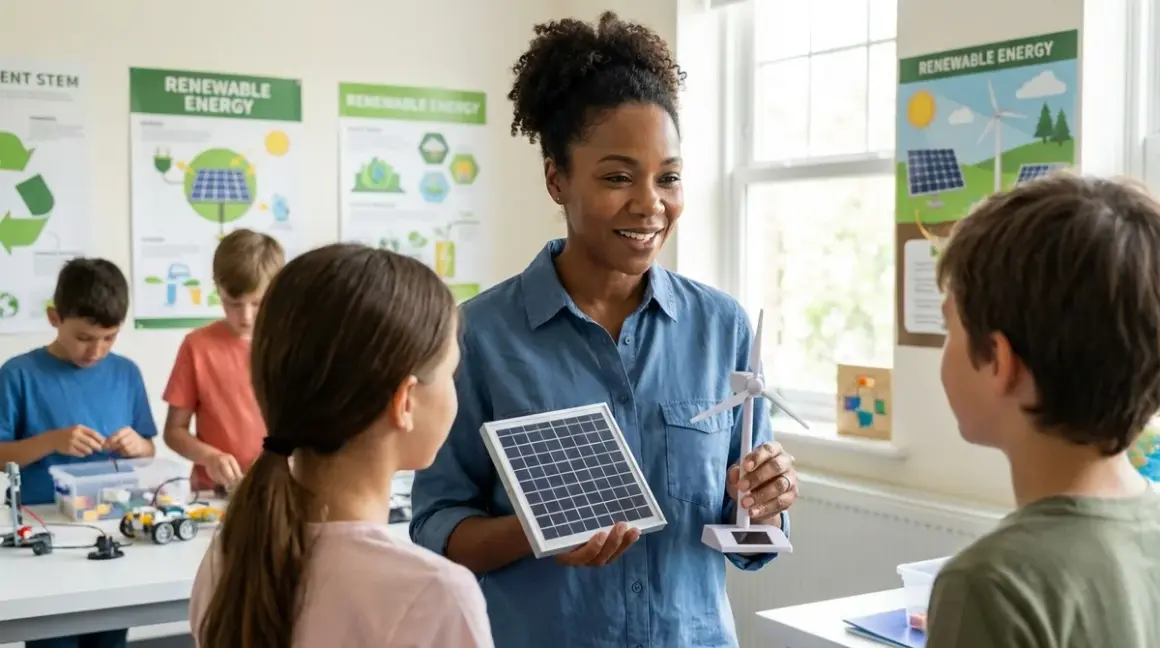

You'll notice something urgent in the air when your daughter asks where electricity comes from, or your son wonders why we can't just run cars on sunshine. What is renewable energy for kids isn't just a science question—it's the foundation of every climate conversation they'll navigate for the rest of their lives. Understanding renewable energy before middle school means your child can move from passive concern to active problem-solving, building real systems that capture wind, sun, and water to generate measurable power. This guide translates complex energy concepts into hands-on learning outcomes, with clear pathways from basic circuits to solar panel efficiency calculations that mirror what grid engineers actually do.
What Is Renewable Energy for Kids?
Renewable energy is power generated from natural sources that replenish themselves faster than we can use them up. When we talk about what is renewable energy for kids, we're describing energy from the sun, wind, moving water, geothermal heat, and organic matter—sources that won't run out in a human lifetime, unlike fossil fuels that took millions of years to form and will eventually be exhausted.
Here's the distinction that matters: fossil fuels (coal, oil, natural gas) release stored carbon when burned, contributing to atmospheric CO₂ levels and climate change. Renewable sources generate power without combustion in most cases, producing zero or near-zero direct emissions during operation. Solar panels convert sunlight into electricity through photovoltaic cells. Wind turbines capture kinetic energy from air movement. Hydroelectric systems harness flowing water. Geothermal taps underground heat. Biomass converts organic waste into fuel.
The educational value here isn't just vocabulary—it's systems thinking. When your ten-year-old builds a working solar panel and measures voltage output across different times of day, they're internalizing energy conversion efficiency, grid storage challenges, and the intermittency problem that real renewable engineers solve daily. Understanding what is renewable energy for kids means grasping that these aren't theoretical concepts—they're active career fields with urgent, well-funded problems waiting for the next generation's solutions.
This knowledge becomes the scaffolding for advanced STEM pathways: electrical engineering, environmental science, data analysis (tracking weather patterns and energy output), materials science (improving panel efficiency), and policy work (grid integration and energy storage). The earlier kids see renewable energy as a design challenge rather than a lecture topic, the more likely they'll pursue careers that matter.
How Renewable Energy Works
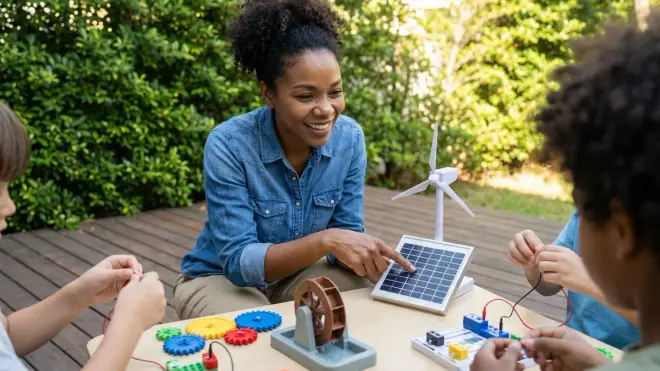
Every renewable energy system follows the same fundamental pattern: capture natural energy → convert it to usable electricity → store or transmit it. Let's break down the mechanisms your child will encounter in hands-on kits and real-world installations.
Solar energy relies on the photovoltaic effect. When photons from sunlight hit a solar cell (typically made from silicon), they knock electrons loose, creating an electrical current. The Thames & Kosmos Solar Power Kit demonstrates this with working panels that kids can wire into circuits—you'll measure voltage and amperage with a multimeter, then graph how panel angle and cloud cover affect output. That's not toy work; that's replicating what solar installers do during site assessments. Most educational solar panels operate at 3–6V DC, enough to power small motors and LED arrays without safety concerns. Real rooftop systems scale that principle to 300–400W panels wired in series, feeding inverters that convert DC to household AC.
Wind energy captures kinetic energy. Moving air spins turbine blades, which rotate a shaft connected to a generator—essentially a motor running in reverse. Inside the generator, spinning magnets create a changing magnetic field that induces electrical current in copper coils (electromagnetic induction, the principle behind every power plant). Hands-on wind turbine projects teach blade pitch optimization: steeper angles catch more wind but create drag; shallower angles spin faster but capture less force. You'll test different blade counts, materials, and hub heights, then plot energy output against wind speed. That's aerodynamic engineering compressed into a weekend project. The data your child collects mirrors the siting studies that commercial wind farms conduct before installing million-dollar turbines.
Hydroelectric systems convert gravitational potential energy. Water stored at height flows downward, spinning a turbine (similar to wind, but using liquid mass instead of air). Small-scale hydro kits use water wheels or Pelton turbines—cup-shaped blades that catch water jets. Your child will experiment with flow rate (liters per minute), drop height, and turbine design to maximize power output. The math gets real: Power = (flow rate × height × water density × gravity × efficiency). That equation governs everything from backyard stream generators to the Hoover Dam.
Geothermal energy taps underground heat. While less common in kids' kits (it requires drilling or hot spring access), the principle is straightforward: hot water or steam from the earth spins turbines, or heat pumps transfer ground warmth to buildings. Educational models often use thermoelectric generators that create voltage from temperature differentials—place one side on ice, the other on a hot surface, and watch electrons flow.
Biomass converts organic matter into fuel. Anaerobic digesters break down food waste or manure, producing methane (biogas) that burns cleanly. Biofuel kits demonstrate fermentation: yeast consumes sugars, producing ethanol that can fuel model engines. This introduces microbiology and chemistry alongside energy concepts.
The critical insight for young learners: every renewable source has intermittency challenges. The sun doesn't shine at night. Wind speeds fluctuate. Rivers run dry. That's why grid-scale renewables depend on battery storage, capacitor banks, and diversified energy portfolios. When your child builds a solar-wind hybrid system, they're solving the same reliability puzzle that powers California's grid. Those hands-on frustrations—voltage drops when clouds roll in, storage batteries that drain overnight—aren't failures. They're the design constraints that define modern energy engineering.
Why Understanding Renewable Energy Matters for Kids
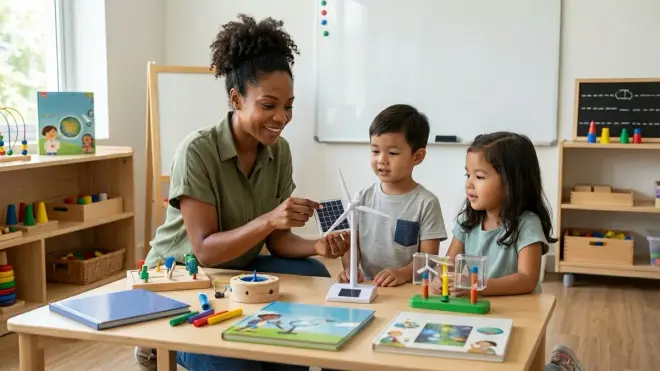
Climate literacy is no longer optional. By the time today's elementary schoolers enter the workforce, renewable energy will represent the majority of new power generation globally. The U.S. Department of Energy projects that solar and wind will account for over 60% of new capacity installations through 2030, with accelerating adoption as storage technology improves and fossil fuel infrastructure ages out. Your child isn't preparing for a distant future—they're preparing for the industry that's hiring now.
But the real reason what is renewable energy for kids matters goes beyond job markets. It's agency. Every year I run solar workshops, I watch kids move from vague climate anxiety ("the planet is doomed") to tangible capability ("I just powered this motor with a panel I built"). That shift is everything. Renewable energy education transforms abstract threats into concrete problems with measurable solutions. When your daughter optimizes a wind turbine blade and increases output by 15%, she's not playing—she's experiencing the iterative design process that drives real innovation.
The skills stack in ways that surprise parents. A solar panel efficiency project requires:
- Electrical engineering: circuit design, voltage regulation, series vs parallel wiring
- Data science: collecting time-series data, controlling for variables, graphing results
- Materials science: comparing monocrystalline vs polycrystalline silicon, testing panel coatings
- Environmental science: tracking weather variables, understanding seasonal sunlight angles
- Economics: calculating return on investment, payback periods, cost per kilowatt-hour
Those aren't isolated lessons. They're an integrated STEM curriculum disguised as a weekend build. And unlike abstract math problems, the stakes feel real because the output is real—your kid just lit an LED using photons that left the sun eight minutes ago.
There's also a justice component. Renewable energy access correlates with equity. Off-grid solar powers rural clinics in sub-Saharan Africa. Community wind projects reduce energy poverty. When kids understand these systems, they see technology as a tool for expanding opportunity, not just personal convenience. That framing matters for the engineers and policymakers they'll become.
Types of Renewable Energy Systems for Hands-On Learning
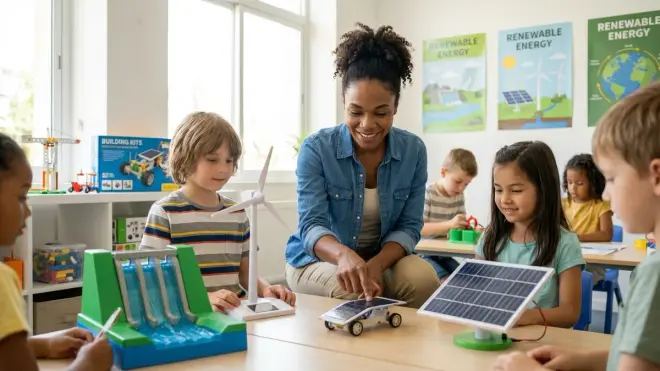
When you're evaluating what is renewable energy for kids through a learning lens, you'll encounter five primary system types, each with distinct skill progressions and expandability paths.
Solar photovoltaic kits are the most accessible starting point. Entry-level models include pre-wired panels, basic motors, and snap-together circuits—no soldering required. Mid-tier kits add multimeters, rechargeable batteries, and charge controllers that prevent overcharging. Advanced builds incorporate Arduino-compatible data loggers for tracking panel efficiency across weeks, microcontrollers for maximum power point tracking (MPPT), and even IoT connectivity for cloud-based monitoring. These kits mirror professional solar installations: site assessment → panel selection → wiring → load calculation → storage integration. A progression from ages 8–16 might look like: basic solar car (8–10) → DIY panel array with battery bank (11–13) → Arduino-controlled solar tracker with efficiency optimization code (14–16). That final project belongs in a college engineering portfolio.
Wind turbine kits teach mechanical design and aerodynamics. Simple pinwheel generators work for ages 7–9, demonstrating that motion creates electricity. Serious kits (ages 10+) include adjustable blade pitch, nacelle housings, and hub height variables. The KidWind Advanced Wind Experiment Kit goes further: laser-cut blade blanks that students shape and test, cup anemometers to measure wind speed, and graphing software to correlate blade design with power output. You'll iterate through five or six blade prototypes, tracking which configurations maximize torque at low wind speeds versus high-speed efficiency. That's not busywork—it's the same design loop that Vestas and GE Renewable Energy run on million-dollar turbines.
Hydroelectric systems require a water source (garden hose, stream, bathtub with drain access). Turbine designs split between impulse turbines (Pelton wheels with cup-shaped buckets that catch high-pressure jets) and reaction turbines (Kaplan or Francis designs where water pressure spins blades). Educational kits let you swap turbine heads and measure output differences. The physics becomes visceral: double the drop height, and you quadruple the kinetic energy available (velocity = √(2 × gravity × height)). Students quickly grasp why hydroelectric dams are so tall—it's pure physics optimization.
Hybrid renewable systems combine two or more sources with intelligent switching. When I built a solar-wind hybrid with a 12-year-old last spring, we used a Raspberry Pi with Python scripts to log which source contributed more power hour by hour, then automated a relay to charge batteries from whichever source was producing better output. That project integrated sensor polling, conditional logic, data visualization, and electrical engineering. It's the kind of build that separates hobbyists from serious makers—and it maps directly to how modern grids balance intermittent renewables.
Energy storage demonstrations close the loop. Supercapacitor banks charge in seconds and discharge quickly—perfect for demonstrating peak shaving. Lead-acid or lithium-ion battery experiments teach charge/discharge cycles, depth-of-discharge limits, and why grid storage is expensive. Some advanced kits explore hydrogen fuel cells: solar panels electrolyze water into H₂ and O₂, the hydrogen is stored, then a fuel cell recombines it with oxygen to generate electricity on demand. That's the storage technology automakers and grid operators are scaling right now. When your teenager builds a working model, they're not decades behind the industry—they're holding the same principles engineers are commercializing today.
Each system type has clear expandability paths. You can start with a $40 basic solar kit and progressively add components: better panels, data logging, motorized tracking, IoT dashboards. That modularity mirrors real STEM careers—you never stop learning, and every project builds on foundational skills. The best renewable energy education isn't a single kit; it's a progressive lab infrastructure where last year's project becomes next year's control variable. That's the approach I test in my own workshop, and it's the standard we should hold products to when we evaluate what is renewable energy for kids as a long-term investment.
Building a Renewable Energy Learning Path at Home
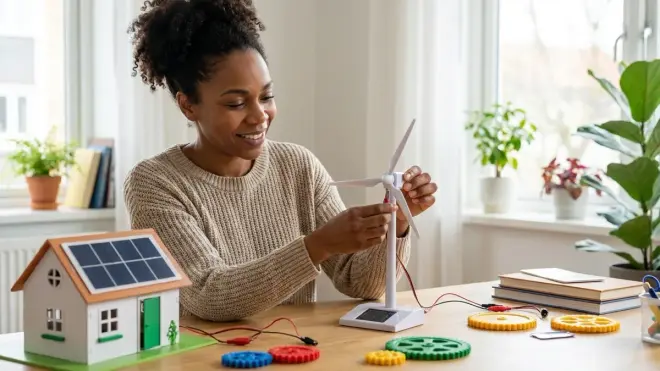
The leap from "my kid likes science" to "my kid builds grid-tied solar systems" isn't magic—it's a structured progression through increasingly complex projects, each one introducing skills that compound. Here's the roadmap I use when parents ask how to translate renewable energy curiosity into measurable capability.
Ages 6–8: Energy fundamentals and basic circuits. Start with screen-free coding toys that introduce logic sequencing, then transition to simple circuit kits. Snap Circuits or Elenco models let kids assemble working systems without soldering. Add a small solar panel that powers a motor or fan—the instant feedback (sunlight makes things move) is critical. At this stage, the learning outcome is causality: solar panels convert light to electricity, motors convert electricity to motion, and you can measure that with a multimeter. No abstract theory—just observable input-output relationships.
Ages 9–11: Multi-source energy systems and data collection. Introduce wind turbine kits, small hydro experiments, and hybrid builds. Your child should be logging data now: daily solar output in a notebook, graphed over two weeks to show weather effects. Teach basic Excel or Google Sheets for plotting results. The Engino Discovering STEM Solar Power Kit is a solid choice here—it includes multiple model builds (cars, planes, rovers) powered by the same panel, teaching energy budget concepts: will the stored power run the car for 10 minutes or 30? That's real-world electrical load calculation. Skills gained: data literacy, experimental design, circuit troubleshooting, basic algebra for power calculations (watts = volts × amps).
Ages 12–14: Arduino integration, efficiency optimization, and environmental variables. This is where learning accelerates. An Arduino Uno (around $25) opens up programmable monitoring: log voltage, current, temperature, and light levels every 30 seconds, store data to an SD card, and analyze trends in Python or MATLAB. Build a motorized solar tracker that uses photoresistors to rotate panels toward maximum sunlight—students will write conditional logic (if left sensor > right sensor, rotate left) and tune PID control loops to avoid oscillation. These are industry-standard programming and engineering challenges. The progression from screen-free coding to text-based programming becomes essential here—your child needs to write functions, debug syntax errors, and understand libraries. Skills: Python or C++ basics, sensor integration, data analysis, mechanical design, iterative testing.
Ages 15–18: Advanced projects for portfolios and competitions. Now you're building systems that belong in renewable energy science fair projects. Design a smart microgrid: solar panels charge a LiPo battery bank, Arduino monitors state of charge, and a relay switches loads (LED strips, phone chargers, small fans) based on available power. Add IoT: push data to ThingSpeak or Adafruit IO for cloud dashboards. Enter regional science fairs—I've seen kids win state-level engineering awards with solar cookers that use parabolic reflectors and temperature PID control. Another strong project: compare monocrystalline vs polycrystalline panel efficiency across identical test conditions, controlling for temperature coefficients and spectral response. That's undergraduate research-level rigor. Skills: systems engineering, project management, technical writing, public presentation, embedded systems programming, statistical analysis.
The infrastructure you need scales with ambition. A basic setup requires: workbench with good lighting, multimeter (Fluke or equivalent, around $60), soldering iron and fume extractor for advanced builds, Arduino starter kit, assorted wire and connectors, safety glasses, and a dedicated STEM lab space where half-finished projects can sit undisturbed. Power requirements: most projects run on low-voltage DC (5V, 12V), so a regulated bench power supply (around $80) is invaluable for testing circuits without draining batteries. Expandability matters: choose kits with open-source hardware and documented APIs, so your child can integrate them with other systems. Avoid proprietary ecosystems that lock you into one manufacturer's products—those are dead ends for serious learners.
Durability is non-negotiable. If the solar panel cracks after two weeks or the turbine blades snap on first assembly, your child learns that renewable energy is fragile and frustrating—the opposite of the message we want. I test kits by dropping them, leaving them in Pacific Northwest rain for a week, and letting kids with zero fine motor patience assemble them. The survivors earn recommendations. The others don't.
One final note: subscriptions and consumables. Most renewable energy kits require no ongoing costs—once you own the panels, turbines, and electronics, they're yours. Avoid "educational platforms" that charge monthly fees for access to lesson plans or software—those costs compound quickly and you're renting knowledge instead of building it. Open-source tools (Arduino IDE, Python, Tinkercad for 3D design) cost nothing and teach transferable skills that every engineering employer values. When you're planning a long-term learning investment, that distinction matters.
Frequently Asked Questions
What age should kids start learning about renewable energy?
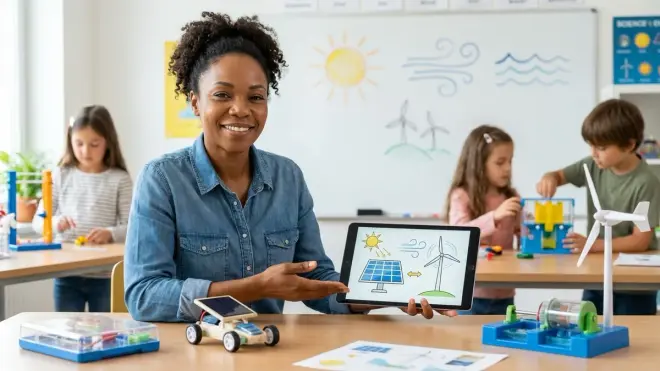
Kids can start grasping renewable energy concepts as early as age six with hands-on demonstrations like solar-powered toys and simple wind pinwheels that show how sunlight and air movement create motion. Formal understanding of energy conversion, electrical circuits, and efficiency calculations typically develops between ages 9–11 when abstract reasoning matures enough to connect cause (sunlight intensity) with measurable effect (voltage output). The key is matching projects to developmental stage: younger kids need immediate visual feedback (the motor spins when the panel faces the sun), while middle schoolers can handle delayed gratification like logging data for two weeks before graphing results to test a hypothesis.
What are the main types of renewable energy kids can explore at home?
Kids can build hands-on projects with five renewable energy types: solar photovoltaic systems that convert sunlight to electricity using panels and circuits, wind turbines that capture air movement with spinning blades and generators, hydroelectric models that use flowing water to spin turbines, geothermal demonstrations using temperature differentials to create voltage, and biomass experiments that ferment organic matter into biogas or ethanol. Solar and wind are the most accessible starting points because they require minimal infrastructure—just a panel or turbine kit, basic electronics, and a multimeter—while hydro needs a water source and biomass involves longer fermentation cycles that test patience.
Do renewable energy kits require subscriptions or ongoing costs?
Most quality renewable energy kits are one-time purchases with no subscription fees, giving you permanent ownership of panels, turbines, motors, and electronics that can be reused across dozens of projects. Avoid "smart" platforms that charge monthly fees for lesson plan access or cloud dashboards—those costs accumulate to hundreds annually and lock you into proprietary ecosystems. The only consumables you'll need are occasional replacement components like worn turbine blades (a few dollars), spare wire and connectors, and batteries if you're building energy storage systems, but even rechargeable lithium-ion or NiMH batteries last hundreds of charge cycles before degrading. Open-source tools like Arduino IDE, Python, and Tinkercad cost nothing and provide all the programming and design capability you need.
How do renewable energy projects prepare kids for real STEM careers?
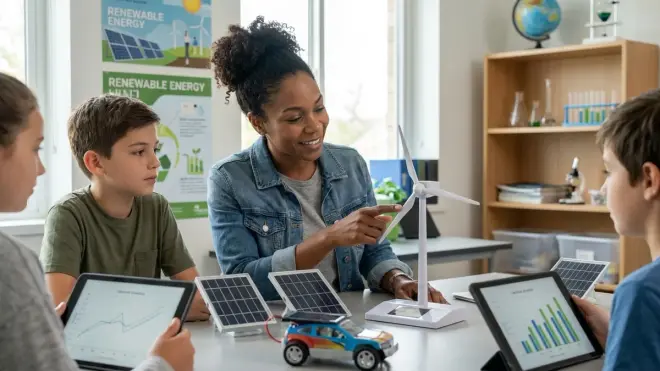
Renewable energy projects teach the exact skills that grid engineers, solar installers, and energy analysts use daily: electrical circuit design and troubleshooting, data collection and statistical analysis, sensor integration and Arduino programming, iterative prototyping and design optimization, and systems thinking about intermittency and storage challenges. When your teenager builds a solar panel array with battery backup and Arduino monitoring, they're replicating the workflow of utility-scale solar farms—just at smaller voltage and capacity. These aren't toy skills; they're industry-standard tools and methodologies that appear in job descriptions at Tesla Energy, NREL, Siemens Gamesa, and every renewable energy startup. Colleges recognize this too: science fair projects that demonstrate multi-month data collection and rigorous experimental design belong in engineering school applications.
What's the difference between a basic renewable energy kit and an advanced one?
Basic renewable energy kits (ages 6–9) use pre-wired components with snap-together circuits, fixed panel angles, and simple on/off demonstrations that show energy conversion without measurement or optimization. Advanced kits (ages 12+) require soldering, include Arduino or Raspberry Pi integration for data logging, provide adjustable mechanical systems like variable-pitch turbine blades or motorized solar trackers, incorporate charge controllers and battery management systems that prevent overcharging, and challenge students to optimize efficiency through iterative testing across controlled variables like panel angle, wind speed, or turbine blade count. The learning outcome shifts from "renewable energy exists" to "I can measure, troubleshoot, and improve renewable energy systems using the same tools professionals use," which is the difference between awareness and capability.
Building the Next Generation of Energy Engineers
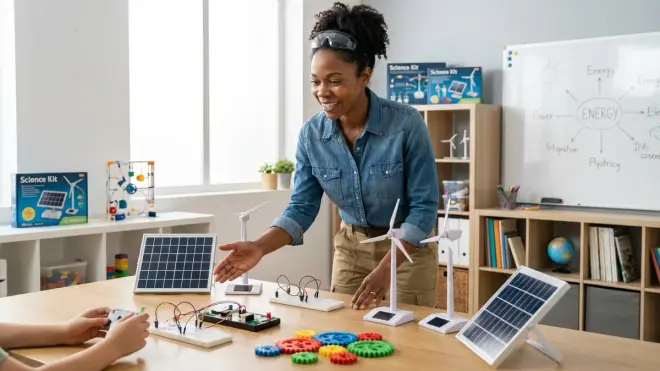
When I handed a twelve-year-old her first multimeter last summer and watched her methodically trace why her solar panel wasn't charging the battery (corroded connection on the positive terminal), I saw the exact diagnostic process I use on my own 2kW rooftop array. She didn't need permission to troubleshoot or a curriculum to tell her what to check—she needed tools, a problem worth solving, and the confidence that she could figure it out. That's what understanding what is renewable energy for kids really means: not memorizing definitions, but building systems that fail, debugging them, iterating, and watching your improvements show up as measurable increases in power output.
The stakes are real. Renewable energy isn't a niche hobby for science enthusiasts—it's the infrastructure that will power your child's entire adult life. The sooner they understand how solar panels work, why wind turbines have three blades instead of five, and what makes grid storage expensive, the sooner they can contribute to solving those problems instead of just worrying about them. Every kit you invest in, every weekend spent graphing solar efficiency, every failed wind turbine prototype that teaches a lesson about blade pitch—those are deposits into a skillset the world desperately needs.
Start where you are. If your kid is eight, grab a basic solar kit and a motor. If they're fourteen, build an Arduino-powered energy monitor and log data for a month. If they're ready for a challenge, design a science fair project that compares solar versus wind efficiency under local weather conditions. The path from curiosity to capability isn't mysterious—it's a series of projects that build on each other, each one harder and more rewarding than the last. You'll know you've succeeded when your child stops asking "what is renewable energy for kids" and starts asking "how can I make this system 10% more efficient?" That question is where real engineering begins.