
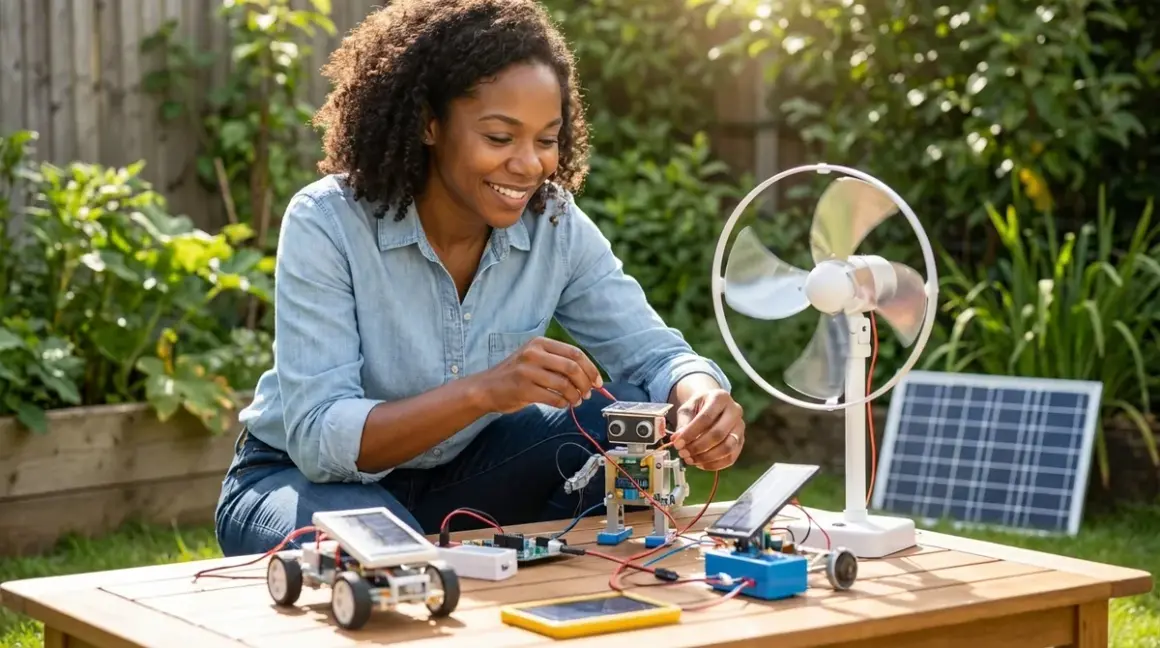

Imagine your daughter hauling her solar energy kit to the kitchen table for the third time this week, not because it's homework, but because she's trying to optimize panel angle to charge her phone faster. That's when you know you've chosen the right learning tool. The best solar energy kits for science projects don't just demonstrate photovoltaic principles—they build testable, repeatable systems that mirror what engineers actually do in the renewable energy sector.
After years building off-grid solar installations and hydroponic systems powered entirely by sun, I've tested dozens of educational solar kits against one criterion: do they teach the physics and the practical engineering? Most fail. They're either too toy-like to yield real data or too advanced to survive middle-school enthusiasm. The kits below bridge that gap—each one delivers measurable outputs, supports genuine experimentation, and prepares students for the tools they'll encounter in clean energy careers.

What to Look For in Solar Energy Kits for Science Projects
Real voltage and current output, not just LEDs. You need kits that produce measurable, variable electricity—not just enough to blink a light. Look for systems with multimeter compatibility and voltage outputs ranging from 0.5V to 12V depending on panel configuration. Students should be able to test series vs. parallel wiring, measure efficiency under different light conditions, and log data over time. If the kit only powers a single fixed LED, it's a demonstration, not a learning platform. The industry standard for photovoltaic cells involves voltage-current curves and efficiency calculations—your kit should make those experiments possible.
Expandability and industry-standard components. The best solar energy kits for science projects grow with your learner. Check whether panels use standard barrel connectors, JST plugs, or alligator clips that interface with Arduino boards, Raspberry Pi systems, or other lab equipment. Can you add a battery storage component? Does it work with third-party charge controllers? My home setup started with a single 10W panel and now powers an entire hydroponic shelf—that's the progression path I want kids to see. Kits that use proprietary connectors or non-standard voltages trap you in a single-use educational product rather than a building block.
Offline functionality and zero subscription dependencies. Solar energy is the ultimate offline technology—it works when the grid doesn't. Your kit should reflect that. Avoid systems that require app connectivity, cloud-based data logging, or subscription services to function. The physics happens whether you have Wi-Fi or not. Look for kits with analog meters, printed data sheets, and experiments that can be conducted and repeated without a screen. That said, optional digital integration via Arduino IDE or Python logging libraries adds value—just make sure it's not mandatory. Check OS compatibility if software is included: Windows/Mac/Linux support, or web-based interfaces that work on Chromebooks.
Durability for repeated experimentation and outdoor use. Science projects mean trial, error, and occasionally dropping things. Solar panels for education should have polycarbonate or tempered glass surfaces (not bare cells that crack on first impact), reinforced solder joints, and UV-resistant casings for outdoor testing. I've seen too many kits with beautiful cells that shatter the first time a student tries to mount them at optimal angle. Check whether components are waterproof or at least splash-resistant—you'll want to test in real sunlight, and weather happens. Kits with replaceable components (extra diodes, fuses, wiring) extend learning life and teach repair rather than replacement.
Clear skill milestones tied to real-world applications. Age ranges mean nothing. What matters is what students can do after completing the kit. Can they calculate efficiency percentages? Wire a battery backup system? Explain maximum power point tracking? The best solar energy kits for science projects include progression from basic series/parallel circuits (ages 10+) to charge controller programming (ages 14+) to efficiency optimization experiments suitable for high school science fairs. Look for kits that explicitly state learning outcomes: "Students will measure open-circuit voltage and short-circuit current to construct I-V curves" beats "Learn about solar power!" Look for alignment with renewable energy science projects that prepare students for engineering pathways, not just one-off demonstrations.
Power requirements and lab specs. Most solar kits need no external power—that's the point—but check whether included components (motors, displays, data loggers) require batteries or USB power. Note the footprint: some kits need 2+ square feet of workspace for full panel layout. Check connectivity options: do experiments require direct sunlight, or will a 100W incandescent bulb work for indoor testing? Temperature operating range matters if you're in the Pacific Northwest drizzle or Arizona sun. And critically: what's the expected lifespan? Panels should maintain 80%+ efficiency for 5+ years of educational use.
Our Top Picks
Thames & Kosmos Solar Power Kit
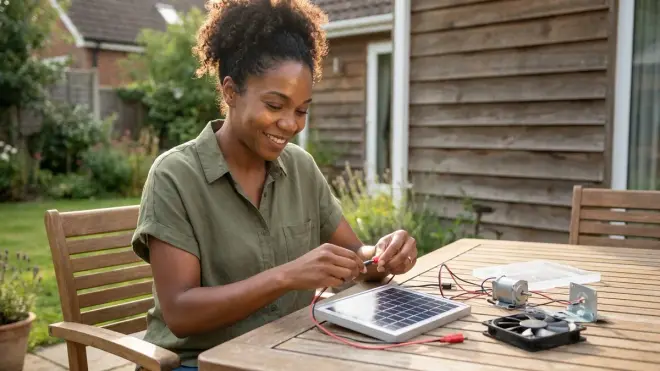
The Thames & Kosmos Solar Power Kit🛒 Amazon is my top recommendation for students ages 10-14 who need a comprehensive introduction to photovoltaic engineering with serious experimental rigor. This kit includes 21 different models ranging from basic solar cars to water pumps, but the real value is in the six monocrystalline panels (each producing 0.25W at 2V) that can be wired in series, parallel, or mixed configurations. You'll teach actual circuit design, not just follow a preset build.
Pros:
- Panels produce measurable, variable voltage (2-12V depending on configuration) suitable for multimeter experiments and Arduino integration
- Modular connector system compatible with standard breadboard jumper wires—no proprietary adapters
- Includes analog instruments (voltmeter, compass) for truly offline experimentation
- 64-page experiment manual with I-V curve plotting, efficiency calculations, and angle-of-incidence testing
- Durable polycarbonate panel housings survive repeated outdoor testing and storage
- Components prepare students for charge controller concepts used in residential solar installations
Cons:
- Motor assemblies use small gears that can strip if students force connections
- No battery storage component included—you'll need to add rechargeable AA cells separately
- Panel surface area (6" × 4" total when assembled) limits peak current to around 150mA, which won't power higher-draw projects without supplemental panels
Lab Specs: No external power required; operates in full sunlight or under 100W+ halogen lamps; all connections via 2mm plugs and standard alligator clips; models pack into 12" × 9" × 3" storage case; panels rated for 10+ years under normal educational use.
Elenco Deluxe Solar Educational Kit
The Elenco Deluxe Solar Educational Kit🛒 Amazon steps up the technical complexity for students ages 12+ who are ready to tackle voltage regulation, diode behavior, and battery charging circuits. This isn't a snap-together toy—it's a breadboard-based learning system that requires actual circuit building and troubleshooting. You'll spend time with it, and that's exactly what builds competence.
Pros:
- Includes solar panel (5V, 200mA), rechargeable battery pack, voltage regulator IC, and full component set for charge controller experiments
- Breadboard-style construction teaches solderless prototyping used in professional electronics development
- Manual covers Ohm's law applications, voltage division, and maximum power point concepts at high school level
- Compatible with Arduino Uno and Raspberry Pi via standard 5V input—students can log data and create automated sun-tracking systems
- Open architecture allows integration with renewable energy lab kits for comparative wind/solar experiments
Cons:
- Requires students to understand polarity and circuit diagrams—not plug-and-play like simpler kits
- Breadboard connections can loosen with repeated use; expect to re-seat wires periodically
- No waterproofing—strictly for indoor use or protected outdoor setups
Lab Specs: Powered entirely by included solar panel or optional 6V wall adapter for cloudy-day testing; breadboard dimensions 6.5" × 4.3"; Windows/Mac/Linux compatible if used with Arduino IDE; components store in compartmentalized case; designed for 100+ build/rebuild cycles.
OWI Frightened Grasshopper Solar Kit
For younger learners (ages 8-11) just beginning their journey into renewable energy, the OWI Frightened Grasshopper Solar Kit🛒 Amazon offers a memorable entry point. It's playful—the grasshopper vibrates away from shadows—but the physics is real. The 0.45V solar panel directly drives a vibration motor, creating an immediate cause-and-effect loop that demonstrates energy conversion without abstraction.
Pros:
- Single-panel, single-motor design eliminates circuit confusion—ideal for first solar experiments
- Demonstrates light intensity vs. motor speed relationship in real time—kids see efficiency variation instantly
- Snap-fit construction (no tools required) works for classroom settings with 20+ students building simultaneously
- Panel produces enough current (50mA in full sun) for meaningful multimeter readings
- Under $15 typically, making it accessible for whole-class purchases or science fair exploration on a budget
Cons:
- No expandability—it's a standalone demonstration, not a platform for progression
- Plastic gearbox can jam if assembled incorrectly; requires adult verification for first build
- Limited experimental scope—you'll exhaust learning potential in 2-3 sessions
Lab Specs: No external power; operates in direct sunlight or under 75W+ incandescent bulb; dimensions 3" × 2" × 2" assembled; no software; suitable for ages 8+; panel life expectancy 3-5 years.
Horizon Fuel Cell Solar Hydrogen Science Kit
When you're ready to bridge solar energy into energy storage and fuel cell technology, the Horizon Fuel Cell Solar Hydrogen Science Kit🛒 Amazon introduces electrolysis and hydrogen generation powered by a 0.75W solar panel. This kit is for students ages 13+ who understand basic chemistry and are ready to explore the clean energy storage challenge that defines modern renewable infrastructure.
Pros:
- Demonstrates complete solar-to-hydrogen-to-electricity cycle used in industry-scale energy storage
- Reversible fuel cell serves as both electrolyzer and power generator—students see energy conversion in both directions
- Includes multimeter leads and connection points for Arduino-based data logging of hydrogen production rates
- Curriculum materials link to renewable energy science fair projects and real-world applications like hydrogen vehicles
- Durable acrylic cells withstand hundreds of electrolysis cycles
Cons:
- Requires distilled water and occasional cleaning—it's not zero-maintenance
- Hydrogen production rate is slow (15-20 minutes per full tank); students need patience
- Fuel cell membrane degrades after 200-300 cycles—replacement available but adds cost
Lab Specs: Solar panel produces 0.75W at 2V; fuel cell operates at 0.5-1V output; requires distilled water (not included); Windows/Mac compatible with optional USB data logger; footprint 10" × 8" when fully assembled; intended for 2-3 years of active use before membrane replacement needed.
Snap Circuits Green Alternative Energy Kit
The Snap Circuits Green Alternative Energy Kit🛒 Amazon combines solar, wind, and hand-crank power in a single modular system, making it ideal for students ages 10+ who want to compare energy sources directly. The solar panel (1.5V, 100mA) isn't the most powerful, but the snap-together circuit design lets students reconfigure experiments in minutes rather than hours—crucial for rapid iteration.
Pros:
- Modular snap connectors eliminate wiring errors and speed up experiment cycles—test 5-6 configurations in one session
- Combines solar with wind and manual generation for comparative solar vs wind energy projects
- Includes capacitor for energy storage experiments—students can measure charge/discharge curves
- Over 125 project combinations scale from simple LED circuits to AM radio powered by sun
- Durable, color-coded components survive classroom use and younger siblings
Cons:
- Snap connections, while convenient, don't teach breadboard or soldering skills needed for advanced projects
- Solar panel output is modest—won't power high-current experiments without supplemental cells
- Instruction manual focuses on building projects rather than explaining underlying physics—you'll need to supplement with theory
Lab Specs: No external power required; solar panel 3" × 2"; operates indoors under bright light (60W+ bulb recommended); all components snap into plastic grid base (12" × 8"); Windows/Mac/Linux compatible if interfaced with Arduino via component connections; designed for 500+ connection cycles.
Engino Solar Power Science Kit
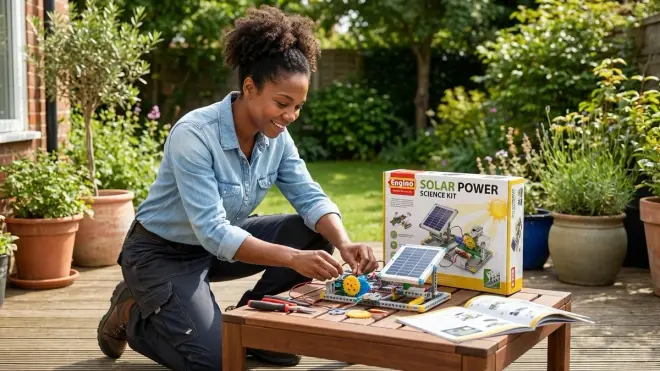
For students ages 12+ pursuing science fair projects or independent research, the Engino Solar Power Science Kit🛒 Amazon delivers professional-grade documentation and experimental protocols. The 0.5W solar panel is smaller than some competitors, but the included angle-adjustable mounting system and shadow analysis tools make it the best choice for students learning how to measure solar panel efficiency across variables.
Pros:
- Includes protractor mount for precise angle-of-incidence testing—students collect publishable data
- Detailed experiment guide covers spectral response, temperature effects, and shading analysis at AP Physics level
- Panel connects via standard banana plugs—fully compatible with school lab equipment and multimeters
- Modular construction allows testing of series/parallel configurations with mathematical predictions vs. measured results
- Online platform (optional) provides graphing tools and sample data sets for comparison
Cons:
- Requires graphing calculator or spreadsheet software for data analysis—not entirely screen-free
- Mounting hardware is plastic; metal brackets would improve long-term durability
- Smaller panel surface area means lower absolute power output—you're optimizing efficiency, not building high-watt systems
Lab Specs: Solar panel 0.5W at 6V; mounting system adjusts 0-90° with 5° precision; requires no external power; optional cloud platform works on Chromebook/Windows/Mac; components pack into 9" × 7" × 3" case; designed for 200+ experiment cycles.
Frequently Asked Questions
What age should kids start using solar energy kits for science projects?
Students can begin exploring solar energy as early as age 8 with supervised single-circuit kits, but meaningful experimental work typically starts at age 10-11 when they can understand voltage, current, and series/parallel concepts. At this stage, look for kits like the Thames & Kosmos system that provide structured experiments with measurable outputs. By age 12-13, students are ready for breadboard-based systems and can design their own experiments testing variables like angle, light intensity, and shading effects. High school students (14+) should work with kits that integrate battery storage, charge controllers, or data logging via Arduino—these prepare them for the actual tools used in renewable energy engineering. The key milestone isn't age, it's whether the student can safely use a multimeter and record data accurately. If they're still at the "following picture instructions" stage, stick with snap-together kits; once they can troubleshoot "why didn't this work?" independently, move to open-architecture systems that require circuit building.
Can solar energy kits work indoors without sunlight?
Yes, but you'll need high-wattage incandescent or halogen bulbs—standard LED bulbs won't produce enough light intensity. Most educational solar panels require 500-1000 lumens focused from 6-12 inches away to generate usable voltage. I test all my kits under a 100W halogen work lamp when Pacific Northwest clouds make outdoor experiments impossible. Fluorescent and LED bulbs produce diffuse light that spreads intensity too thin; you'll get readings, but motors won't run and experiments will take 3-4× longer. For classroom use, position a 75-100W incandescent bulb 8-10 inches from the panel—close enough to concentrate light, far enough to avoid overheating components. Check your kit's manual for spectral response: some panels are optimized for outdoor sunlight wavelengths and perform poorly under artificial light. The advantage of indoor testing is control—you can create repeatable lighting conditions and eliminate variables like cloud cover. The disadvantage is realism—students should experience how solar actually performs in the field, which means understanding that real-world renewable energy engineering involves weather, seasons, and storage solutions.
Do solar science kits require batteries or subscription services?
The best solar energy kits for science projects require neither—they're powered entirely by the sun and include offline experiments. That said, many advanced kits include optional battery storage components to demonstrate charging systems, and some offer cloud-based data logging platforms (like the Engino kit) that aren't required but add value for students doing long-term efficiency studies. Always check the product description for "subscription required" or "app required"—those are red flags that the manufacturer is building in ongoing costs or planned obsolescence. My rule: if the core physics experiments require connectivity or consumables, skip it. You want students to understand that solar energy is fundamentally independent infrastructure. The exception is if you're deliberately teaching battery integration or charge controller concepts—then a kit that includes rechargeable cells as part of the learning objective makes sense. Just make sure you're not locked into proprietary batteries or replacement parts. Standard AA/AAA rechargeable cells or 18650 lithium cells give you flexibility and mirror real-world energy storage systems.
How do solar kits prepare students for renewable energy careers?

Educational solar kits introduce the same fundamental concepts professionals use: photovoltaic I-V curves, maximum power point tracking, charge controller logic, and energy storage efficiency. When students wire panels in series to boost voltage or in parallel to increase current, they're making the same design decisions engineers make when sizing residential or commercial installations. Kits that integrate Arduino boards or Raspberry Pi teach the programmable logic controllers (PLCs) used in utility-scale solar farms to optimize panel angle and manage battery banks. Students who progress from basic snap-circuit kits to breadboard-based systems to microcontroller integration are following the exact learning path of solar installation technicians and renewable energy engineers—they're just compressing years of education into months of hands-on experimentation. The critical career prep happens when students encounter problems: why is my panel producing 20% less voltage than expected? They learn to check connections, measure actual vs. theoretical output, test variables, and document results—those are the troubleshooting skills that define professional competence. For students serious about clean energy careers, pair solar kits with renewable energy science projects that incorporate data analysis, cost-benefit calculations, and system optimization.
What's the difference between solar toys and solar science kits?
Solar toys demonstrate a concept once; solar science kits enable repeated experimentation with measurable, variable outcomes. A solar toy might be a car that drives when you put it in sunlight—fun, but you can't test hypotheses or collect data. A science kit lets you reconfigure circuits, measure voltage and current under different conditions, plot efficiency curves, and answer questions: does panel angle matter? How much power do I lose in shade? What happens when I wire cells in series vs. parallel? The test is simple: can a student use the kit to conduct a fair test experiment and present findings at a science fair? If yes, it's a learning platform. If it's a fixed build with one outcome, it's a toy (which has value for younger kids building intuition, but limited educational lifespan). Science kits also include expansion potential—standard connectors, compatibility with multimeters and microcontrollers, replaceable components. They're investments in a progressive skill path, not one-time amusements. Check whether the kit teaches industry-standard concepts like Ohm's law, power calculations (P=IV), or efficiency formulas—those indicate genuine STEM content rather than entertainment.
The Verdict
The right solar energy kit transforms abstract physics into something you can measure, optimize, and iterate on—it's the difference between "learning about" renewable energy and actually practicing it. For most students ages 10-14, the Thames & Kosmos Solar Power Kit offers the best balance of experimental rigor and hands-on engagement. You'll move from simple circuits to efficiency calculations to system design, all with durable components that survive real scientific curiosity.
If your learner is ready for breadboard-level work and Arduino integration, the Elenco Deluxe kit accelerates that progression. And for students pursuing science fair projects or AP-level experiments, the Engino kit's precision angle mounting and professional documentation support publishable research. Whichever system you choose, prioritize measurable outputs, offline functionality, and expansion potential—those are the features that turn a weekend project into a foundation for engineering careers in the clean energy economy we're all building together.