
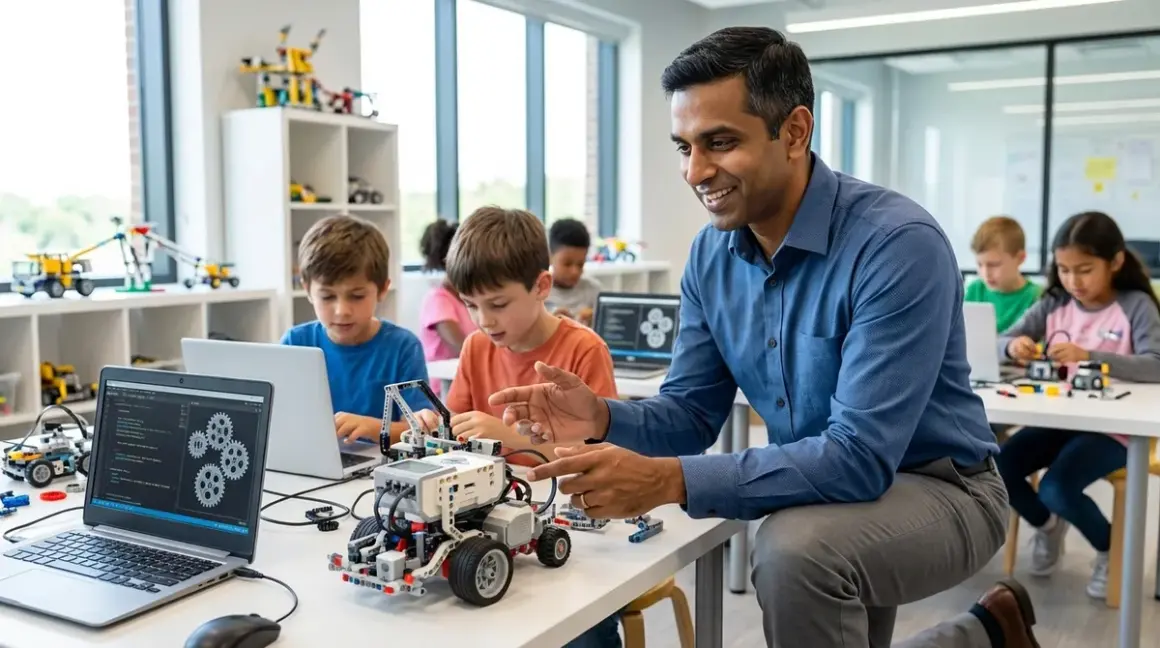

LEGO STEM education represents a structured approach to developing mechanical engineering, programming, and systems integration capabilities through modular construction platforms. Unlike recreational building, these systems establish progressive competency frameworks aligned with industry hiring requirements. The market shift from consumer toys to credentialed learning platforms matters because employers now require demonstrable skills in CAD modeling, logic-based programming, and hardware-software integration—capabilities LEGO's education ecosystem specifically targets.
What Is LEGO STEM Education?
LEGO STEM education comprises three distinct product lines: LEGO Education (classroom-focused kits with curriculum frameworks), LEGO Technic (mechanical engineering emphasis), and LEGO Robotics platforms (SPIKE Prime, EV3 successor systems). These aren't generic building sets. Each line delivers measurable learning outcomes through structured lesson progressions, assessment rubrics, and compatibility with industry-standard software environments.
The differentiation matters. LEGO Education WeDo 2.0 teaches Scratch-style block coding and basic sensor integration for ages 7-9. SPIKE Prime advances to Python text-based programming and multi-sensor decision trees for ages 10-14. The discontinued LEGO Mindstorms EV3 established the robotics competition standard but required significant adult facilitation; SPIKE Prime reduced that friction while maintaining expandability.
Technical foundation: All current platforms run proprietary block-based environments that export to Python. Software operates offline (critical for schools with restricted networks), runs on Windows 10+, macOS 10.14+, iOS 10+, Android 5.0+, and Chromebook. No cloud dependency for core functionality. Storage requirements: 500MB minimum.
Lab specs: Power via rechargeable lithium-ion batteries (8-10 hour runtime), USB-C charging. Bluetooth 4.0+ for wireless programming. Expansion through standardized Technic pin/axle system—kits integrate across product lines if you understand mechanical compatibility constraints.
The curriculum framework component distinguishes this from consumer products. LEGO Education provides 40+ hours of scaffolded lessons per kit, aligned to NGSS (Next Generation Science Standards) and Common Core math standards. This matters for homeschool documentation and credit validation.
How LEGO STEM Education Works
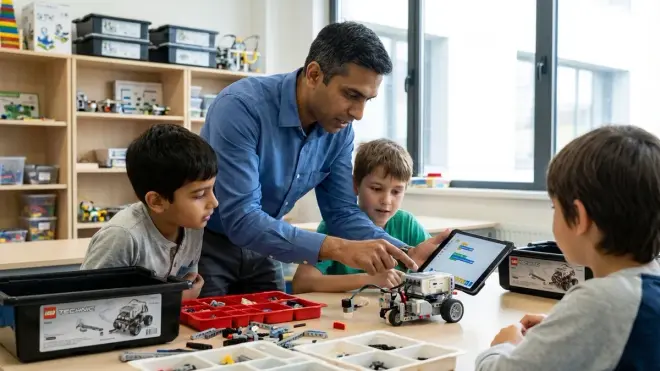
The learning architecture operates through three parallel development tracks: mechanical systems, programming logic, and sensor integration. Students don't build random structures—they solve constrained engineering problems with defined success criteria.
Mechanical progression: Initial builds focus on gear ratios, lever mechanics, and structural stability. WeDo 2.0 introduces simple machines (pulleys, gears, cams). SPIKE Prime advances to complex drivetrains, differential mechanisms, and load-bearing frame design. Technic kits push into pneumatics, linear actuators, and multi-DOF (degrees of freedom) joints. Each stage introduces one new constraint while reinforcing previous concepts.
Programming integration: Block-based coding starts with sequential command execution (move forward, turn, stop). Complexity layers through conditional logic (if-then statements), loops, variables, and eventually functions. SPIKE Prime's Python bridge exposes actual syntax—students see their block code rendered as Python script, creating a visual Rosetta Stone for text-based languages.
I ran my own children through this exact curriculum. The transition point where block coding becomes limiting happens around 80-100 hours of build time. Students start wanting nested functions and custom libraries—capabilities that require text-based environments. SPIKE Prime's dual interface handles this gracefully; older EV3 required a hard jump to a new IDE.
Sensor-driven decision making: This is where actual systems integration begins. A light sensor triggers LED color changes (simple input-output). A distance sensor modulates motor speed based on proximity (proportional control). Multi-sensor arrays create autonomous navigation—ultrasonic for obstacle detection, gyroscope for heading correction, color sensor for line following. By SPIKE Prime Level 3, students build state machines with five+ sensor inputs informing real-time motor adjustments.
Lab implementation: Each kit requires dedicated workspace—minimum 24" × 36" building surface, nearby power access for charging, and component organization system (the small Technic pins disappear instantly). Plan for 45-90 minute uninterrupted sessions; context-switching kills momentum. Projects don't pack down well mid-build, so permanent or semi-permanent space matters.
Expandability architecture: LEGO Education kits ship with 280-560 pieces depending on platform. Expansion sets add specialized components (large motors, advanced sensors, pneumatic systems). Cross-compatibility exists but requires understanding Technic vs. System brick integration. SPIKE Prime uses Technic frames with System brick compatibility—you can incorporate standard LEGO elements but structural loads require Technic pin connections.
Consumables and ongoing costs: Rechargeable batteries degrade after 300-500 charge cycles (18-24 months heavy use). Replacement hub batteries run $30-40. Technic pins and axles are technically consumable—they don't break but they disappear. Budget $40-60 annually for component replacement in active learning environments.
The curriculum delivery model offers flexibility but requires instructor investment. Lesson plans provide structure, but effective facilitation demands adult understanding of mechanical principles and programming logic. LEGO Education offers certification programs (online, self-paced, free)—worth the 8-10 hours for anyone running home lab implementations.
Why LEGO STEM Education Matters
The skills gap between secondary education outputs and entry-level engineering requirements widened significantly between 2020-2025. Employers consistently cite deficiencies in three areas: systems thinking (understanding how subsystems interact), debugging methodology (systematic troubleshooting), and documentation practices (communicating technical decisions). LEGO STEM education specifically addresses these gaps through its constraint-based problem architecture.
Career pathway alignment: The progression from block coding to Python directly mirrors professional embedded systems development workflows. Arduino programming, Raspberry Pi automation, and industrial PLC configuration all follow similar logic structures. Students who complete SPIKE Prime's advanced curriculum transition to Arduino robotics platforms with minimal friction—they already understand PWM motor control, sensor polling rates, and interrupt handling at conceptual level.
Measurable competency milestones: By 120 hours with SPIKE Prime, students should independently:
- Design gear trains achieving specific speed ratios (mechanical engineering)
- Write 100+ line Python programs with functions and error handling (software)
- Calibrate multi-sensor arrays for autonomous navigation (systems integration)
- Document build instructions and code logic for team handoffs (technical communication)
These aren't abstract benefits. When my daughter applied to a competitive STEM high school program, her portfolio included a SPIKE Prime autonomous warehouse robot project. The admissions interview focused on her debugging process when the gyroscope drift caused navigation errors—exactly the systems thinking they wanted to see.
Industry tool exposure: SPIKE Prime's Python environment isn't educational Python—it's actual Python 3.x with standard library access. Students learn authentic syntax, not a simplified dialect requiring relearning later. The CAD-style building approach (planning assemblies before construction) parallels Fusion 360 and SolidWorks workflows. Understanding mechanical constraints in physical builds translates directly to 3D design environments.
Cost-per-skill-hour analysis: SPIKE Prime kit ($330-380) delivers 150-200 hours of structured learning before students exhaust the curriculum. That's $1.80-2.50 per learning hour—competitive with consumable-dependent platforms and superior to subscription coding platforms at 100+ hour timeframes.
The durability factor matters for ROI calculations. We're 400+ hours into our SPIKE Prime kit with one motor replacement ($25) and one hub battery replacement ($35). ABS plastic components survive repeated assembly/disassembly. Compare this to electronics breadboard kits where components fail after 20-30 insertion cycles or 3D printer filament costs accumulating at $15-25 per significant project.
Types & Variations in LEGO STEM Platforms
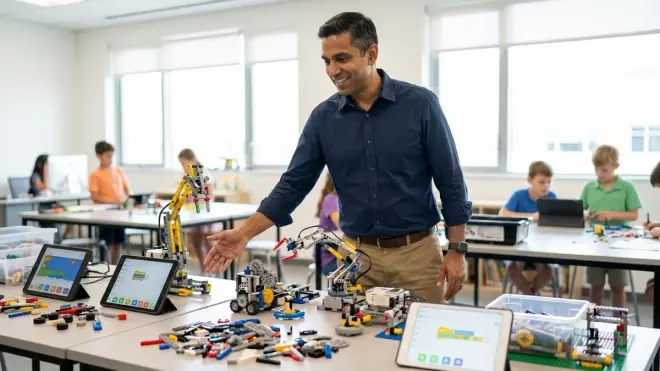
Understanding platform differentiation prevents expensive mismatches between student capability and system requirements. Each LEGO STEM line targets specific age ranges and skill development focuses.
LEGO Education WeDo 2.0 (ages 7-9, $160-180 base kit): Entry point for motor control and basic sensors. Single motor, motion sensor, tilt sensor. Runs proprietary block-based software (Scratch derivative). Builds focus on simple machines—lever systems, pulley mechanisms, gear demonstrations. Limitations: Can't transition to text-based coding; students outgrow it quickly (60-80 hours typical). Best use: Introducing cause-effect programming logic before reading fluency develops. What skills 10-year-olds actually need often exceeds WeDo capabilities.
LEGO SPIKE Essential (ages 6-8, $230-260): WeDo replacement released 2021. Two motors, color sensor, light matrix display. Same software limitation—block coding only, no Python bridge. Curriculum emphasizes storytelling integration with engineering (build characters that solve problems). Useful for schools prioritizing literacy-STEM integration; less valuable for pure technical skill development.
LEGO SPIKE Prime (ages 10-14, $330-380): Core platform for progressive LEGO stem education. Three motors (two medium, one large), distance sensor, color sensor, force sensor, 6-axis gyroscope. Critical differentiator: Dual coding environment (block-based or Python). Hub runs dedicated processor (STM32F413), 320KB RAM, 1MB flash storage. Expansion sets available (accessories $80-120). This is the sweet spot for home lab implementations—sufficient complexity for 200+ learning hours, authentic programming environment, competitive robotics ready (FIRST LEGO League uses SPIKE Prime).
LEGO Mindstorms Robot Inventor (ages 10+, discontinued 2024 but widely available): EV3 successor targeting consumer market. Four motors, color/distance sensor, hub with speaker. Uses same programming app as SPIKE Prime but lacks Education's curriculum framework. Expansion path unclear—LEGO shifted focus to SPIKE Prime for education market. Consideration only if found significantly below SPIKE Prime pricing; otherwise SPIKE offers better support ecosystem.
LEGO Technic sets (ages 9+, $30-500 range): Mechanical engineering focus, typically no electronics. Advanced gear systems, pneumatics, complex linkages. Use for understanding mechanical advantage, structural engineering, and load transfer before adding programming complexity. High-end Technic sets (Liebherr crane, Bugatti Chiron) demonstrate professional CAD-to-physical-product workflows through their assembly instructions.
Platform migration strategy: Start with SPIKE Prime unless student is under age 8 (then WeDo/SPIKE Essential). Skip intermediate steps—the capability ceiling matters more than perfect age alignment. Supplement with Technic sets for mechanical concept reinforcement. After 150-200 hours with SPIKE Prime, transition to Arduino platforms or VEX Robotics for industry-standard electronics and metal construction.
Building a Progressive LEGO STEM Learning Path
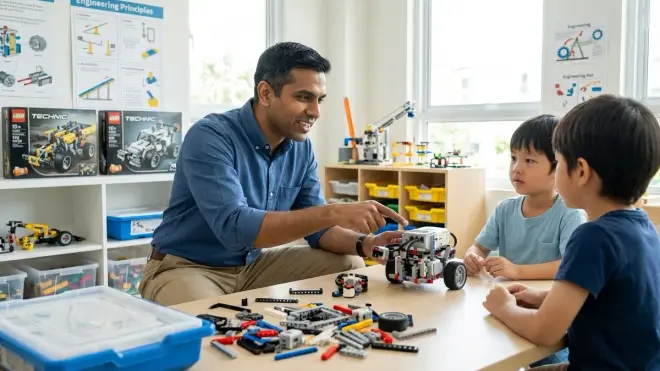
Effective LEGO stem education requires structured progression through defined capability milestones, not random project selection. The framework below represents 18-24 months of development for a motivated 10-12 year old investing 3-4 hours weekly.
Phase 1: Mechanical fundamentals (Weeks 1-8, 25-30 hours) Complete SPIKE Prime Unit 1 curriculum focusing on structural integrity and basic mechanisms. Key builds: driving base (gear ratio understanding), grabber mechanism (linkage design), crane system (pulley mechanics). Success criteria: Student independently calculates gear ratios for specific speed/torque requirements and troubleshoots structural failure points without prompting.
Phase 2: Sensor integration (Weeks 9-16, 30-35 hours) Progress through Units 2-3 adding sensors to mechanical builds. Critical milestone: autonomous line-following robot using color sensor feedback and proportional steering control. This reveals whether student understands closed-loop systems versus sequential programming. Many students plateau here—they can follow instructions but struggle with independent sensor calibration. Push through with systematic debugging practice: document sensor readings, test hypotheses about threshold values, iterate calibration parameters.
Phase 3: Python transition (Weeks 17-24, 35-40 hours) Switch from block coding to Python environment. Initial projects replicate previous block-based builds in text syntax. SPIKE Prime's side-by-side comparison view is essential—students see their blocks convert to Python, building translation skills. Focus on functions, variables, and basic libraries before attempting new projects. Students ready for this phase can explain what a variable stores and why functions reduce code duplication.
Phase 4: Complex autonomous systems (Weeks 25-40, 50-60 hours) Multi-sensor state machines, competition-style challenges, custom project development. Example: warehouse automation robot that navigates maze, identifies colored objects, sorts to designated zones. Requires sensor fusion (distance + color + gyroscope), state management (searching, approaching, grabbing, delivering states), and error recovery (what happens when object isn't where expected?).
Phase 5: Competition preparation or custom engineering (Weeks 41+, 60+ hours) Two paths: FIRST LEGO League competition participation (teaches teamwork, documentation, presentation skills alongside technical capability) or independent project development (create something novel, document the engineering process, present findings). Both require competencies beyond programming—project management, technical documentation, iterative design methodology.
Integration with broader STEM path: LEGO platforms sit between screen-free coding fundamentals and text-based robotics programming. They offer physical feedback that pure software environments lack while maintaining expandability that fixed-function robots don't support. After exhausting SPIKE Prime's capability ceiling, students possess prerequisite skills for Arduino C++, Raspberry Pi Python automation, and entry-level CAD software.
Common failure modes I've observed:
- Skipping mechanical fundamentals to jump directly into programming (results in unstable robots and debugging confusion)
- Abandoning projects when initial code doesn't work instead of systematic troubleshooting
- Parent over-involvement in problem-solving, preventing student development of debugging methodology
- Inadequate documentation of successful solutions, requiring re-solving identical problems weeks later
The solution: enforce documentation requirements from day one. Before moving to the next project, student must create build instructions and code comments explaining their solution. This mirrors professional engineering practice and dramatically reduces learning friction.
Lab Specs for LEGO STEM Implementation
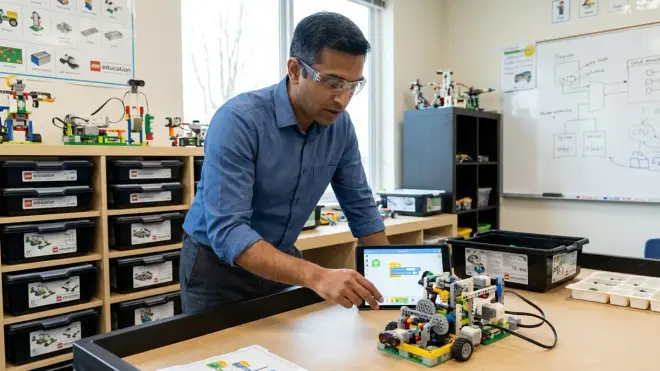
Effective learning requires appropriate infrastructure. These specifications derive from running intensive home lab sessions with multiple students over 400+ hours.
Physical workspace requirements:
- Minimum surface: 24" × 36" stable table space, ideally 36" × 48" for complex builds
- Storage: Organized component system, minimum 6-compartment container for Technic pins/axles/connectors. Tackle boxes work well—$15-25 range with adjustable dividers
- Power access: Within 6 feet for hub charging, USB power adapter (5V/2A minimum)
- Lighting: Overhead plus task lighting, minimum 500 lumens at work surface. Color sensors need consistent lighting for reliable readings
- Flooring consideration: Carpet loses small components permanently. Hard flooring recommended or large work mat over carpet
Computing requirements:
- Hardware: Any laptop/desktop meeting minimum OS requirements (Windows 10+, macOS 10.14+, or Chromebook running Chrome OS 90+)
- Tablet option: iPad (iOS 10+) or Android tablet (5.0+), minimum 9.7" screen for usable interface
- Bluetooth: Version 4.0+ required for hub connectivity, most devices 2018+ compliant
- Storage: 500MB application plus 100-200MB per student project documentation
- Network: Initial software download requires internet; all subsequent operation fully offline
SPIKE Prime specific specs:
- Hub: 6 ports (4 medium motors or sensor ports, 2 large motor ports), programmable light matrix (5×5), 6-axis gyroscope, speaker
- Battery: Rechargeable lithium-ion, 2100mAh, 8-10 hours runtime, 3-4 hour charge time via USB-C
- Motors: Large motor (850°/sec, running torque 25 Ncm), Medium motor (1400°/sec, running torque 8 Ncm). Speed vs. torque tradeoff teaches mechanical engineering principles
- Sensors: Ultrasonic distance (4-250cm range, ±1cm accuracy), color sensor (8 color detection, reflectivity mode 0-100%), force sensor (0-10N range)
- Connectivity: Bluetooth only, 10-meter range typical. USB-C cable included for wired programming during initial setup or Bluetooth troubleshooting
Expansion pack considerations: SPIKE Prime Expansion Set ($100-120) adds 603 additional pieces including specialized elements (large wheels, complex gears, structural frames). Necessary for advanced projects but not required for first 80-100 hours of curriculum. Prioritize if pursuing competition robotics; otherwise delay until student completes base kit projects.
Durability and maintenance:
- Expected lifespan: 400-600 hours before component replacement needed, assuming proper storage
- Wear items: Motor gears (replacement $20-28 per motor after 300+ hours heavy use), hub battery ($30-40 at 18-24 months)
- Common failures: Technic pin loosening in frequently-assembled joints, axle stress cracking at high-load connection points
- Prevention: Rotate which pins/axles get used in high-stress applications, avoid over-tightening connections, store in consistent temperature environment (not garage in temperature-extreme climates)
Software version considerations: LEGO Education maintains SPIKE Prime app with backward compatibility to original 2019 hardware. Updates add features (improved Python libraries, expanded block coding options) without breaking existing projects. Unlike consumer robotics platforms with frequent software overhauls requiring project migration, SPIKE maintains 4+ year stability. Updates optional but recommended—bug fixes and improved sensor calibration routines matter.
Multi-student implementations: One SPIKE Prime kit supports 2-3 students collaboratively. Beyond that, motor/sensor sharing creates bottlenecks. 4-6 student groups need two kits. Component mixing allowed—students can combine elements across kits for larger projects, though this requires coordination and advanced organizational systems.
Integration with other platforms: SPIKE Prime components physically compatible with all LEGO Technic elements and standard LEGO System bricks (via Technic-to-System adapter pieces). Electronic compatibility limited to SPIKE ecosystem—can't use Arduino sensors with SPIKE hub. This is intentional design isolation maintaining age-appropriate complexity. After outgrowing SPIKE, transition to Arduino environments for open-architecture sensor integration.
Skills Progression: Capability Milestones in LEGO STEM Education
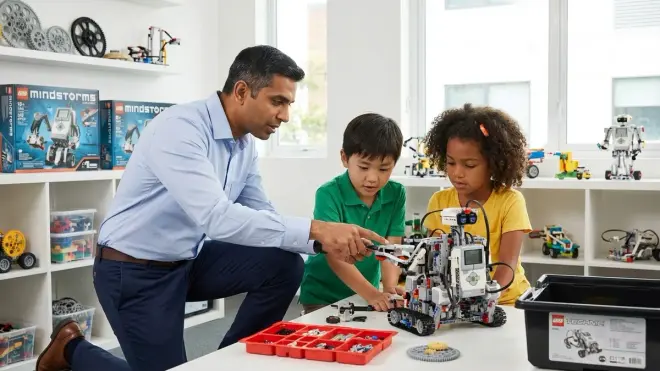
Vague age ranges provide minimal guidance. These concrete milestones define what proficiency looks like at each stage, enabling objective assessment of student progress.
Milestone 1: Mechanical assembly competency (20-25 hours) Student independently follows digital build instructions, identifies correct pieces from visual reference, executes 40+ step assemblies without adult intervention. Demonstrates understanding that structural integrity requires proper connection sequences—doesn't force pieces, recognizes when frame isn't square. Tests: Can student troubleshoot why a gear train binds? Do they check for correct pin insertion depth before declaring a build "broken"?
Milestone 2: Basic programming logic (35-40 hours) Writes block-based programs with 15+ commands including loops and basic conditionals. Understands that computers execute instructions sequentially, that loops repeat code blocks, that conditional statements create decision points. Creates simple sensor-responsive behaviors (robot stops when detecting obstacle, changes direction when seeing specific color). Tests: Can student explain why their program didn't work and propose a specific fix? Do they grasp cause-effect relationships between sensor readings and motor commands?
Milestone 3: Systematic debugging methodology (55-65 hours) When program doesn't work as expected, student follows diagnostic process: isolate which component isn't behaving correctly, test that component independently, form hypothesis about cause, test hypothesis through targeted code changes. Maintains change log documenting what modifications were attempted. Uses print statements or LED indicators to verify variable values during execution. Tests: Present a partially-working robot with a subtle error (sensor threshold set incorrectly). Does student methodically test components or randomly change values hoping for improvement?
Milestone 4: Python syntax proficiency (80-100 hours) Writes Python programs (50+ lines) with functions, variables, and imported libraries. Understands indentation requirements, basic data types (integers, strings, lists), function parameters and return values. Translates block-based programs to text syntax without side-by-side reference. Tests: Can student write a function that accepts motor speed as parameter and returns calculated distance traveled? Do they understand scope (why variables defined inside functions aren't accessible outside)?
Milestone 5: Multi-sensor system integration (120-150 hours) Designs autonomous robots using 3+ sensors simultaneously, implements state machines managing robot behavior based on sensor combinations. Calibrates sensors for environmental conditions (light sensors behave differently under fluorescent vs. LED lighting). Creates robust behaviors handling edge cases (what should robot do if sensor reads unexpected value?). Tests: Student builds competition-style challenge robot that navigates unknown course, adapts strategy based on discovered obstacles, completes task without human intervention.
Milestone 6: Independent project development (180-200+ hours) Identifies real problem, designs solution approach, implements mechanical and software systems, tests iteratively, documents process. Manages scope (recognizes when design is too complex, simplifies appropriately). Creates technical documentation enabling another student to replicate project. Presents project explaining engineering decisions and tradeoffs. Tests: Student conceives and executes novel project not from curriculum—warehouse automation, automated plant watering system, security patrol robot, etc.
Career-relevant capabilities at completion: Students finishing this progression possess foundational skills for:
- Robotics engineering: Mechanical design, sensor integration, autonomous behavior programming
- Embedded systems development: Microcontroller programming, hardware-software integration, real-time control systems
- Manufacturing automation: Understanding of robotic material handling, quality sensing, process sequencing
- Product design: CAD-style assembly planning, constraint-based engineering, iterative prototyping
The gap between SPIKE Prime mastery and entry-level engineering internship eligibility narrows considerably. Students still need calculus, physics, and advanced programming, but they possess practical systems integration experience most university freshmen lack. Three of my daughter's high school classmates who followed similar paths secured summer positions at automation companies specifically because they could demonstrate hands-on robotics experience during interviews—not just theoretical knowledge from classroom STEM courses.
For additional context on skill development frameworks and how these capabilities fit into broader STEM progression, see our detailed analysis of what skills 10-year-olds actually master in STEM environments and how to design progressive learning paths that build on these foundations.
Frequently Asked Questions
What age should students start LEGO STEM education programs?
Students should begin structured LEGO stem education at age 7-8 with platforms like WeDo 2.0 or SPIKE Essential if they possess basic reading comprehension and can follow multi-step instructions independently, though most students achieve better long-term outcomes starting directly with SPIKE Prime at ages 10-11 when abstract thinking capabilities support understanding variables, conditional logic, and systematic debugging methodologies that define actual programming competency rather than simple command sequencing.
Does LEGO STEM education require ongoing subscription costs?
LEGO STEM education platforms require no mandatory subscriptions for core functionality—all software downloads free from LEGO Education, operates entirely offline after initial installation, and includes full curriculum access with kit purchase—though optional expansion packs ($80-120), replacement consumables like hub batteries every 18-24 months ($30-40), and motor replacements after 300+ hours intensive use ($20-28 each) represent the actual ongoing cost structure families should budget approximately $60-100 annually for active learning implementations.
Can LEGO robotics platforms teach real Python programming?
SPIKE Prime and Robot Inventor platforms teach authentic Python 3.x syntax with standard library access including math, random, time, and utime modules, enabling students to write actual Python code executing on the hub's embedded processor rather than simplified educational dialects, though the development environment provides scaffolding through autocomplete and error highlighting that production Python IDEs may not offer, creating minor transition friction when students advance to professional development tools like VS Code or PyCharm.
How does LEGO STEM education compare to VEX Robotics for skill development?
LEGO STEM platforms prioritize rapid prototyping, mechanical iteration, and accessible entry points for ages 10-14 through tool-free assembly and block-to-Python coding progression, while VEX Robotics systems target ages 13+ with metal construction requiring actual tools, C++ text-based programming from start, and competition-focused curriculum that builds toward industry-standard robotics engineering but demands significantly higher initial adult facilitation and troubleshooting support as detailed in our direct platform comparison.
What's the expected lifespan of a LEGO SPIKE Prime kit with regular use?
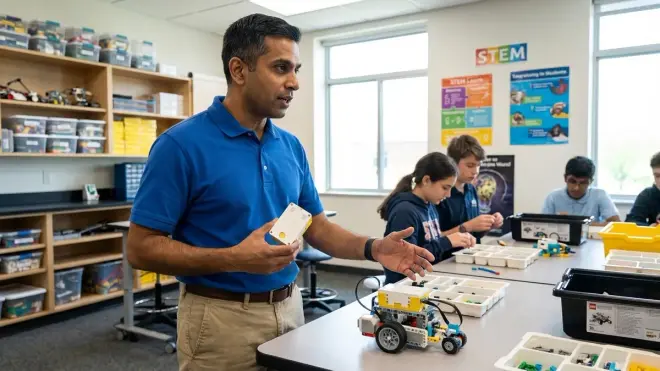
A SPIKE Prime kit supports 400-600 hours of active building and programming before requiring significant component replacement assuming proper storage and handling, with rechargeable hub batteries degrading after 300-500 charge cycles typically 18-24 months of intensive use, motors occasionally requiring replacement after 300+ hours at high loads, and structural pieces like Technic pins and axles remaining functional indefinitely unless lost, making the per-hour learning cost approximately $0.60-0.95 when including reasonable expansion and maintenance expenses over a 3-4 year active learning period.
Summary
LEGO stem education delivers measurable technical competencies through structured progression from mechanical assembly through Python programming and autonomous systems integration. The platform differentiation matters: SPIKE Prime represents the optimal entry point for ages 10-14, providing 200+ hours of curriculum before capability ceiling, authentic Python syntax enabling direct transition to industry-standard tools, and expansion architecture supporting competitive robotics or custom engineering projects.
The investment framework is clear—$330-380 base kit, $60-100 annual maintenance, dedicated workspace with computing device and organized storage. The return: systematic debugging methodology, hardware-software integration fundamentals, and demonstrable project portfolio distinguishing students in competitive STEM program applications.
Implementation requires adult understanding of mechanical principles and programming basics, minimum 3-4 hour weekly dedicated sessions, and enforcement of documentation practices that mirror professional engineering workflows. Students completing this progression possess prerequisite skills for Arduino development, CAD design systems, and entry-level automation engineering—capabilities directly aligned with current industry hiring requirements rather than abstract STEM exposure.
The platform works when matched to student readiness and supported with structured progression. It fails when used as entertainment, implemented without workspace infrastructure, or abandoned at the first debugging frustration. For families committed to developing actual technical capabilities rather than accumulating educational toys, LEGO STEM education represents one of the few systems delivering both measurable skill development and clear pathways to industry-standard tools.