
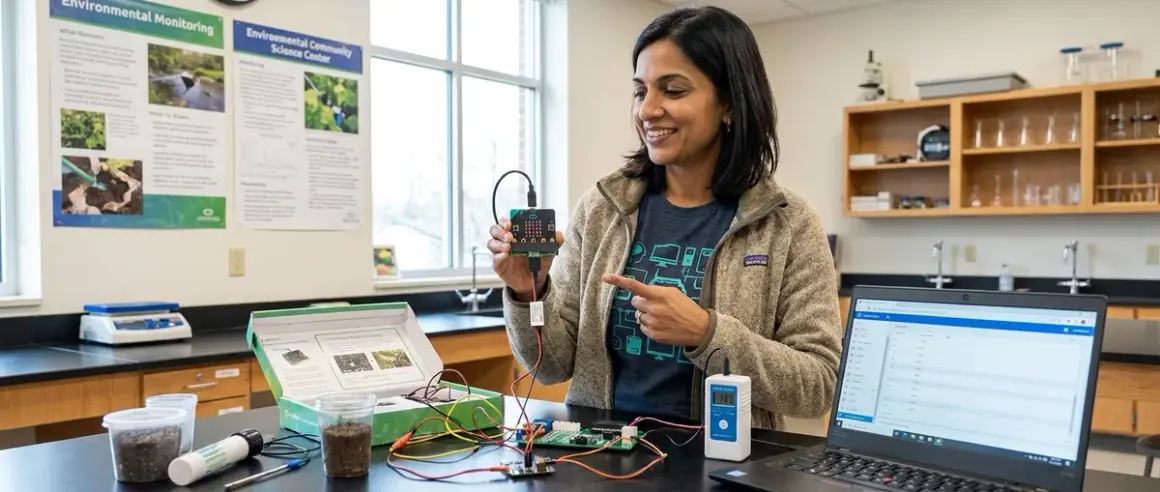

Picture this: your middle-schooler rushes in from the backyard, clutching a micro:bit and breathlessly explaining how the air quality sensor just detected a spike in particulate matter when the neighbor started their lawnmower. That's the moment when data collection stops being an abstract concept and becomes a tangible investigative tool. micro:bit citizen science kits transform your child from passive science consumer to active environmental researcher, building skills that bridge classroom learning with real-world data contribution. The best kits combine accessible block-based programming with industry-standard sensor technology, creating a scaffolded path from simple measurements to authentic research participation.
Quick verdict: The Kitronik Environmental Science Board leads for comprehensive sensor arrays and educator support, while the SparkFun micro:climate kit excels for budget-conscious families seeking expandable weather monitoring capabilities.
What to Look For in micro:bit Citizen Science Kits
When I evaluate micro:bit citizen science kits for student use, I'm assessing whether they genuinely prepare young researchers for authentic data collection or simply provide superficial "science play." Here's what separates legitimate research tools from glorified toys.
Sensor Accuracy and Calibration Capability
The sensors determine whether your child's data is meaningful enough to contribute to actual research projects. Look for kits that include calibration protocols—not just sensor modules you plug in blindly. Professional-grade citizen science platforms like SciStarter and the Environmental Protection Agency's Air Sensor Toolbox require data quality documentation, which means students need to understand sensor limitations and calibration procedures.
I've watched too many sixth-graders grow frustrated when their temperature readings drift by 3-4 degrees Celsius because the sensor sits too close to the micro:bit's processor heat. Quality kits address this with proper sensor placement guidance, external probe options, or temperature compensation algorithms in the sample code. For air quality monitoring, look for particulate matter sensors that specify their detection range (PM2.5 vs PM10) and limitations—not vague "air quality" claims.
Calibration features to prioritize: reference value comparison protocols, documented sensor accuracy specifications (±X% or ±X units), and sample code that includes calibration constants you can adjust based on known reference measurements.
Data Export and Platform Compatibility
Citizen science contributions require getting data out of the device and into analysis tools or submission platforms. This capability separates actual research instruments from isolated gadgets. Your kit should support CSV export, serial data streaming, or direct cloud integration with platforms like Adafruit IO, Microsoft MakeCode data logging, or custom Python scripts.
The micro:bit V2 includes onboard data logging to its flash storage—a significant upgrade over V1's lack of built-in storage. Kits designed for V2 leverage this with logging intervals, timestamp capabilities, and straightforward data retrieval via USB connection. For long-term environmental monitoring (tracking temperature trends over weeks, documenting seasonal air quality patterns), you need storage capacity beyond a few dozen readings.
I recommend kits that explicitly include data analysis scaffolding—sample spreadsheets, graphing templates, or connection guides for Google Sheets or Excel. The technical jump from "I collected data" to "I can visualize patterns and calculate meaningful statistics" is precisely where many young researchers stall. Environmental data collection requires this analysis bridge to transform raw numbers into insights.
Progressive Skill Development and Expandability
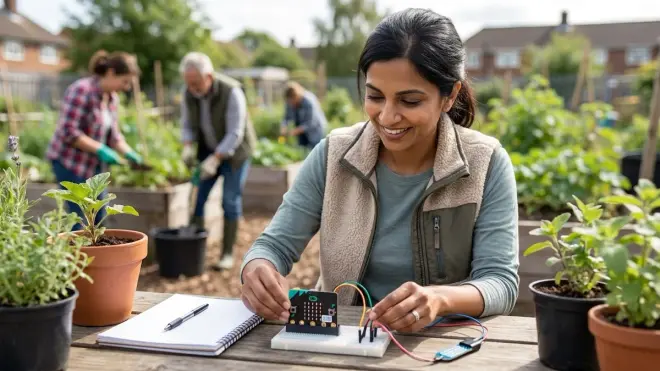
The best citizen science kits function as entry points to professional-grade environmental monitoring, not educational dead-ends. Assess whether the kit supports skill progression from block-based MakeCode to text-based Python, and whether sensors use standard protocols (I2C, analog voltage, digital communication) that students will encounter in Arduino and Raspberry Pi platforms later.
Expandability matters tremendously. Can your student add a soil moisture sensor to their weather station kit? Does the environmental board support additional breakout modules when they want to monitor sound levels or UV radiation? Kits built on standard connection headers (Grove connectors, Qwiic/STEMMA QT, or labeled GPIO access) prepare students for the modular approach used in university research labs and professional environmental consulting.
I've structured countless progressive STEM learning paths, and the transition from structured kits to custom sensor arrays represents a critical capability milestone—roughly aligned with the shift from consumer of science knowledge to designer of experimental protocols.
Documentation Quality and Research Integration
This criterion separates kits designed for education from kits designed for educators. Exceptional citizen science kits include lesson plans aligned with NGSS standards (particularly MS-ESS3 Earth and Human Activity, MS-ETS1 Engineering Design), data collection protocols that mirror professional methodologies, and explicit connections to active research projects accepting student contributions.
Look for documentation that explains the why behind sensor placement, sampling frequency, and data quality checks. When my students understand that meteorologists take temperature readings in shaded, ventilated enclosures for good reasons—not arbitrary rules—they develop the scientific thinking that transfers beyond the specific kit.
The strongest kits provide pathways to authentic research participation: submission protocols for projects like GLOBE Observer, iNaturalist air quality contributions, or local watershed monitoring initiatives. This transforms data collection from academic exercise to genuine scientific contribution—profoundly motivating for middle-school researchers who crave real-world relevance.
Our Top Picks
Kitronik Environmental Science Board for BBC micro:bit
The Kitronik Environmental Science Board for BBC micro:bit🛒 Amazon represents the most comprehensive sensor array designed specifically for educational citizen science, integrating BME280 environmental sensing (temperature, humidity, pressure), light level detection, and sound level monitoring in a single, thoughtfully-designed board. This UK-based educational technology company built this kit with explicit alignment to environmental monitoring curricula, including detailed calibration guides and data submission protocols for European environmental monitoring networks.
Lab Specs: Requires micro:bit V2 (sold separately), powered via USB (5V) or 3×AA battery pack (4.5V), operates -40°C to +85°C ambient range, I2C sensor communication allows expansion with additional compatible modules, durable ABS plastic enclosure available separately for outdoor deployment. Compatible with Microsoft MakeCode (block-based), MicroPython, and JavaScript programming environments across Windows, macOS, ChromeOS, and Linux platforms—completely offline-capable once code is downloaded to the micro:bit.
Skill Outcomes: Students progress from basic data reading (single sensor polling) through multi-sensor correlation analysis (understanding humidity's impact on perceived temperature) to time-series data collection with statistical analysis. The kit scaffolds the concept of sensor fusion—combining multiple environmental variables to draw richer conclusions—which mirrors professional meteorological practice. By project completion, students should achieve the capability milestones of: designing sampling protocols with justified intervals, implementing calibration procedures using reference measurements, and exporting datasets formatted for spreadsheet analysis.
This kit particularly excels at connecting micro:bit projects to environmental monitoring research students might continue with Arduino or Raspberry Pi platforms. The BME280 sensor appears in countless professional weather stations and IoT environmental monitors, so students learn to work with an industry-standard component rather than an educational analog.
Pros:
- BME280 sensor provides research-grade accuracy (±1°C temperature, ±3% relative humidity) suitable for authentic data contribution
- Comprehensive curriculum materials include NGSS-aligned lesson plans, calibration protocols, and data analysis templates
- I2C expansion header allows integration of additional sensors (soil moisture, UV index, particulate matter) using standard breakout boards
- Well-documented Python and MakeCode examples demonstrate professional coding practices (error handling, data validation, logging intervals)
- Optional weatherproof enclosure (sold separately) enables genuine outdoor deployment for long-term monitoring projects
Cons:
- Requires separate micro:bit purchase—total cost around $60-65 for complete functional kit
- Sound level sensor provides relative readings (not calibrated to dB SPL standards) limiting its utility for noise pollution studies requiring absolute measurements
- Default battery life of approximately 18-24 hours with continuous logging necessitates power planning for multi-day deployments
- UK-based manufacturer means some curriculum examples reference European environmental standards rather than EPA frameworks (though sensor data itself is universally applicable)
SparkFun micro:climate Kit for micro:bit
The SparkFun micro:climate Kit for micro:bit🛒 Amazon focuses specifically on atmospheric monitoring, combining the BME280 environmental sensor with thoughtful expansion options and SparkFun's characteristically excellent technical documentation. This Colorado-based company designed the kit as an accessible entry point to meteorological data collection while maintaining compatibility with their extensive ecosystem of Qwiic-compatible sensors.
Lab Specs: Compatible with micro:bit V1.5 and V2, powered via micro USB or JST-connected 3.7V LiPo battery (not included), Qwiic connector system enables tool-free sensor expansion with 80+ compatible modules, operates within standard BME280 environmental range, includes optional weather-resistant enclosure design files for 3D printing. Programming support includes MakeCode blocks, MicroPython, and Arduino IDE (with micro:bit core), fully functional offline after initial code development.
Skill Outcomes: Students master fundamental meteorology concepts—barometric pressure trends for weather prediction, dew point calculations from temperature and humidity, absolute vs relative humidity—while building data collection infrastructure. The kit intentionally emphasizes maker skills alongside data science: students learn to design sensor enclosures (introducing basic CAD if they 3D print the case), troubleshoot I2C communication issues, and implement battery power management for portable monitoring stations. These capabilities align with the engineering practices component of NGSS standards and prepare students for the expanded project scope enabled by Arduino-based citizen science platforms.
Pros:
- Budget-friendly entry at around $35-40 without the optional enclosure, making it accessible for multi-child families or classroom sets
- Qwiic connector system dramatically simplifies sensor expansion—students can add air quality, UV, or soil sensors with zero soldering
- SparkFun's tutorial documentation excels at explaining the why behind sensor specifications and measurement protocols
- Designed for easy transition to Arduino—students can use the same BME280 breakout with Arduino projects as skills progress
- Active community forums provide troubleshooting support and project inspiration from other student researchers
Cons:
- Kit ships as separate components (sensor board, carrier board, connectors) requiring initial assembly—beneficial for learning but potentially frustrating for immediate deployment
- No sound or light sensors included—strictly atmospheric monitoring unless you purchase additional modules
- Battery not included means additional cost (around $10-15) and battery management learning curve for portable deployments
- Weather enclosure requires 3D printing or DIY fabrication—no off-the-shelf weatherproof option available
- Documentation occasionally assumes familiarity with electronics terminology (I2C addresses, pull-up resistors) that may require parental scaffolding for younger students
Monk Makes Environmental Sensor for micro:bit
The Monk Makes Environmental Sensor for micro:bit🛒 Amazon takes a deliberately simplified approach, prioritizing ease of use and immediate data collection over comprehensive sensor arrays. This UK educational supplier designed the kit for rapid deployment—particularly valuable when you want students focused on experimental design and data interpretation rather than technical setup.
Lab Specs: Micro:bit V1.5/V2 compatible, powered through micro:bit power supply (USB or battery pack), integrated sensors include temperature, humidity, light level, and sound level on single compact board that connects directly to micro:bit edge connector, no separate power supply needed, operates in typical classroom/outdoor conditions (-20°C to +60°C practical range). Software support emphasizes MakeCode blocks with straightforward library integration, though MicroPython support exists for advanced students. Completely offline-functional with no cloud dependencies.
Skill Outcomes: This kit excels at scaffolding the data science workflow—question formulation, hypothesis development, systematic data collection, pattern analysis, and conclusion formation—without technical assembly distracting from the scientific process. Students can deploy the sensor and begin collecting meaningful environmental data within 15-20 minutes, allowing class time to focus on experimental variables, controlled sampling procedures, and statistical analysis. The simplified approach particularly suits students making their first transition from teacher-provided datasets to self-collected research data—a conceptual leap that's cognitively demanding enough without simultaneous technical troubleshooting.
Pros:
- Plug-and-play design eliminates assembly and troubleshooting—functional within minutes of unboxing
- Integrated design means no loose connections or compatibility issues between sensor modules
- Compact form factor (roughly micro:bit-sized) simplifies enclosure design for outdoor monitoring
- Excellent starter kit for younger students (ages 9-11) before progressing to more complex platforms
- Pre-built MakeCode extensions include data logging examples and graph visualization templates
Cons:
- Limited expandability—the integrated design that simplifies setup also prevents adding additional sensor types
- Sensors provide educational-grade rather than research-grade accuracy (suitable for pattern observation but not precision measurement)
- No explicit calibration protocols provided—assumes sensors are "close enough" for educational purposes
- Sound sensor gives relative readings only, with no calibration to absolute decibel measurements
- Higher per-sensor cost (around $25-30) than modular alternatives, though this reflects the simplified integration
Elecfreaks Smart Science IoT Kit with micro:bit
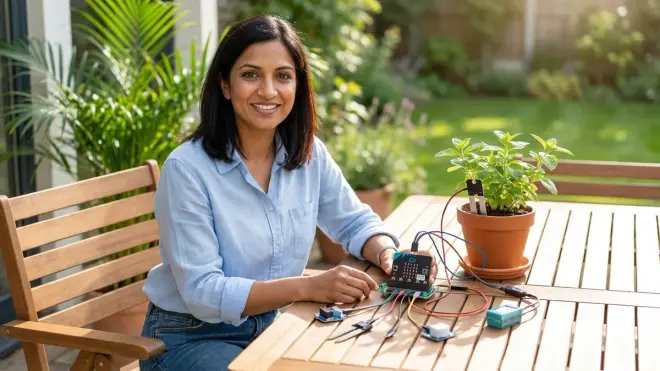
The Elecfreaks Smart Science IoT Kit🛒 Amazon positions itself at the intersection of environmental monitoring and Internet of Things integration, including OLED display, multiple sensors (UV, dust/PM2.5, water level, soil moisture, temperature/humidity), and built-in WiFi capability through the IoT:bit expansion board. This Chinese manufacturer targets the growing interest in connected environmental monitoring and cloud-based data platforms.
Lab Specs: Requires micro:bit V1.5+ (V2 recommended), powered via USB or external 3.7V battery through IoT:bit board, WiFi connectivity (2.4GHz 802.11 b/g/n) enables ThingSpeak, Microsoft Azure IoT, or custom server data streaming, 1.3" OLED display provides local data visualization without computer connection, operates standard environmental range with sensor-dependent specifics. Programming through MakeCode or MicroPython, includes JavaScript API for cloud integration. Cloud-dependent for IoT features but sensors function in offline data logging mode.
Skill Outcomes: This kit introduces connected device concepts that bridge citizen science with emerging smart city and environmental monitoring networks. Students learn not just sensor operation but also network protocols, API interaction, and cloud database management—capabilities that reflect how professional environmental monitoring operates in 2026. The progression from local data logging to cloud-connected real-time monitoring represents a significant capability milestone, particularly for students interested in data science and computer science pathways alongside environmental science.
The kit's strength lies in connecting micro:bit projects to industry-standard IoT practices. Students working with ThingSpeak or Azure IoT gain exposure to the same platforms used in commercial environmental consulting and municipal air quality monitoring—genuine career preparation rather than educational simulation.
Pros:
- Comprehensive sensor array addresses air quality (PM2.5), environmental conditions, soil/water monitoring in single kit
- WiFi integration enables real-time data sharing with research platforms and collaborative monitoring networks
- OLED display allows field deployment without laptop—students can verify sensors are functioning during setup
- ThingSpeak integration provides free cloud data storage and visualization with MATLAB analysis tools for advanced students
- Robust case design includes mounting options for permanent installation in school gardens or yards
Cons:
- Complex setup requires WiFi network configuration, cloud platform account creation, and API key management—significant technical overhead before data collection begins
- WiFi dependency means the kit cannot function in IoT mode in locations without 2.4GHz network access
- Documentation quality varies—some tutorials assume familiarity with networking concepts that require parental support
- Dust sensor (PM2.5) requires periodic cleaning for accuracy maintenance—an excellent learning opportunity but ongoing maintenance requirement
- Higher price point (around $85-95) reflects the expanded capabilities but may challenge budget constraints
DFRobot micro:bit Science Laboratory Kit
The DFRobot micro:bit Science Laboratory Kit🛒 Amazon adopts a modular breadboard-based approach, providing separate sensor modules (light, sound, temperature, soil moisture, water level) that students connect via labeled breadboard and jumper wires. This Chinese educational robotics company deliberately designed the kit to teach electronics fundamentals alongside data collection.
Lab Specs: Compatible with micro:bit V1.5/V2, powered via micro:bit USB or external battery pack, breadboard-based connections require manual circuit building using included jumpers, operates in typical educational/indoor environment, includes detailed wiring diagrams for each sensor configuration. Programming support through MakeCode and MicroPython with sensor-specific code libraries. Completely offline-functional—no cloud services required.
Skill Outcomes: This kit emphasizes the engineering fundamentals underlying citizen science instrumentation. Students learn to read wiring diagrams, understand analog vs digital sensor outputs, troubleshoot connection issues, and recognize how sensor signals become data—the foundational electronics literacy that professional environmental engineers use daily. The deliberate inclusion of breadboarding represents preparation for Arduino and Raspberry Pi projects where custom sensor integration is standard practice.
I've observed that students who master breadboard-based sensor connections develop significantly stronger troubleshooting skills than those who work exclusively with pre-integrated modules. When a sensor stops working, they can systematically check power connections, signal paths, and code rather than assuming "it's broken."
Pros:
- Exceptional preparation for Arduino/Raspberry Pi progression—directly transferable breadboarding and wiring skills
- Modular design allows students to build increasingly complex multi-sensor systems as skills develop
- Detailed documentation includes electronics concepts (voltage dividers, pull-up resistors) that explain how sensors work, not just how to use them
- Lower cost (around $45-50) reflects the educational breadboard approach rather than custom PCB integration
- Soil moisture and water level sensors add agricultural and hydrology monitoring options missing from atmospheric-only kits
Cons:
- Breadboard connections can work loose during handling—less robust for portable or outdoor deployment than integrated boards
- Setup time for each experiment increases significantly compared to plug-and-play alternatives
- Jumper wire management becomes chaotic with complex multi-sensor configurations—organizational skills required
- No calibration protocols provided for sensors—students need to develop their own reference measurement procedures
- Breadboard learning curve may frustrate younger students (under age 11) expecting immediate results
micro:bit Climate & Environment Science Kit by OSEPP
The OSEPP micro:bit Climate and Environment Science Kit🛒 Amazon provides middle-ground positioning between plug-and-play simplicity and breadboard complexity, using a custom edge connector board that accepts both built-in sensors and expansion modules. This US-based educational electronics company designed the kit specifically for North American NGSS alignment and EPA air quality monitoring protocols.
Lab Specs: Micro:bit V2 required for onboard data logging features, powered via USB or 3×AAA battery pack, custom carrier board includes integrated temperature/humidity sensor plus expansion ports for included UV sensor and optional add-on modules, operates -10°C to +50°C practical range. Software support includes dedicated MakeCode extension plus MicroPython libraries with EPA-aligned data formatting examples. Offline-capable with all core features, optional cloud logging available through third-party platforms.
Skill Outcomes: The kit particularly emphasizes data quality and scientific rigor, with documentation that guides students through measurement uncertainty, sampling bias, and quality assurance protocols. This focus on the methodology behind data collection—not just the mechanics—builds genuine research literacy. Students learn to document environmental conditions affecting measurements, recognize when data appears anomalous and requires verification, and format datasets according to professional standards.
The explicit alignment with EPA Air Quality Index calculations and NOAA weather observation protocols means students work with the same frameworks used by professional environmental monitors—valuable preparation for students considering environmental science careers.
Pros:
- Strong curriculum integration includes pre-built lesson plans, assessment rubrics, and NGSS crosswalk documentation
- UV sensor addition addresses sun safety and ozone depletion topics often missing from basic weather kits
- EPA protocol alignment means student data potentially contributes to recognized air quality monitoring networks
- Expansion ports support DFRobot Gravity series sensors—broad compatibility with affordable add-on modules
- US-based support includes educator professional development resources and classroom implementation guides
Cons:
- Requires micro:bit V2 specifically—no backward compatibility with V1.5, increasing initial investment
- Limited sensor array compared to competitors—basic environmental monitoring only without additional purchases
- Custom carrier board means students don't learn breadboard skills or standard connector systems (Grove, Qwiic)
- Documentation occasionally over-emphasizes compliance with protocols at the expense of exploratory investigation
- Moderate price point (around $55-60) positions it between budget and premium options without clearly excelling in either direction
Frequently Asked Questions
What's the difference between micro:bit V1.5 and V2 for citizen science projects?
The micro:bit V2 includes onboard data logging to its built-in flash storage—the single most impactful upgrade for citizen science applications. With V1.5, you need a constant computer connection or complex SD card expansion to store extended environmental measurements. V2 lets students set their micro:bit recording temperature every 10 minutes for three days, disconnect it, retrieve it from the backyard weather station, and download a complete CSV file of timestamped data via USB. That capability transforms the micro:bit from a demonstration tool into a genuine research instrument.
V2 also provides a built-in speaker (useful for audible alerts when sensor readings exceed thresholds), touch-sensitive logo (can trigger data capture events), and significantly more RAM and flash storage for complex data processing code. For citizen science specifically, the 8KB of onboard data storage accommodates roughly 4000 individual measurements depending on your data structure—plenty for weekend monitoring projects or week-long classroom studies. The micro:bit Educational Foundation provides detailed documentation on accessing this data logging functionality through MakeCode or Python. If you're purchasing new, V2 is worth the marginal cost increase for the data logging alone.
Can micro:bit sensor data contribute to actual research projects?
Absolutely, with proper attention to calibration, documentation, and data quality protocols. Several established citizen science platforms accept micro:bit-collected data, including GLOBE Observer for atmospheric and cloud observations, local air quality monitoring networks coordinated by environmental agencies, and watershed groups tracking temperature and weather conditions. The critical requirement is demonstrating your sensors are properly calibrated against known references and documenting your measurement methodology.
Professional citizen science coordinators care less about which device collected the data than whether you can document measurement uncertainty, sensor specifications, sampling protocols, and quality assurance steps. I've had middle-school students contribute micro:bit temperature and humidity data to local climate resilience studies after working through environmental sensor calibration procedures with reference thermometers and known humidity sources. The micro:bit sensors themselves—particularly the BME280 used in multiple kits above—appear in professional-grade environmental monitors when properly deployed.
Start by exploring what citizen science means for young researchers and review project requirements carefully. Some initiatives specifically welcome student data collection, while others require pre-approval or training. Your role as the educational guide is helping your child understand that data quality matters more than data quantity—ten carefully calibrated measurements with proper documentation contribute more to research than a thousand uncalibrated readings.
How do I choose between micro:bit and Arduino for environmental monitoring?
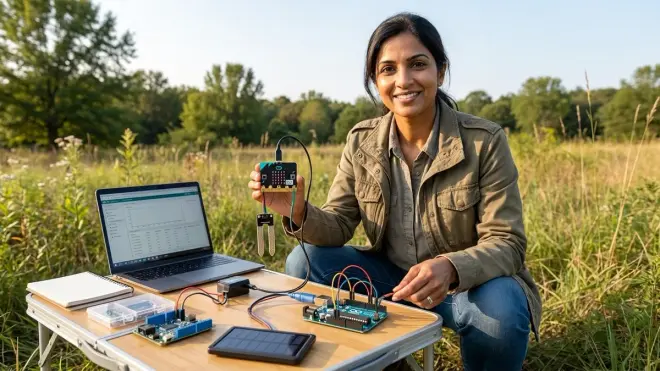
The decision comes down to where your student sits on their programming journey and whether you prioritize rapid deployment or expanded capabilities. Micro:bit excels as an entry platform (ages 9-13 typically) because MakeCode's block-based programming removes syntax barriers, the platform is intentionally simplified to reduce troubleshooting, and educational support materials are exceptional. You can have a functioning weather station collecting data within an hour of opening the box.
Arduino provides significantly more power, flexibility, and expandability—but demands text-based programming, electronics breadboarding skills, and tolerance for technical troubleshooting. If your student has mastered micro:bit projects and expresses frustration with its limitations (limited processing power, fewer GPIO pins, simplified IDE), that signals readiness for Arduino. I've detailed this progression in Arduino vs micro:bit for citizen science comparisons.
The ideal learning path uses micro:bit to build foundational concepts—what sensors measure, how to structure data collection, why calibration matters—then transitions to Arduino when students want to integrate GPS logging, cellular data transmission, solar power management, or sensor arrays beyond micro:bit's capabilities. Think of micro:bit as the training ground for environmental monitoring concepts, Arduino as the platform for custom research instrumentation. Many of the sensor modules above use industry-standard communication protocols (I2C, analog voltage) that transfer directly to Arduino projects, making your initial kit investment part of an expanding toolkit rather than an isolated purchase.
Do these kits require ongoing subscriptions or consumables?
The hardware itself requires no subscriptions—once purchased, your micro:bit and sensors function indefinitely with free software tools. However, several considerations affect the total cost of ownership. Batteries represent the primary consumable for portable deployments; a weather station running continuously on AA batteries might require replacement every 2-4 weeks depending on logging frequency and whether you use rechargeable cells (strongly recommended from both cost and environmental perspectives).
Cloud-connected kits like the Elecfreaks IoT option work with free platforms (ThingSpeak, Adafruit IO) up to certain data limits, then may require paid subscriptions for high-frequency logging or extended data retention. These costs typically range from free for educational use to around $15-20 annually for individual researcher accounts—quite reasonable compared to proprietary platforms that charge monthly fees.
Some sensors have practical lifespan limitations. Particulate matter sensors (air quality monitors) may need replacement after 12-18 months of continuous operation as the detection chamber accumulates contamination. Soil moisture sensors eventually corrode from electrochemical reactions in moist soil—stainless steel probes last longer but cost more initially. Budget around $10-25 annually for sensor maintenance and replacement if running continuous monitoring stations. For typical project-based use (few weeks of intensive monitoring, then storage until the next investigation), sensors should last multiple years without replacement.
The genuinely open-source nature of micro:bit education means curriculum resources, programming tools, and community support remain free indefinitely—a marked advantage over proprietary STEM platforms requiring curriculum licenses or software subscriptions.
How do I protect outdoor sensor deployments from weather damage?
Environmental enclosure design represents a valuable learning project itself—students must balance protection from precipitation with airflow for accurate measurements, shield sensors from direct sunlight while maintaining light exposure, and position equipment to avoid ground splash or insect intrusion. This engineering challenge beautifully complements the data science focus of environmental monitoring.
For temperature and humidity monitoring, a passive radiation shield (white ventilated enclosure that blocks direct solar heating while allowing air circulation) is essential—professional meteorologists use sophisticated versions, but students can build functional shields from nested plastic containers, white paint, and strategically drilled ventilation holes. Position sensors 4-6 feet above ground to minimize ground heat effects while keeping within easy access for battery changes and data downloads.
Rain sensors and water-resistance require more careful execution. Conformal coating spray (available at electronics suppliers) provides water-resistance for circuit boards without affecting sensor performance, while carefully placed cable glands allow wires to enter enclosures without admitting water. The SparkFun and Kitronik kits above include design files or recommendations for weatherproof enclosures that maintain sensor functionality.
I strongly recommend starting with a semi-protected location (covered porch, roof overhang, garden shed) for your first deployment to build confidence before attempting fully exposed outdoor installation. Review general home STEM lab safety requirements and add weather-specific considerations like grounding for lightning protection if mounting sensors on poles or rooftops. The citizen science project setup checklist covers deployment planning systematically.
The Verdict
micro:bit citizen science kits occupy a sweet spot in progressive STEM education—sophisticated enough to collect research-grade data when properly deployed, accessible enough for upper elementary and middle school students to achieve independence within weeks rather than months. Your choice ultimately depends on whether you prioritize comprehensive sensors (Kitronik), budget expandability (SparkFun), rapid deployment (Monk Makes), IoT integration (Elecfreaks), electronics skill-building (DFRobot), or curriculum alignment (OSEPP).
For most families establishing their first environmental monitoring capability, I recommend the Kitronik Environmental Science Board. Its sensor accuracy, expansion potential, and exceptional documentation create the clearest path from initial data collection to genuine research contribution. Pair it with a micro:bit V2, work through the calibration protocols methodically, and you'll establish an environmental monitoring foundation that expands naturally as your young researcher's questions grow more sophisticated.
The equipment matters less than the investigative mindset it enables. These kits succeed when they transform your child from someone who checks the weather forecast to someone who understands where that forecast originates—who sees the world as measurable, question-worthy, and open to systematic investigation.