
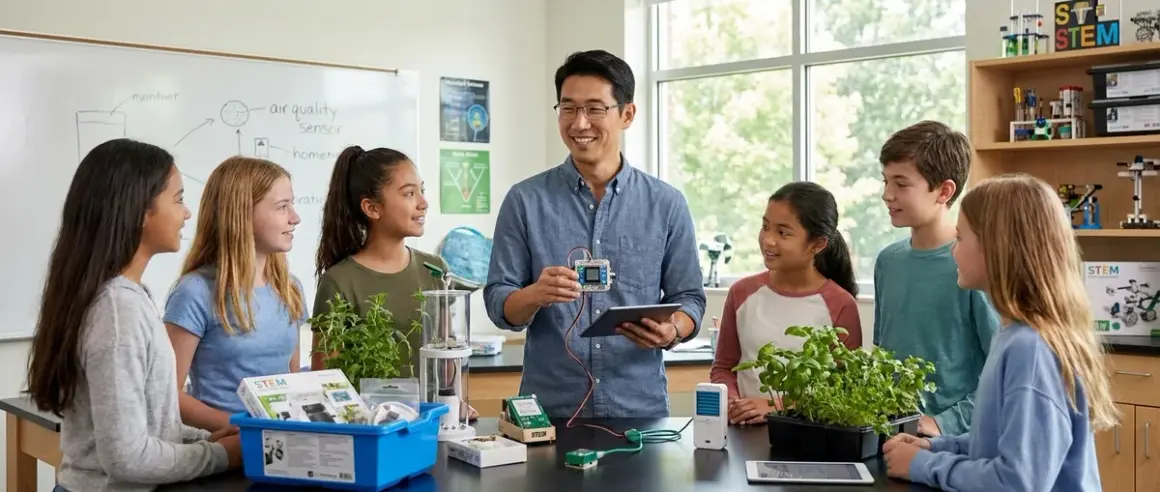

I've been setting up air quality monitoring stations in maker spaces and schools for five years now. When kids understand how air quality sensors for kids explained actually function—not just "it tells you the air is bad"—they grasp measurement principles that carry directly into professional environmental engineering. These aren't science fair props. They're the same sensing technologies EPA-approved monitors use, scaled for student budgets and learning curves.
What Are Air Quality Sensors?
Air quality sensors are electronic devices that detect and measure concentrations of specific airborne substances, translating physical or chemical interactions into electrical signals your microcontroller can read. When we talk about air quality sensors for kids explained in the citizen science context, we're primarily discussing particulate matter (PM) sensors, gas sensors (for CO₂, volatile organic compounds, ozone, nitrogen dioxide), and occasionally temperature/humidity sensors that provide environmental context.

Here's what makes them different from the air quality monitors you mount on a wall: educational sensor modules expose the raw data stream. The Nova PM SDS011 Laser PM2.5 Sensor outputs particle counts that your Arduino or Raspberry Pi reads directly—you're not getting a pre-digested "good/moderate/unhealthy" light. That's the learning opportunity. Kids see the actual numbers fluctuate when someone sprays aerosol deodorant or opens a window.
Most student-grade sensors connect via UART serial communication, I2C bus, or analog voltage output. That means they plug into platforms kids already use in robotics programming: Arduino IDE (C++), MicroPython on micro:bit or ESP32, or visual environments like Scratch extensions for Raspberry Pi. The technical skills built here—serial communication protocols, data logging, threshold-based alerts—transfer directly to industrial automation and IoT development careers.
How Air Quality Sensors Work
The mechanism varies dramatically by what you're measuring. I'll break down the three types you'll encounter in student citizen science projects.
Particulate Matter Sensors: Laser Scattering
PM2.5 and PM10 sensors use light-scattering principles. A tiny laser diode (650nm red is common) shoots through an air chamber. A photodiode positioned at a specific angle—usually 90 degrees—detects light that bounces off particles floating through. Larger particles scatter more light. The sensor's internal microprocessor counts scattering events and calculates size distribution using Mie scattering theory.
The SDS011 I mentioned earlier pulls air through at a controlled flow rate using a miniature fan (you hear a faint whir every few seconds). That's why PM sensors have two-wire power requirements—typically 5V at 70-100mA during active measurement. They cycle between sleep and active modes to extend lifespan; the laser diode degrades after about 8,000 hours of continuous operation.
Here's the critical limitation for student scientists: optical PM sensors don't chemically identify particles. They measure size and count, not composition. Smoke, pollen, and dust all register similarly if particle diameters match. That's fine for most citizen science work tracking pollution trends, but kids should understand they're measuring particulate load, not specific substances.
Gas Sensors: Two Main Technologies
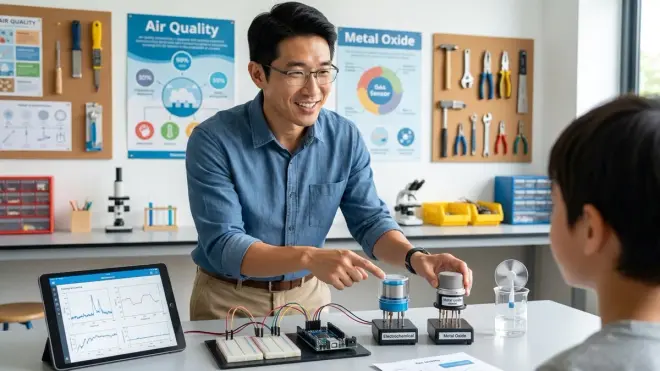
Metal oxide semiconductor (MOS) sensors heat a tin dioxide or other metal oxide film to 200-400°C. Target gases alter the film's electrical resistance. An CCS811 Air Quality Sensor detects total volatile organic compounds (TVOCs) this way—it can't distinguish between acetone and formaldehyde, but it'll catch both. These sensors draw 15-50mA continuously because the heating element runs constantly. They also need 24-48 hour burn-in periods before stable readings and require recalibration every few months. I always warn students: readings drift. Real environmental monitoring requires calibration protocols.
Electrochemical sensors use a chemical reaction that generates current proportional to gas concentration. CO and NO₂ sensors often use this method. They're more selective than MOS sensors but have 6-24 month lifespans depending on exposure—a consumable component kids need to budget for. Professional environmental consultants replace these on schedules; students should too.
The Data Chain: Sensor to Analysis
Once the sensor outputs voltage, frequency, or serial data, your microcontroller reads it. Arduino sketches typically sample every 1-10 seconds, average readings to reduce noise, then either display on an OLED screen, log to SD card (the SPI protocol skill they need for data collection), or transmit via WiFi to platforms like ThingSpeak or Adafruit IO. This entire workflow—sample, filter, log, visualize—mirrors industrial SCADA systems. I've hired fabrication techs who learned these exact patterns building high school air quality monitors.
Why Air Quality Monitoring Matters for Student Development
Beyond the obvious environmental awareness angle, air quality sensors teach measurement validity and error analysis better than almost any other student project I've supervised. Kids quickly discover their sensors disagree with each other. Two identical PM sensors, same batch, read 15-20% different. That's not malfunction—it's measurement uncertainty, a concept professional engineers grapple with daily.
This leads to essential skills:
Calibration against reference standards. When students compare their DIY monitor against a school district's EPA-certified Purple Air station, they learn what "ground truth" means and why traceability matters in scientific measurement.
Data validation and outlier detection. One student's sensor started reporting 999 µg/m³ PM2.5 whenever humidity spiked—moisture condensed in the optical chamber. Debugging that teaches more about sensor limitations than a semester of textbook reading.
Statistical literacy through real datasets. Calculating rolling averages, standard deviations, and confidence intervals becomes necessary, not academic, when you're trying to determine if today's reading actually differs from last week's baseline. This preparation feeds directly into the data analysis components of machine learning projects many students tackle next.
The citizen science aspect adds motivation. When students submit data to PurpleAir's global network or contribute to local air quality advocacy, they see their measurements matter. That's a different psychological engagement than "this counts for 20% of your grade."
Types and Variations: Choosing the Right Sensor Platform
All-In-One Educational Monitors
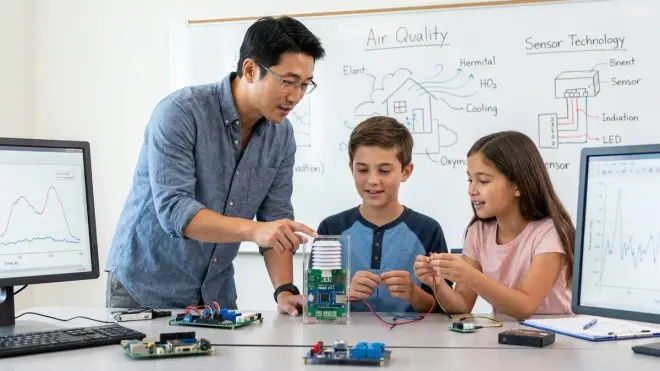
Pre-assembled units like the Air:bit micro:bit environmental sensor board bundle PM, CO₂, and VOC sensors with a micro:bit slot. These cost around $60-80 and work with Microsoft MakeCode (block-based) or MicroPython. Perfect for ages 10-14 building their first monitoring station. The durability is acceptable—I've seen classroom sets last two years with normal handling—but the sensors aren't replaceable. Once the CCS811 drifts out of spec after 18 months, you're done.
Skill milestone: These teach basic data logging and conditional logic ("if PM2.5 > 35, turn red LED on") but don't expose the electrical interface details. Students won't learn I2C addressing or calibration procedures.
Modular Sensor Kits for Arduino/Raspberry Pi
This is where serious capability-building happens. Students select individual sensors—a Plantower PMS5003 for particulates (around $20), an SCD-40 CO₂ sensor (around $50), a BME680 environmental combo chip (around $25)—and wire them to an Arduino Uno, ESP32, or Raspberry Pi.
Power and connectivity: ESP32 boards with built-in WiFi (around $8) are ideal because students can push data to cloud dashboards without tethering to a computer. You'll need a 5V/2A power supply for the sensor cluster—the PMS5003 pulls 100mA during its fan cycle. For outdoor deployment, add a weatherproof enclosure (around $15) and ensure proper ventilation so you're sampling ambient air, not the heated interior microclimate.
Skill milestone: Wiring multiple I2C devices on the same bus (you'll encounter address conflicts—that's the lesson), writing code libraries, implementing data smoothing algorithms. Ages 13+ with prior Arduino experience. This directly prepares students for Arduino-based robotics platforms and industrial sensor integration.
Professional-Grade Student Accessible Options
For students ready to contribute publication-quality data, the Clarity Node-S or similar research-grade units (around $200-500 used) offer NIST-traceable calibration and weather-resistant construction. Some university citizen science programs loan these. They typically require subscription cloud services (around $5-10/month), which introduces the ongoing-cost discussion I have with every parent setting up a home STEM lab.
The advantage: data defensible enough for EPA community monitoring programs. The tradeoff: closed ecosystems with limited learning visibility into the measurement mechanisms.
Frequently Asked Questions
What age can kids start working with air quality sensors?
Age 10+ can successfully build and code basic air quality monitors using visual programming platforms like MakeCode with pre-assembled sensor boards. Students need comfort with conditional logic ("if-then" statements) and basic measurement concepts like units (µg/m³ vs. ppm). By age 13-14 with Arduino experience, students can tackle modular sensor integration requiring serial communication protocols and data structure handling—skills that map directly to professional embedded systems development.
Do air quality sensors need WiFi or can they work offline?
Most educational air quality sensors function entirely offline, storing data to SD cards or displaying readings on OLED screens without any network connectivity. WiFi or cellular connectivity becomes necessary only when you want real-time cloud dashboards or contribution to networked citizen science platforms like PurpleAir. Offline operation is actually pedagogically valuable—students learn local data logging, file systems, and time-stamping before tackling the added complexity of network protocols and API authentication that cloud platforms require.
How accurate are student-grade air quality sensors compared to professional monitors?
Student-grade optical PM sensors typically show ±15-25% variation compared to EPA Federal Reference Method monitors under controlled conditions, with accuracy degrading further in high-humidity or extreme-temperature environments. That sounds bad, but the goal isn't regulatory compliance—it's understanding trends and learning measurement principles. Professional environmental consultants pay $15,000-30,000 for reference-grade monitors with heated inlets, flow controllers, and NIST-traceable calibration; student sensors costing around $20-80 teach the same measurement concepts while producing data useful for identifying pollution episodes, comparing indoor vs. outdoor air, and understanding temporal patterns, even if absolute numbers require skepticism.
What's the difference between PM2.5, PM10, and AQI that sensors measure?
PM2.5 and PM10 refer to particulate matter with diameters smaller than 2.5 and 10 micrometers respectively—physical measurements your sensor directly detects. AQI (Air Quality Index) is a calculated public health scale from 0-500 that converts pollutant concentrations into standardized risk categories. Your sensor measures the raw PM concentrations in µg/m³; your code or dashboard then applies the EPA's AQI formula to convert those numbers into the "good/moderate/unhealthy" categories people recognize. Understanding this distinction—raw measurement versus derived index—is critical data literacy for students moving toward environmental data analysis.
Can air quality sensors detect coronavirus or other viruses in the air?
No, particle sensors cannot detect specific viruses or identify biological agents—they measure particle size and count using light scattering, with zero capability to determine chemical composition or biological identity. A PM2.5 sensor will register the presence of virus-laden aerosols if present (viruses typically attach to particles in the 0.5-5 µm range), but it will register identically to any other particles of similar size: dust, pollen, or smoke. This limitation is exactly the kind of nuanced sensor understanding that prepares students for professional scientific instrumentation work, where knowing what your measurement doesn't tell you is as important as what it does.
Building Measurement Literacy One Sensor at a Time
Air quality sensors for kids explained correctly open a direct path from elementary data collection to professional environmental monitoring careers. I've watched students progress from micro:bit light sensors at age 10 to deploying multi-node ESP32 sensor networks submitting data to research institutions by age 16. The key is framing these as measurement capability investments, not just science projects.
Start with the skill level, not the sensor. A kid with zero Arduino experience doesn't need the most accurate PM sensor—they need the learning path that takes them from visual programming to text-based sensor libraries to understanding calibration drift. The air quality domain provides endless real-world measurement challenges to keep that progression engaging. Six months monitoring their bedroom air quality teaches more persistent data collection discipline than any abstract curriculum.
The sensors themselves will improve—better selectivity, lower drift, cheaper precision. But the fundamental skills of translating physical phenomena into electrical signals, validating measurements, and questioning your data? Those never go obsolete. That's what we're actually building here.