
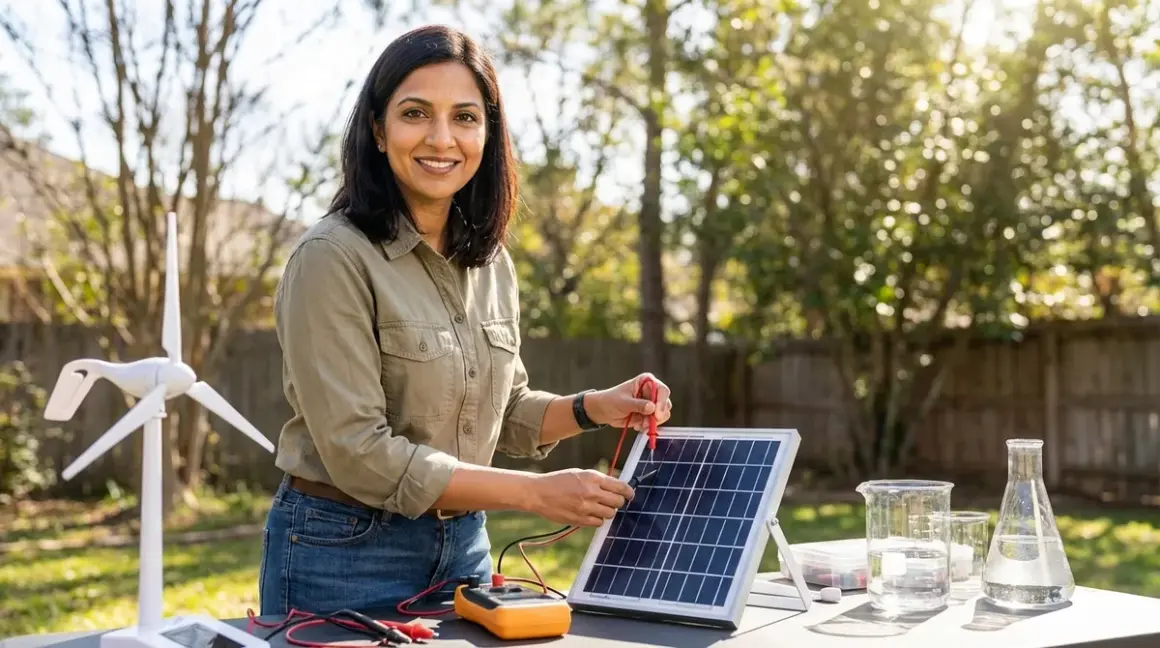

When you're gearing up for a renewable energy science experiment, you need more than curiosity and a workbench—you need the right renewable energy science experiment supplies to turn abstract concepts like photovoltaic conversion and mechanical energy transfer into something your child can measure, troubleshoot, and genuinely understand. This checklist walks you through every category of supplies you'll need, from the core energy-generation components to the measurement tools that transform a demonstration into a rigorous investigation. I've organized this based on how I scaffold these experiments in my own classroom, starting with foundational equipment and building toward advanced analysis tools that prepare students for genuine engineering problem-solving.
Core Energy Generation Components
These are the workhorses of your renewable energy science experiment supplies—the components that actually capture and convert energy. You're not just buying materials here; you're investing in the physical representations of engineering principles your child will reference for years.
Small photovoltaic solar panels (1-6V output range): These panels let students manipulate variables like angle, distance from light source, and surface coverage to observe real-time voltage changes, building schema around the relationship between photon absorption and electron flow. Look for panels with exposed terminals rather than pre-wired connections—the Sunnytech 1W 5V Mini Solar Panel works well—so students can practice circuit-building rather than just plugging things in. The main drawback is that cheaper panels often come with no documentation about their actual max current output, which makes calculating power frustratingly imprecise.
DC hobby motors (1.5-3V rated): These serve double duty as both energy consumers (when you're powering them with solar panels) and energy generators (when you spin them manually or with wind to create voltage), which beautifully demonstrates energy conversion reversibility. Choose motors with exposed shafts so students can attach fan blades, wheels, or pulleys—generic 130-size hobby motors from electronics suppliers work perfectly and cost pennies. They're disappointingly fragile, though; the tiny brushes wear out quickly with repeated experiments.
Wind turbine blade sets or lightweight propeller assortments: You need these to convert wind energy into rotational mechanical energy, and blade design becomes the experimental variable—students can test two-blade vs. three-blade configurations, blade pitch angles, and surface area. Craft foam sheets or balsa wood let students fabricate custom blades, which adds a design-engineering dimension. Pre-made blade sets save time but remove the iterative design process that builds the deepest understanding.
Hand-crank generators or dynamo units: These let students feel the resistance of energy generation in their own muscles, creating a kinesthetic connection to the concept of mechanical work input. The Elenco Hand Crank Generator Kit includes a small dynamo with a gear ratio that makes cranking manageable while still generating measurable voltage. The crank handle is awkwardly short for larger hands, making sustained cranking uncomfortable.
Small water turbine or waterwheel components: For hydroelectric experiments, you need a wheel with angled cups or blades that can spin when water flows over or through it, coupled to a small generator. Many students build these from scratch using plastic spoons and cardboard, but a pre-made Mini Hydroelectric Generator Water Turbine gives you reliable baseline performance data before moving to custom designs. Flow rate requirements are finicky—you often need a surprisingly large volume of water or a significant height drop to generate measurable voltage.
Micro wind turbine kits with generator integration: These combine blades, a mounting system, and a small generator in one assembly, letting students focus on siting and measurement rather than mechanical troubleshooting. The trade-off is reduced customization—you can't easily swap components to isolate variables. Look for kits that include multiple blade sets or adjustable pitch mechanisms.
Low-voltage LED arrays (various colors): LEDs serve as immediate visual feedback for energy generation—they light up when voltage crosses a threshold—and different colors have different forward voltage requirements, creating a natural experiment in energy threshold detection. Red LEDs light at around 1.8V, while blue and white need closer to 3V, so you can demonstrate power output differences visibly. Buy assortments of 3mm or 5mm LEDs rather than pre-wired modules; bare components teach circuit fundamentals.
Small rechargeable battery packs (AA or AAA NiMH): These let students store generated energy and measure charging rates, introducing energy storage as a distinct engineering challenge from generation. NiMH batteries are safer and more forgiving than lithium-ion for student experimentation, and you can use inexpensive USB-based NiMH chargers with multimeters to track charging current. The downside is that charging is slow—students often need to wait hours or days to see meaningful charge accumulation, which disrupts the immediate feedback loop.
Essential Measurement and Data Collection Tools
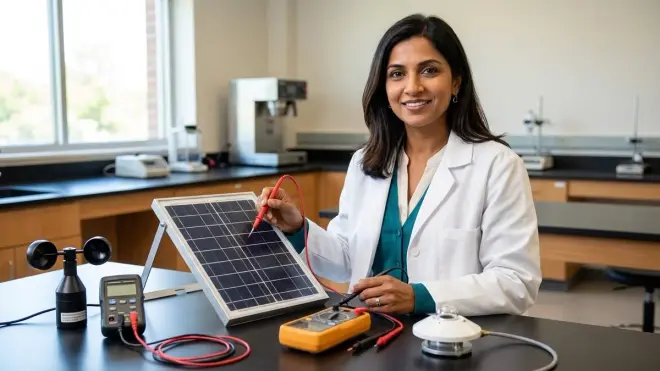
Without measurement, you've got a demonstration, not an experiment. This is where renewable energy science experiment supplies shift from "look, it spins!" to genuine scientific inquiry that aligns with NGSS practices around data analysis and computational thinking.
Digital multimeter with voltage, current, and resistance modes: This is your non-negotiable centerpiece measurement tool. Students need to measure open-circuit voltage, short-circuit current, and resistance values to calculate power output and efficiency. Choose a multimeter with large, clear digits and a manual range selection option—auto-ranging meters are convenient but hide the concept of measurement scale from students. Basic models around the $15-20 range work fine; the AstroAI Digital Multimeter offers good accuracy for the price, though the test lead jacks are slightly loose and require careful insertion.
USB power meter or inline current/voltage monitor: These devices sit between a power source and load (like a USB-charged device) and display real-time voltage, current, power, and accumulated energy. They're perfect for renewable energy experiments because students can watch power fluctuate as sun intensity changes or wind speed varies. The limitation is that they only work with USB-compatible voltages (roughly 5V), so you'll need DC-DC boost converters for lower-voltage solar panels.
Analog voltmeter or ammeter: While digital meters are more precise, analog meters with moving needles give students a visceral sense of fluctuating power—the needle bounces and swings as clouds pass or wind gusts hit, which builds intuition about renewable energy variability that static digital numbers don't convey. Educational supply versions with large, wall-mounted displays work well for group demonstrations.
Light intensity meter or lux meter: For solar experiments, light intensity is your critical independent variable, and eyeballing "bright vs. dim" doesn't cut it for rigorous work. Lux meters quantify illumination, letting students correlate light levels with voltage output and calculate panel efficiency. Smartphone apps with decent accuracy are available (search "lux meter" in app stores), but dedicated handheld meters respond faster and work better in bright outdoor conditions where phone screens wash out.
Anemometer for wind speed measurement: To investigate wind turbine performance, you need to measure wind speed in meters per second or miles per hour, then correlate that with power output. Handheld cup anemometers or digital vane anemometers both work; look for models that average wind speed over time rather than just showing instantaneous readings, since wind speed fluctuates wildly. Even inexpensive models drift out of calibration, so treat absolute values skeptically and focus on relative comparisons.
Infrared thermometer or thermocouple probe: Temperature becomes relevant when students investigate panel efficiency degradation at high temperatures or measure energy loss as heat in motors and generators. Non-contact IR thermometers are faster and safer, but they measure surface temperature only; thermocouples give you internal readings. Either way, temperature data adds a dimension to efficiency calculations that surprises most students—they don't expect solar panels to perform worse when they're hot.
Timer or stopwatch (preferably with lap function): Energy is power multiplied by time, so you need precise time measurement to calculate work done, charging rates, or how long a stored energy reserve can power a load. Smartphones work fine, but dedicated stopwatches with lap memory let students capture multiple intervals without resetting. Laboratory timers with large displays help when you're working with a group.
Kitchen scale or precision balance (0.1g resolution): For experiments involving potential energy conversion (like water wheels or gravity-powered generators), you'll need to measure mass to calculate gravitational potential energy. A basic kitchen scale works for most experiments, but if students are building miniature turbines with different blade materials, a 0.1g resolution scale helps compare component weights meaningfully.
Electrical Connection and Circuit-Building Supplies
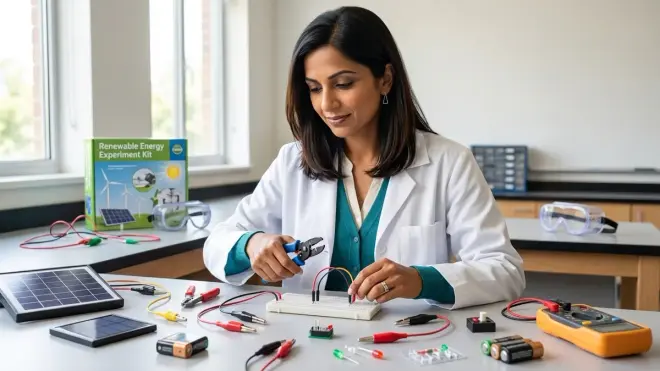
This is where I see the most frustration in home experiments—families buy great core components but skimp on connection materials, then waste hours troubleshooting loose wires and intermittent contacts. Professional renewable energy science experiment supplies include robust, reconfigurable connection systems.
Breadboard (standard 830-point solderless): Breadboards let students build and modify circuits without soldering, which is essential for iterative experimentation. The Elegoo Breadboard Kit includes a breadboard, jumper wires, and a power supply module. Internal contact strips lose tension with heavy use, causing intermittent connections, so buy a few spares and rotate them out when you notice flaky behavior.
Alligator clip test leads (various lengths, insulated): These give you quick, reconfigurable connections to solar panels, motors, battery terminals, and multimeter probes. Buy sets with shrouded metal clips—bare clips are a short-circuit waiting to happen when they touch each other or nearby conductors. The clips wear out and lose grip strength, so you'll replace these regularly.
Jumper wire assortment (solid core for breadboards, stranded for external connections): You need both types—solid core (22 AWG) for breadboard insertion, and flexible stranded wire for connecting to components with screw terminals or solder joints. Pre-cut, pre-stripped jumper sets save time; bulk wire spools give you custom lengths but require a wire stripper. Color-code your wiring (red for positive, black for ground, other colors for signal paths) to make troubleshooting easier.
Screw terminal blocks or barrier strips: When you're connecting multiple components to a single power source (like parallel solar panels or series battery packs), terminal blocks give you secure, labeled connection points. They're especially valuable for semi-permanent setups that students will return to over multiple experiment sessions. Cheap terminal blocks have soft brass terminals that strip easily, so look for ones rated for at least 10A even if your experiment draws milliamps.
Heat shrink tubing assortment: For any soldered connections or exposed wire junctions, heat shrink tubing provides insulation and strain relief. Buy an assortment of diameters; you'll use 3mm and 5mm sizes most often. A heat gun or even a lighter (used carefully) shrinks the tubing. This feels like a minor detail until a student shorts out a circuit because bare wire touched a metal workbench.
Electrical tape: It's the backup for everything. Use it to secure loose connections, label wires, insulate terminals, and provide strain relief. Real electrical tape (vinyl, rated for electrical use) is self-extinguishing and stretches; generic tape dries out and leaves residue. Black is standard, but multicolor sets help with circuit tracing.
Wire strippers (adjustable or multi-gauge): You'll strip dozens of wire ends during a single experiment session. Adjustable wire strippers let you dial in the exact wire gauge; multi-notch strippers have sized holes for common gauges. Either works, but avoid cheap strippers that nick the conductor strands—damaged wire breaks easily.
Soldering kit (iron, solder, stand, sponge) for permanent connections: Once students finalize a design, soldering creates reliable, low-resistance connections that won't wiggle loose. A basic 30-40W soldering iron works for electronics; lead-free solder is safer but requires slightly higher temperatures. Soldering introduces a new skill domain, so budget time for practice joints before students work on actual components. This is where you're introducing industry-standard assembly practices used in actual renewable energy installations.
Data Recording, Analysis, and Presentation Materials

The difference between a science activity and a science experiment is the systematic collection and analysis of data. These renewable energy science experiment supplies turn observations into evidence.
Engineering notebook or bound lab journal: Loose papers get lost; spiral notebooks let pages fall out. A bound composition notebook with numbered pages and a table of contents becomes an authentic engineering documentation tool. Students should record hypotheses, procedure steps, raw data tables, observations, and post-experiment analysis all in one place. I tell students this is the same type of documentation engineers keep in industry—it's legally admissible proof of who discovered or invented something when.
Graph paper or engineering grid notebooks: For plotting voltage vs. current curves (to find maximum power point), power output vs. wind speed, or efficiency vs. light intensity, students need proper grid paper. Quarter-inch or 5mm grids work well; logarithmic paper is useful for advanced students investigating exponential relationships. Alternatively, students can use spreadsheet software, but hand-plotting builds deeper understanding of scale, axis labeling, and data distribution.
Spreadsheet software (Excel, Google Sheets, or equivalent): For experiments generating lots of data points, manual calculation becomes tedious and error-prone. Spreadsheets let students create formulas once, then apply them to entire columns. They're also where students learn to create proper graphs with labeled axes, units, trendlines, and error bars. Google Sheets has the advantage of real-time collaboration if multiple students are working together. This connects directly to data analysis skills used in professional renewable energy system design.
Camera or smartphone for photo documentation: Visual documentation captures experimental setups, component arrangements, and results displays. Photos are essential for science fair presentations and engineering reports. Students should photograph their setup from multiple angles, include a ruler or reference object for scale, and capture close-ups of critical connections. Teach them to export photos with timestamps—it's a basic evidence practice.
Presentation materials (poster board, digital slide software): Eventually, experimental findings need to be communicated. Physical poster boards work for traditional science fairs; digital slides (PowerPoint, Google Slides, Keynote) suit classroom presentations or virtual sharing. The key is teaching students to organize content logically: question, hypothesis, methods, data, analysis, conclusion—the same structure they'll use in any technical field.
Label maker or label tape: Clear labeling prevents confusion when you've got multiple circuits, component bins, or battery packs in play. Labels on storage containers, experimental setups, and even individual wires make setup faster and reduce errors. Even masking tape and a permanent marker work if you don't have a dedicated label maker.
Calculator (scientific, with trigonometric and exponential functions): Power calculations, efficiency percentages, and uncertainty propagation require more than basic arithmetic. Students need square roots (for RMS calculations), exponents (for area calculations), and possibly trig functions (if they're optimizing solar panel angles based on latitude and season). Graphing calculators are overkill unless students are already using them for math coursework. Smartphone calculator apps work but create distraction risk.
Supporting Infrastructure and Safety Equipment
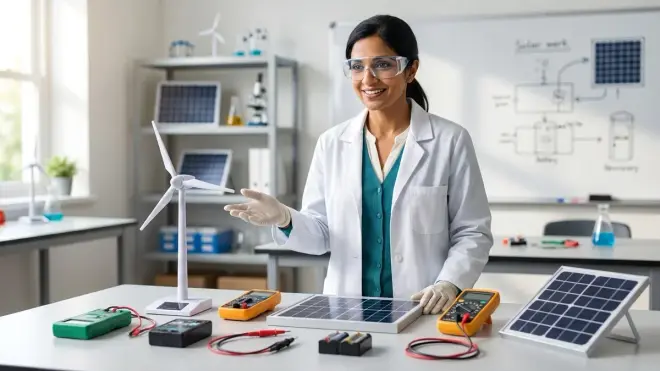
These are the supplies that don't generate or measure energy but make experiments possible, safe, and repeatable—the infrastructure that separates a one-time demonstration from a sustainable learning environment.
Adjustable light source (desk lamp with flexible arm and bright LED bulb): For indoor solar panel testing, you need a consistent, repositionable light source. A 60W-equivalent LED bulb in a gooseneck desk lamp gives you reasonable intensity and flexibility to test distance and angle variables. The lamp needs a stable base—cheap plastic lamps tip over easily. Recognize that even bright indoor lighting is much dimmer than outdoor sunlight, so results will differ significantly. You can also look at our guide on how to measure solar panel efficiency in science projects for protocols around light source standardization.
Electric fan (adjustable speed, stable base): For wind turbine testing when outdoor wind is unavailable or inconsistent, a box fan or oscillating fan provides controlled airflow. You're trading realism for experimental control—real wind gusts and shifts direction; fan wind is steady and unidirectional. Measure distance from fan to turbine carefully; wind speed drops off quickly with distance and also varies across the fan's diameter.
Water source setup (pitcher or elevated reservoir with controlled flow): Hydroelectric experiments need flowing water, which means either a faucet (variable flow, wasteful), a raised reservoir with a valve (adjustable, reusable), or a recirculating pump setup (complex but sustainable). The elevated reservoir approach works best for most families—a 5-gallon bucket elevated 3-6 feet with a plastic spigot valve gives you adjustable flow and measurable head height.
Sturdy project base or breadboard mounting platform: Renewable energy experiments involve multiple components with connecting wires, and everything needs to stay put when you're adjusting variables or taking measurements. A foam core board, plywood sheet, or plastic project tray gives you a stable work surface you can move without disturbing the setup. Include mounting options—Velcro strips, hot glue, or even just masking tape—to secure components.
Small screwdriver set (Phillips and flathead, precision sizes): Solar panels, terminal blocks, and many hobby motors have small screw terminals that require #0 or #1 size screwdrivers. A basic precision screwdriver set costs a few dollars and prevents stripped screws and frustrated students. Magnetic tips are helpful but not essential.
Safety glasses or goggles: Any time students are soldering, cutting wire, or working with springs and spinning components, eye protection is non-negotiable. Splashing water from hydroelectric setups is usually harmless, but solder splatter or a snapped wire under tension can cause serious eye injury. Buy safety glasses that fit properly and aren't so uncomfortable that students take them off.
Cable management supplies (zip ties, hook-and-loop straps, cable clips): Once you've got five wires running from a solar panel array to a breadboard circuit to a multimeter to a load, cable management stops being optional. Organize and secure cables so they don't pull on delicate connections or create trip hazards. Reusable hook-and-loop straps are better for experimental setups than zip ties, which need to be cut off when you reconfigure.
Storage containers with compartments: Small components—LEDs, resistors, wire ends, screws, blade sets—disappear quickly without organized storage. Tackle boxes, craft organizer cases, or compartmented plastic bins keep everything findable. Label each compartment; transparent lids let you see contents at a glance.
Power supply or battery holder (for comparison experiments): While the goal is renewable energy generation, you'll often need a known, stable power source for control comparisons or to power measurement devices. A variable DC power supply is ideal but expensive; AA battery holders with fresh batteries work fine for most experiments. This gives students a baseline: "The solar panel generates 2.5V, compared to 3V from two AA batteries."
Extension cords and power strips (with surge protection): Soldering irons, hot glue guns, lamps, fans, and other experiment infrastructure all need power. A surge-protected power strip prevents equipment damage, and a long extension cord gives you flexibility to work near windows (for solar access) or sinks (for hydroelectric setups). Make sure cords are rated for the total amperage you're drawing.
Fire extinguisher or fire blanket: If you're soldering or using hot glue guns, fire safety equipment needs to be within arm's reach. A small ABC-rated fire extinguisher handles electrical and common combustible fires; a fire blanket smothers small fires without making a mess. Teach students to turn off heat sources immediately if something starts smoking, and never leave heated tools unattended.
Final Check Before You Go
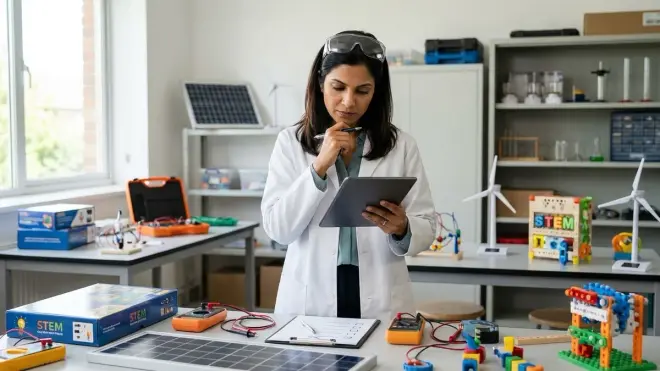
Before you start your renewable energy science experiment, run through this quick verification checklist to make sure you have the essential renewable energy science experiment supplies and infrastructure in place:
- At least one energy generation component (solar panel, wind turbine, or hand-crank generator) with documented voltage/current specs
- Multiple energy loads (LEDs, small motors, buzzers) with known power requirements
- Digital multimeter with fresh battery and working test leads
- Breadboard and assorted connection materials (jumper wires, alligator clips)
- Measurement tools appropriate to your experiment type (lux meter for solar, anemometer for wind)
- Bound lab notebook or structured data recording system
- Calculation tools (calculator, spreadsheet software access)
- Appropriate environmental controls (adjustable lamp for indoor solar, fan for wind simulation)
- Safety equipment (eye protection, clear workspace, fire safety tools if using heat)
- Stable work surface with secured components and organized cables
- Storage and organization system for small components
- Photo documentation method (camera or phone) for recording setups and results
Frequently Asked Questions
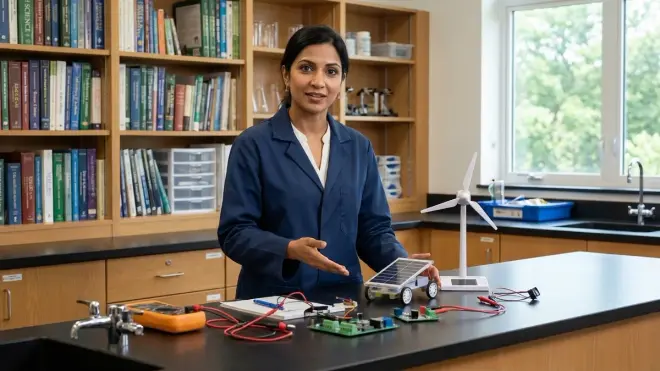
What renewable energy science experiment supplies do I need to get started on a basic solar power project?
You need a small photovoltaic solar panel in the 1-6V range with exposed terminals, a digital multimeter to measure voltage and current, a breadboard with jumper wires for circuit building, several LEDs of different colors as loads, and a bright adjustable desk lamp for indoor testing or access to direct sunlight for outdoor experiments, plus a notebook for recording your measurements and observations systematically.
Can I use regular household items instead of specialized renewable energy science experiment supplies?

You can use some household items like desk lamps, fans, water pitchers, rulers, and stopwatches, but you'll still need specialized components like solar panels, small motors that function as generators, and multimeters because these aren't common household items and the specific electrical characteristics matter for meaningful data collection—an approximate voltage isn't sufficient when you're calculating efficiency or power output.
How much should I expect to spend on renewable energy science experiment supplies for a middle school science fair project?
A complete starter set of renewable energy science experiment supplies including a solar panel, small motor-generator, basic multimeter, breadboard, connection supplies, measurement tools, and documentation materials typically costs between $60 and $120 depending on whether you choose individual components or educational kits, with more advanced experiments involving multiple energy sources or data logging equipment running $150 to $250, which represents a worthwhile investment in reusable tools your student will use across multiple projects as they advance their skills.
Final Thoughts
The renewable energy science experiment supplies you gather aren't just materials for a single project—they're the foundation for progressive skill development that moves students from basic observations about energy conversion through quantitative analysis and eventually into the engineering optimization practices used by professionals designing actual solar installations, wind farms, and hydroelectric systems. I've watched students who started with simple "make the LED light up" experiments in sixth grade return two years later to design maximum power point tracking circuits or conduct efficiency comparisons that mirror industry testing protocols. The key is choosing supplies that expose rather than hide the underlying physics, that allow manipulation of meaningful variables, and that support rigorous measurement instead of just subjective observation. When you invest in quality measurement tools, flexible connection systems, and proper documentation materials alongside your energy generation components, you're building not just one experiment but a complete renewable energy learning laboratory that will support increasingly sophisticated investigations as your student's skills grow. That progression from hands-on exploration through data-driven analysis to engineering-level problem solving—that's where genuine STEM competency develops, and it starts with having the right supplies organized and ready to support curiosity the moment it strikes.